
World War II brought changes to transportation in the county
‘Due to wartime priorities, all train travel must be booked five days in advance.”
The intimidating sign stood in the doorway of San Luis Obispo’s new “mission-style” railroad depot in 1943. The depot was the busiest place in town. Lucille Sanders of San Luis Obispo worked in both the old and new Southern Pacific depots. During World War II, she recalled seeing “wives and sweethearts running after the train, waving to their loved ones and not knowing if their men would return.”
She remembered the depot as “so packed you literally couldn’t get into it sometimes.”
Even during her 11 p.m. to 7 a.m. shift there were so many soldiers jammed together that individual service was impossible.
So, for example, she would shout, “How many going to New York?”
Then, on the basis of the response, she would make out that number of tickets.
The new depot was a refreshing change from the old drab, dirty and miceinfested 1890s structure. Still, there had been controversy over replacing the old depot. On June 24, 1941, the Telegram-Tribune reported that the City Council voted to urge a missionstyle design for a possible new depot. This was over the objection of Councilman Joseph Leary, who declared, “People are tired of these Mexican-style buildings.”
Mayor Fred C. Kimball retorted, “The mission style is traditional to San Luis Obispo.” And residents were urged to send letters to Southern Pacific in support of that style of architecture.
The local transportation picture had undergone earlier changes in connection with the war. In a review of 1941 published on Page 3 of its Jan. 1, 1942, edition, the Tribune observed, “SLO went ‘big time’ on the 20th (of June) when the green buses of the Jones Transportation Company began to operate on scheduled routes.”
Shortly after the bus system started, San Luis Obispo became a city with an “All-Girl Taxicab Business.” In its Page 6 report on July 11, 1941, the San Luis Obispo Independent said the City Council awarded the franchise over the objections of Leary, who “questioned the propriety and fitness of women as taxicab operators.”
Throughout the war, Steve Zegar continued to provide taxi services.
Granny Orr, public health nurse and lifelong observer of public affairs, recalled: “He was so kind, squeezing six or eight people into his taxi at once, often letting the soldiers and tired nurses go free to save them the walk to the hospital. He was so tired himself, driving day and night.”
Private driving was restricted by tire and gas rationing. On Dec. 31, 1941, the Tribune reported that tire rationing would begin the next day. And soon the newspaper was printing the names of those who were allotted tires. For example, a Page 5 story on March 24, 1942, revealed that “George E. Pounder got one tire and the California Division of Highways and the Dewey Auto Wrecking Company each got two.”
Forrest Coyner, a half owner of the Kimball Tire Company during that time, said, “For six months we literally worked shifts around the clock without stopping to meet the Army’s need for tires. We’d get used tires from the troops in the South Pacific, retread and recap them and send them back. And we did the same things for Camp Roberts and Camp San Luis Obispo.”
Still, civilians generally had a better chance of obtaining tires for their cars than of obtaining a new car. And this, as a Tribune editorial from Feb. 2, 1942, observed, meant a major “dislocation” of auto selling agencies in the United States, including San Luis Obispo.
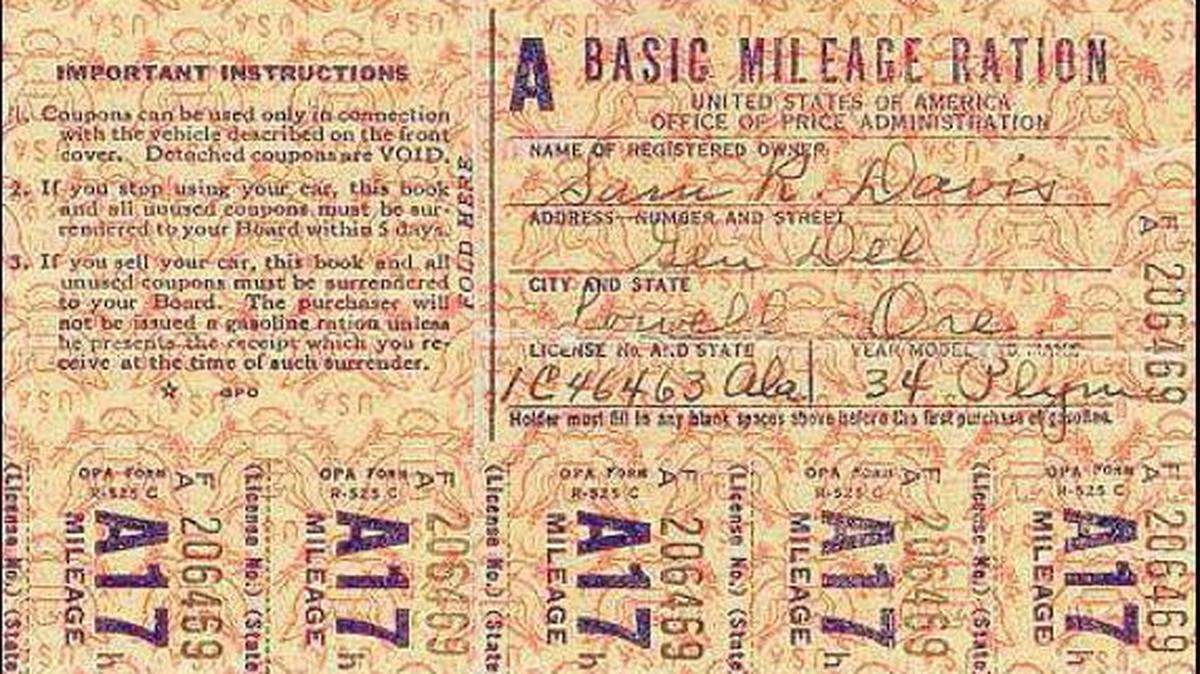
A person’s gasoline rationing allotment was public information with A, B or C stickers on the windshield indicating the size of the driver’s allotment. There were curbside arguments over why one family was receiving more gas than another. In addition to A, B and C categories, truck drivers were denoted with T’s while politicians and “other important” folks got X’s.
This story was originally published September 8, 2014 at 6:08 AM with the headline "World War II brought changes to transportation in the county."