
Idyllic Cayucos has a history of lively and not always legal activity
On Aug. 31, 1892, J. P. Andrews’ Cayucos Bank witnessed the most spectacular bank robbery in our county during the 19th century. The event included the first recorded law enforcement stakeout in the history of our region.
Today, Cayucos seems like an idyllic spot. But outward appearances of the visually stunning, quiet coastal village belie its lively history, from rum running and bank robberies to action during World War II.
The town got its name in 1603, when Sebastian Vizcaino sailed his ships off the Central Coast and observed a number of small canoes just south of Point Estero. He christened the site “Cayucos,” or place of small canoes. Like the Santa Lucia Mountains, also named by Vizcaino, the place-name remains unchanged.
During the mission period, the area from the southern end of Morro Bay to Point Estero was designated as the Rancho Moro y Cayucos. In 1842, Mexican Governor Juan Bautista Alvarado granted the rancho to Martin Olivera and Vincente Feliz.
The ranch was later bought by James McKinley, a Scot sailor who had married into the wealthy Amesti family of Monterey. After the great drought ended in 1865, McKinley divided his rancho into a number of sizable dairy ranches.
His timing coincided with the unification of Italy and the disintegration of Austria’s control over the north of Italy. Thousands of Swiss-Italians lived in the cantons between Switzerland and the new Italian state. These hard-working dairy farmers found their livelihood damaged by Italy’s imposition of high tariffs on dairy products. Some left for California’s Central Coast.
The rains of the late 1860s restored the narrow-bladed grasses to the coastal hillsides. Today we can see ample evidence of the lush green that greeted the first immigrants from Canton Ticino and the alpine lake region of Italy. The Swiss-Italians quickly bought up McKinley’s dairy ranches.
By the 1880s, travelers noted that Italian was the most commonly spoken language along our north coast.
In 1868, Captain James Cass, an English seaman, came to Cayucos. Cass tried his luck at both mining and farming in Amador and Sacramento counties. Now he was ready to settle down. The sea lanes were the only viable link between the dairies and the outside world.
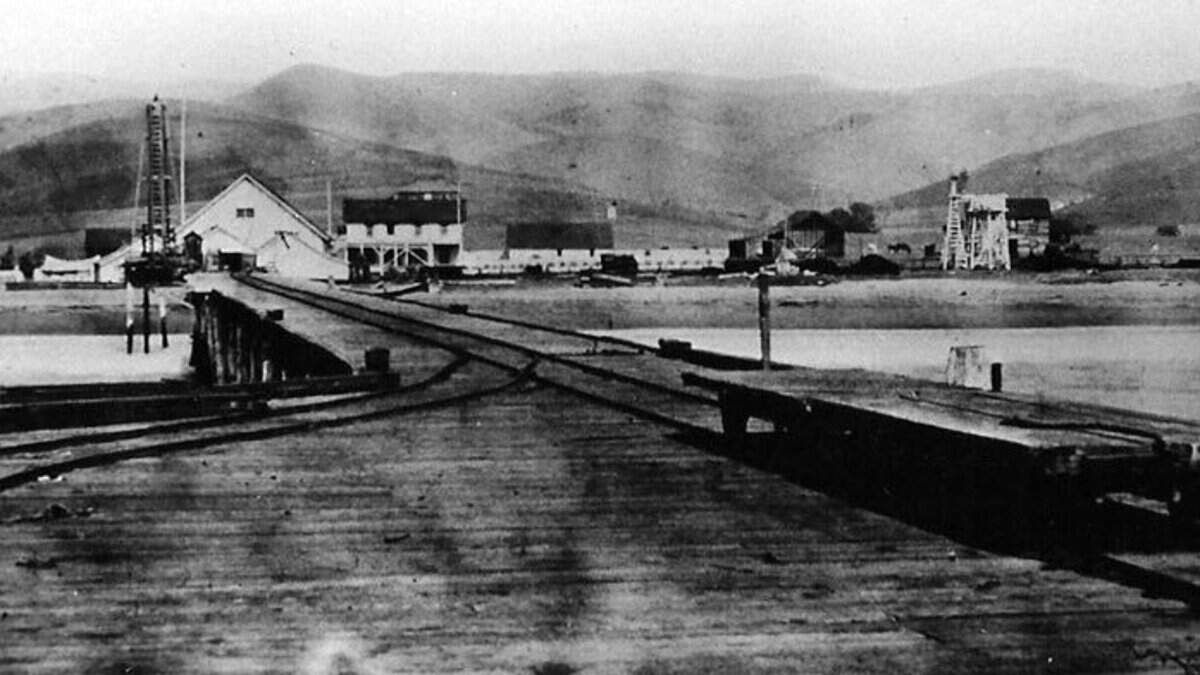
There wasn’t a good seaport north of Port Harford, which we now call Port San Luis. Cass built a short wharf and then extended it so that large steamships could dock. Cass constructed a warehouse where hundredweight boxes of butter and cheese could be stored until the steamer arrived. He also built a fine wooden house which still stands near his warehouse and wharf. Cass and his wharf made Cayucos an important commercial center.
It was a place where the dairy farmers from the remote inland valleys came to ship their butter and cheese, shop, pick up their mail, drink, gossip and play games. A common saying was that you could hear the noise of market day in Cayucos from Toro Creek to Point Estero.
Cayucos eventually became one of the most active rum running seaports along the Pacific coast. Dozens of rural farm families earned a little extra money during hard times by assisting the bootleggers.
During the early morning hours of Dec. 23, 1941, a Japanese submarine launched its attack on the UNOCAL tanker S.S. Montebello just off its shore. Part of the rescue operations for the crew of the sunken tanker came from the little town’s wharf.
On Friday, June 27 at 7 p.m. I’ll be doing an illustrated show on the history of “lively Cayucos” in the Cayucos School Auditorium, 301 Cayucos Drive. It’s free and families are encouraged to come.
You will also want to see the new Cayucos History Museum located at 41 S. Ocean Ave. at the Cayucos Visitors Center. The summer hours are Friday-Monday, 11 a.m.-4 p.m.
This story was originally published June 14, 2014 at 6:28 PM with the headline "Idyllic Cayucos has a history of lively and not always legal activity."