
Times Past: Nipomo's claims to fame
Capt. William G. Dana’s Nipomo rancho and the community that evolved on the 37,000-acre Mexican land grant are central to the history of our state.
In December 1846, Dana’s famed herd of California mustangs saved Col. John C. Fremont’s Battalion of Mounted Rifles (California Battalion) from disaster. Without the extra mounts, Fremont could not have proceeded over the San Marcos Pass and recaptured Santa Barbara.
That event led Mexican Gen. Andrés Pico to surrender to Fremont at the Capitulation of Cahuenga on Jan. 14, 1847.
But the Dana rancho’s most important role was as a “college of law.”
Henry Amos Tefft, a New York-born attorney from Racine, Wis., arrived at the Dana adobe in 1849.
His ship to San Francisco had been forced to take refuge in Southern California. He stayed at the adobe for three months. Through his conversations with Capt. Dana, Tefft became familiar with Spanish-Mexican legal traditions.
Tefft was one of the first 10 delegates to be seated at the California Constitutional Convention held in Monterey’s Colton Hall in August 1849.
He quickly became the chief advocate for retaining California’s existing Hispanic laws, in which Mexican law guaranteed California women separate property rights.
Capt. Dana’s teaching was formalized in the California Constitution of 1849 which was presented for statehood. It was renewed in the California Constitution of 1879. It is truly a unique event in the history of civil rights for women.
The introduction of specialized crop agriculture promoted the development of Nipomo’s own regional economy. Its fame as acenter of pole bean production lead to the importation of migrant labor.
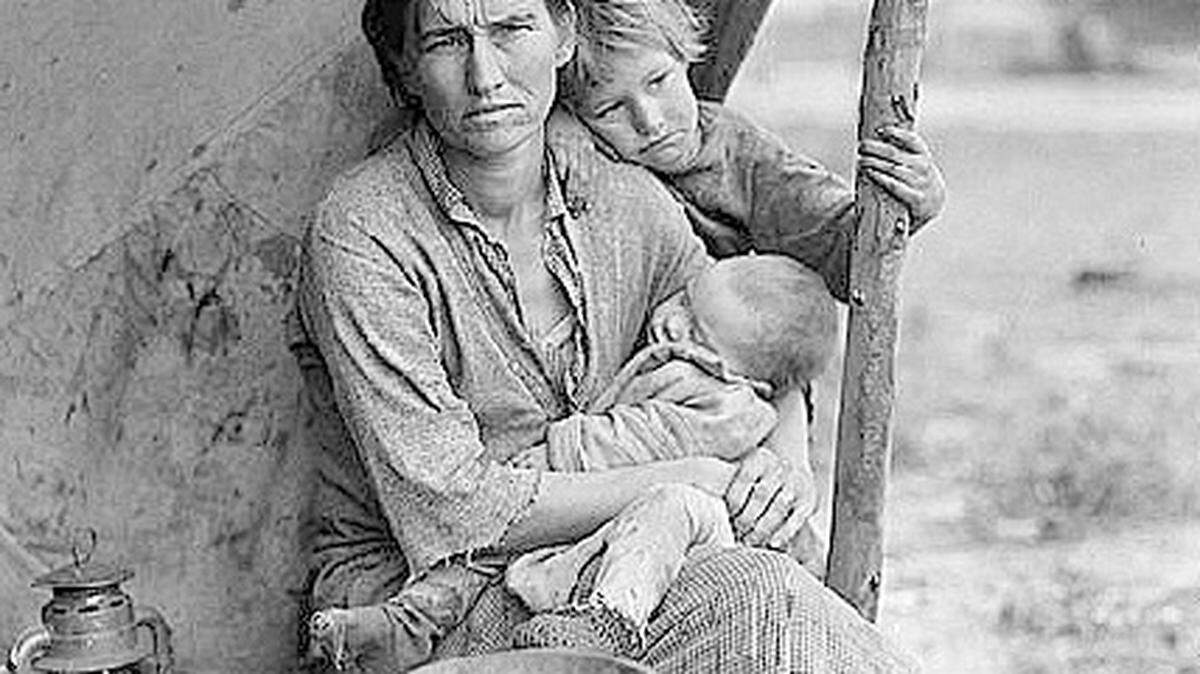
In 1936, Dorothea Lange, working for the Resettlement Administration, photographed a series of images in Nipomo that became a metaphor for the Great Depression.
In 1960, Lange told the magazine Popular Photography that she “ saw and approached (a) hungry and desperate mother, as if drawn by a magnet. I do not remember how I explained my presence or my camera to her, but I do remember she asked me no questions. I made five exposures, working closer and closer from the same direction. I did not ask her name or her history. She told me her age, that she was 32. She said that they had been living on frozen vegetables from the surrounding fields, and birds that the children killed. She had just sold the tires from her car to buy food. There she sat in that leanto tent with her children huddled around her, and seemed to know that my pictures might help her, and so she helped me. There was a sort of equality about it.”
The photographs Lange made of Florence Owens Thompson and her children in February or March 1936 in Nipomo moved a nation. The “migrant mother” prints and Lange’s recollection have been subject to much speculation and reinterpretation by philosophers and historians alike. The images remain arguably the most famous in the history of photography.
Doug Jenzen, a Cal Poly graduate in history, has produced a lively visual history of the Nipomo region for Arcadia Press. It’s titled “Nipomo and Los Berros” and depicts the evolution of a community from rancho days to the hard times when the “migrant schools” struggled to meet the needs of the Dust Bowl refugees.
You are invited to come in historical costume when this book is premiered at the Orchid Show Preview Benefit and Book Release Party for the Dana Adobe.
It’s on March 30 from 6:30 to 9:30 p.m. at the South County Regional Center. Tickets are $40.
You may purchase them online or by calling 929-5749 or 481-3991. Check out www.fcos.org for updated show information.
Dan Krieger is a professor emeritus of history at Cal Poly and president of the California Mission Studies Association.
This story was originally published March 19, 2012 at 5:05 AM with the headline "Times Past: Nipomo's claims to fame."