
The Betteravia sugar plant explosion of 1988
Betteravia, a company ghost town west of Santa Maria, is a rusting monument to the past.
For more than a century, the area was a sugar production center.
The French word for "root" is "betterave," and for many years the root of the sugar beet was the focus of the town, population 350.
The development of railroads in the late 1800s was followed by a sugar beet farm and sugar mill, complete with dozens of company houses.
Union Sugar Refining Co. was the owner, and in the 1950s the company quit the landlord business and sold the cottages for $50 each to be hauled away.
The plant continued operations, later under the ownership of Imperial Holly.
The sugar beet industry was a major regional agricultural crop and railroad freight in both Santa Barbara and San Luis Obispo counties during the 20th century, but by 2009 it was no longer listed in the San Luis Obispo County annual crop report.
The Betteravia sugar plant closed in 1993, according to various websites.
A 1988 industrial accident did not help.
From the March 19, 1988, Telegram-Tribune:
Sugar plant explodes; seven burned
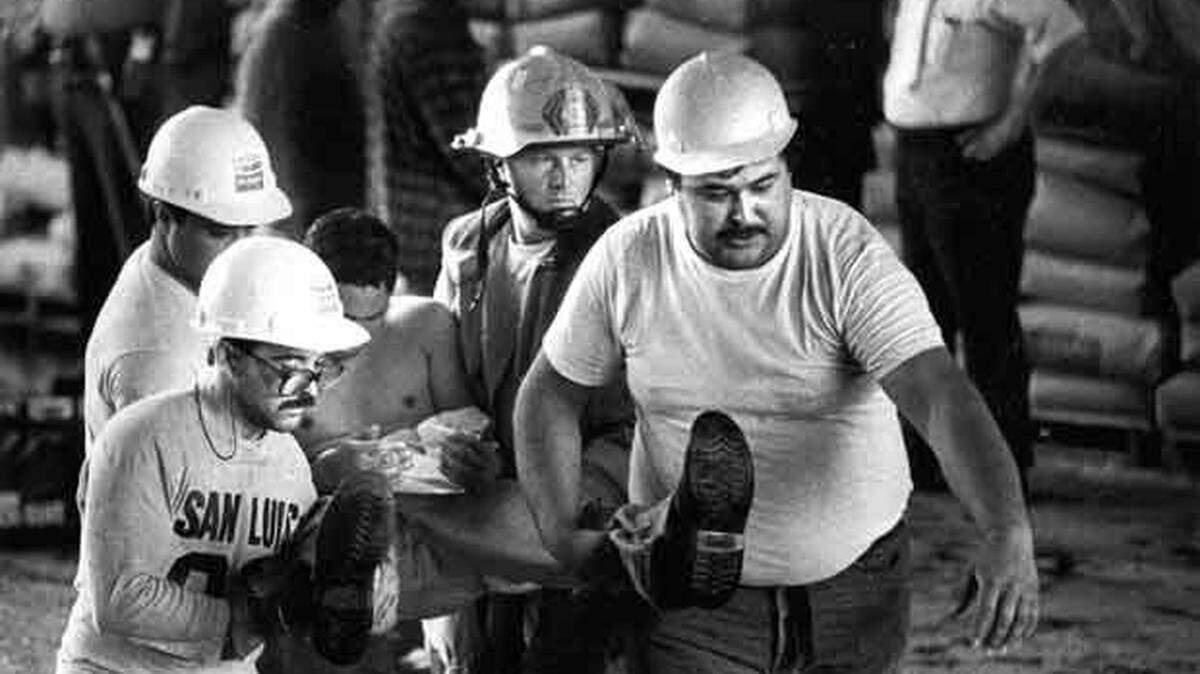
An explosion and flash fire rocked a Santa Maria sugar refinery Friday, burning seven workers, three of them critically.
The explosion tore through the Union Sugar division of the Holly Sugar Corp. plant at 1:58 p.m., said Santa Barbara County fire department spokesman Capt. Charlie Johnson.
The explosion wreaked “considerable” damage to the sugar plant’s walls and roof, but fire damage was “minimal,” Johnson said. He likened the accident to grain elevator explosions, in which fine particles of wheat can be ignited by a single spark.
“It appears to be very similar to a dust explosion common in the Midwest,” Johnson told the Associated Press.
Fire department and hospital officials had not released the names of the victims by Friday evening, but a Telegram-Tribune photographer at the scene was told that one of the injured was Raul Orozco, 23, of Guadalupe.
Orozco was reportedly one of the three seriously burned men airlifted to Sherman Oaks Community Hospital in the Los Angeles area.
The nursing supervisor at that hospital, Brenda Tames, said the three men arrived between 4:30 and 5:30 p.m. and were in the hospital’s burn unit. Their condition was serious but stable, she said.
Two of the men had burns over 20 percent of their faces, arms and hands. The other suffered burns over 40 percent of his face, arms, hands and back, Tames said. The three were taken first to Marian Medical Center, where they were listed in critical condition, said nursing supervisor Ethel Donati.
Four burn victims were taken to Valley Community Hospital, where they were treated and released, an evening nursing supervisor said.
On entry, all were listed in satisfactory condition, said Nursing Supervisor Maureen Shannon.
“None of our patients received extensive burns. They are all alert, awake and talking with their loved ones,” Shannon said, adding that the hospital was withholding their names.
Initial reports said eight people had been burned, but Johnson said that was probably a miscount, or perhaps someone with minor burns was treated at the scene.
Fire Capt. Jim Trask said at the scene that the blast fed on sugar dust, but that investigators had yet to determine what touched it off.
Fifteen county firefighters responded, but the flash fire was contained quickly, Johnson said.
The blast occurred on the second floor of a six-story brick warehouse, in a room where workers said different grades of sugar are sorted, according to The Associated Press.
The plant, which produces beet sugar, is isolated from other buildings about 5 miles outside Santa Maria on West Betteravia Road.
Johnson said there are no dollar estimates yet on the damage done to the sugar plant. Fire investigators sent to the explosion scene were joined by inspectors from Cal-OSHA, building inspectors and county health officials, he said.
Plant employees beginning cleanup operations had to be told to stop so investigators could gather evidence from the explosion scene, Johnson said.
Holly Sugar Corp. has headquarters in Colorado Springs, Colo.
Wesley Mueller, a professor of crop science at Cal Poly, said the process of refining sugar beets into a floury, dusty mix is “inherently dangerous. … It’s a very flammable situation.”
“Grinding sugar is dangerous in the same way that pouring wheat into a silo is dangerous,” Mueller said. “The refining process creates a fine dust, and it is that dust that is highly flammable.”
Mueller said sugar dust is particularly flammable because the sugar particles are high in carbohydrates, which provide energy and fuel when burned.
Any spark, whether in a silo or inside the plant itself, could ignite the mixture, he said. Meuller said a spark from a hot bearing in plant machinery, an electrical short-circuit or excessive heat created by machinery friction could have caused the explosion in Santa Maria.
Contributing to this report were staff writers Gary Taylor and Teresa Brown.
This story was originally published January 9, 2015 at 12:31 PM with the headline "The Betteravia sugar plant explosion of 1988."