
How the Cal Polys — SLO and Pomona — got their names
People hate it when you get their names wrong.
Universities probably do, too. But when your official name is 20 syllables long (21 if you count "at"), mistakes will be made.
A few years back, Chris Gocong was in the lineup for the Philadelphia Eagles football team. His televised introduction was at least twice as long as other players: "Chris Gocong, California Polytechnic State University at San Luis Obispo."
They almost had to cut to commercial after the introductions.
Recently, national basketball broadcasters fumbled both San Luis Obispo's and Cal Poly's names. They would say things like San Looouuuuie or confuse the San Luis Obispo campus with baby sister campus in Pomona.
Here is a brief history of the names.
San Luis Obispo is derived from Spanish, not French. Stop with the Louie Louie.
Now about the school.
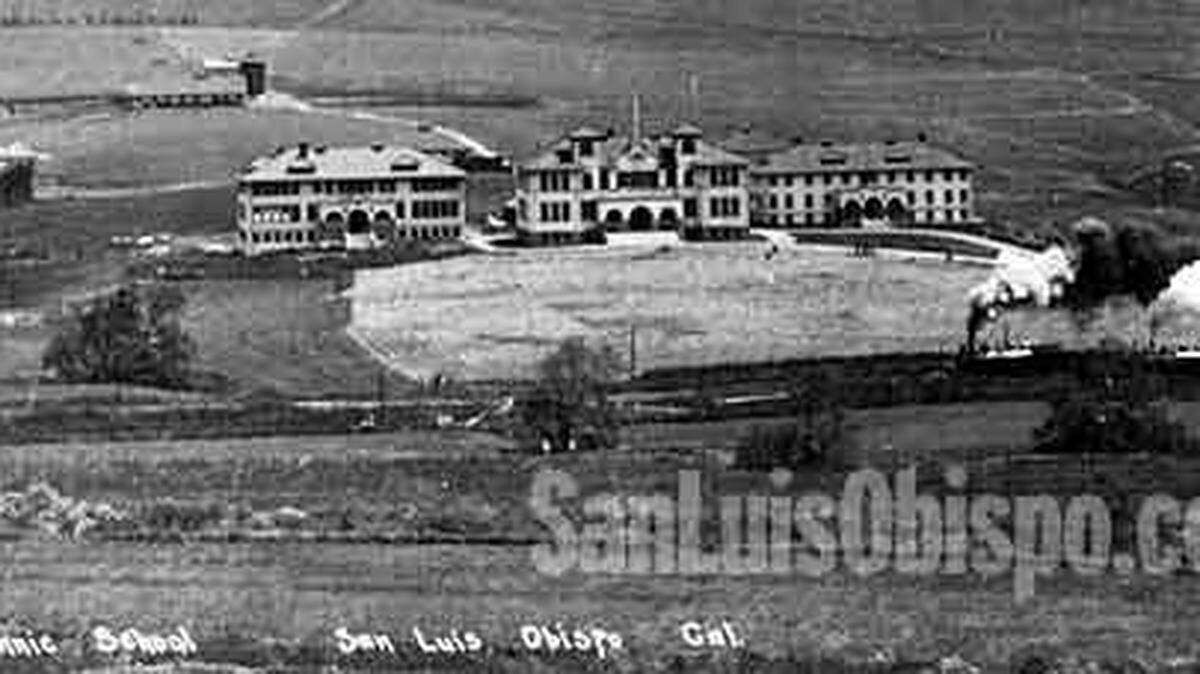
The California Polytechnic School was established in 1901 when Gov. Henry Gage signed a bill establishing a vocational high school in the cow county of San Luis Obispo.
The school was the brain child of one-time Tribune newspaper editor Myron Angel.
Both he and another Tribune editor, Benjamin Brooks, advocated for the school and the positive influence it would bring to the community.
Isolation was a boon and a bane for the school.
The isolation allowed the school to develop a unique personality with a minimum of interference from Sacramento, but funding would frequently be threatened.
Over the first three decades the campus was threatened more than once with closure. In 1912 the school moved from a three- to a four-year course of study, but after a funding crisis in the 1923 the school was in jeopardy.
In 1925 the school added enterprise projects, a forerunner to the senior projects required today, and "Earn While You Learn" was adopted as a motto. Not far from the "Learn by Doing" motto that would become the institution's guiding mantra.
By 1927 the name Cal Poly was in popular use.
The Great Depression strangled funding in 1933. An aggressive young president Julian McPhee was appointed to a school that had been drastically reorganized by the State Board of Education.
Junior College Division classes had been abolished, and the school had returned to two-year technical and vocational roots. Women no longer were allowed to attend.
One of the first solid endorsements of future stability came in 1938 when Cal Poly received its first million-dollar gift; Charles and Jerry Voorhis donated their Southern California ranch for use as a horticultural training center.
In 1940 the school was granted collegiate status, and the name change was adopted in 1947. Meanwhile the Voorhis unit was enjoying success and needed to expand. In stepped the foundation of cereal magnate W.K. Kellogg, donating a 812-acre horse ranch in Pomona to the college.
By 1950 it had the clunky name Kellogg-Voorhis Unit.
In 1949 San Luis Obispo and Pomona built a Cal Poly float for the Tournament of Roses Parade in Pasadena. It was the most visible public link the two schools would share, a partnership that continues to this day.
The schools separated in 1966, and the southern portion was known for a time as California State Polytechnic College, Kellogg Campus; it's now called Cal Poly, Pomona.
Cal Poly was registered as a trademark, and in 2005 the San Luis Obispo campus published a detailed web page devoted to the correct way to refer to the school.
"For reference, the formal name derivations of the university are:• California Polytechnic State University
and
"Other less formal, but recognized name derivations that can be used are:
"(Note: if using this word combination, the San Luis Obispo must be a smaller font than the university name and must not appear connected as if one string of words)"
There are at least 11 "improper uses" that the institution would like to stamp out with Clydesdale-sized horseshoes — for example, Cal Poly SLO.
Judging from the recent NCAA Tournament broadcasts, that horse may have already left the barn.
CAL POLY
Enrollment: 19,003
Footprint: 9,678 acres (Including 3 properties not contiguous to campus)
Athletic Division: Division I
Mascot: Musty Mustang
Colors: Green & Gold
Notable alumni: John Madden, NFL Hall of fame head coach and announcer; Burt Rutan, aviation designer; Weird Al Yankovic, pop recording parodist; Robert "Hoot" Gibson, Federick Sturckow and Gregory Chamintoff, astronauts; Abel Maldonado, 47th lieutenant governor of California; Ozzie Smith, Hall of Fame Major League Baseball shortstop; Chuck Liddell, former UFC light heavyweight champion.
CAL POLY POMONA
Enrollment: 22,156
Footprint: 1,438 acres
Athletic Division: Division II
Mascot: Billy Bronco
Colors: Green & Gold
Notable alumni: Forest Whitaker, Academy Award winning actor; Hilda Solis, former U.S. Secretary of Labor; Jim Zorn, NFL head coach
A previous post on the Cal Poly basketball team, circa 1924.
This story was originally published March 26, 2014 at 1:09 PM with the headline "How the Cal Polys — SLO and Pomona — got their names."