There wasn’t anything else like it when the abalone farm north of Cayucos was built.
Interest in the aquaculture facility is renewed as a new group of scientists propose to revive activity at the site.
When it was founded, John Alexander would be a constant over the years keeping the vision alive.
His long life and association with the project would ensure that several biographies were published on him over the years in the Telegram-Tribune.
John Alexander, left, eyes Frank Oakes’ handful of tiny abalone in one of the nurseries at the California Marine Associates’ Abalone farm near Cayucos on Oct. 12, 1978. Wayne Nicholls Telegram-Tribune
He had invented the tilt-up concrete commercial building process and had took pride in being part of an aquaculture project that was cutting edge.
In 1978, Alexander was the person in charge at the facility and they were still working toward economic viability a decade after he and three others started the project. Scientist David Leighton had left for a job at Scripps Institute of Oceanography, but Hugh Stanton and John Perkins were still working on the project.
The actual operation of the facility evolved over time and some details in the article that follows, like how often the abalone spawned, were quite different when the facility was operating commercially.
It was closer to a quarterly spawning cycle once commercial operation was underway.
Early opponents to the facility included commercial abalone divers who saw the facility as a threat to their business. The commercial market was impacted by the expansion of sea otters and a withering syndrome.
While the facility operated successfully for many years, it was designed in an era before computer automation and many of the processes required hands-on, 24-hour human supervision.
It took years for the abalone to grow to commercial harvest size, so any breakdown was a potential catastrophic loss.
The high cost of electric power was also a factor, and operations wound down in the 2000s.
Farmed abalone would eventually be allowed to be sold beyond California, but there was still much to be discovered when this first-of-its-kind facility opened.
Long-time writer and editor Elliot Curry wrote this first article on the project Aug. 1, 1968:
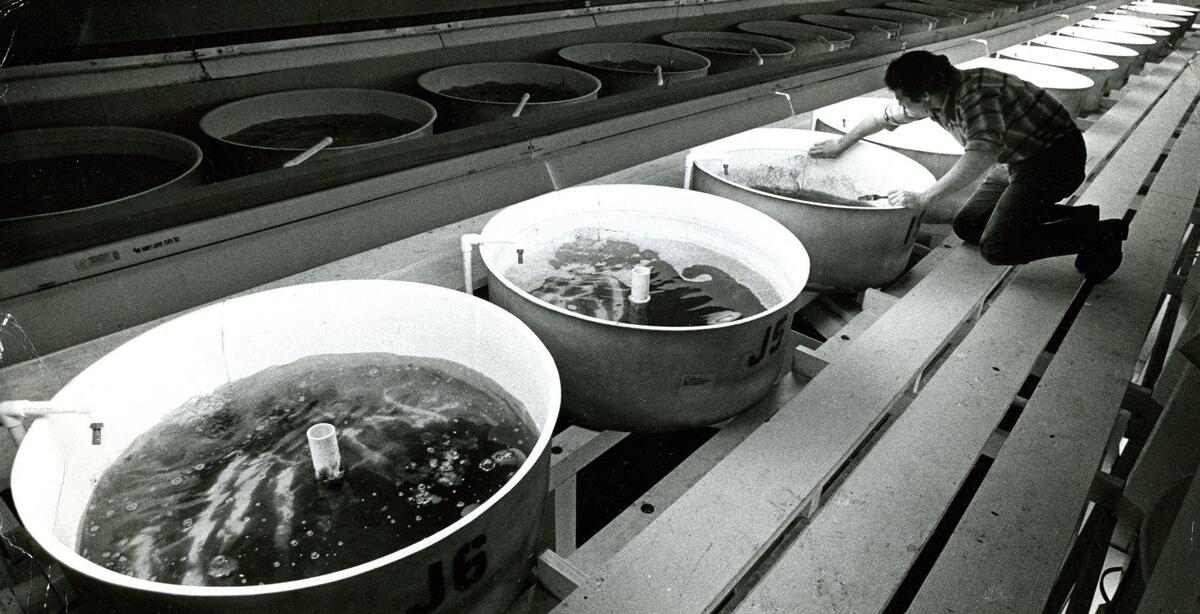
Frank Oakes leans to clean one of 228 fiberglass tubs, where young abalone graze on microscopic sea algae in gently swirling salt water. Abalone farm tour near Cayucos on Oct. 12, 1978. Wayne Nicholls Telegram-Tribune
Trio opens Cayucos abalone farm
Three young men from the Los Angeles area are staking their future here on abalone no bigger in diameter than a human hair.
They are Hugh M. Staton, John Perkins and Dr. David Leighton and they are the designers, builders and operators of a unique abalone propagation and rearing laboratory at Point Estero near the mouth of Villa Creek. Their company is known as California Marine Associates.
“I think I can show you one of our abalone,” said Dr. Leighton. He was holding a small glass plate with a few drops of water on it. Nothing was visible to the naked eye, but when he put the slide under a microscope, multiplying it 150 times, a tiny but lively speck of life could be studied.
Five years from now, if everything goes well, that tiny speck could become an abalone steak. The partners in California Marine Associates and their financial backers are gambling that millions of abalone can be raised to maturity in the controlled environment which they are building on the John Alexander ranch.
Staton, who’s home is in Orange County, is director of operations for CALMA, and the project was originally his idea. He started out once to be a zoologist, but became interested in the declining abalone resources in California.
Perkins is the market expert with the group, hoping some day that he will be shipping abalone all over the country.
Dr. Leighton has recently obtained his doctorate after a long study of the feeding habits of abalone at Scripps Institute of Oceanography at La Jolla. He has the vital role of seeing that the abalone get the right kind of food that will make them grow into husky shellfish.
Stated in its simplest terms, the CALMA plan is a process of propagating and rearing abalone in tanks. A continuous supply of sea water is being pumped into the vats where adult abalone, male and female, have been made at home.
At spawning time the male abalone releases sperm and the female then releases eggs, millions of them, many of which will be fertilized by the male sperm, floating free in the ocean water. In the ocean many of the eggs would be eaten by fish.
The fertilized egg buries itself in a food supply and the long process of becoming an abalone is started.
Fran k Oakes checks some of the 300 to 600 pounds of bulb kelp trucked fresh weekly from the Santa Barbara Channel to feed the abalone at farm near Cayucos Oct. 12, 1978. Wayne Nicholls Telegram-Tribune
The CALMA tanks have had two spawnings so far. They hope to have about one each week. As the abalone grow, they will be transferred from the vats into larger and larger tanks, soon to be constructed at the Point Estero site.
That’s the theory.
Staton, Perkins and Leighton have built their plant and everything in it with their own hands. It is a plain enough building but a lot of study had gone into every detail of both building and equipment. To carry it through these early years, CALMA is getting some $250,000 in financial backing from Southern California residents, mainly in Orange County.
Another person to whom Staton gives the greatest credit is Cayucos rancher John Alexander. Without him the whole project might never have been able to get off the ground. He has supplied the site for the undertaking at an ideal location for abalone operation and is going along with the gamble which the rest of the partners are taking.
The whole community has been wonderfully cooperative, Staton said. Dr. Leighton has already moved his family to the area. Staton and Perkins each plan to do the same before too long. Staton points out that even if CALMA is supremely successful, that little or or no effect should be felt by the diver abalone industry of the area. Under present regulations, abalone cannot be shipped out of California. That would not apply to commercially grown abalone, however which leaves all the other 49 states as an open market.
CALMA is basing its economics on the theory that when abalone is selling for $2.50 a pound or more that they can be raised profitably in captivity.
The adult abalone which comprise the CALMA “breeding stock” were purchased in Morro Bay and seem to be adjusting to tank life. When first placed in the vats they close up at the passing of every shadow. After a few days Staton can run his hand over them and they remain quite unconcerned.
Abalone are strictly vegetarians, feeding only on certain kinds of kelp.
Abalone are grown successfully in Japan, Staton said, and a number of experiments have been made in this country. Cal Poly scientists in Morro Bay in recent years propagating abalone in a controlled environment and the CALMA people are familiar with some of those experiments.
But the time the microscopic abalone now being born at Point Estero are big enough to market, CALMA expects to have some 11 to 12 acres under water, all swarming with abalone in various stages of development.
So far as Staton knows, this is the only operation of its kind in the United States.
Red Abalones shimmer in the light of a potentially profitable future for commercial growers in California, farm tour near Cayucos on Oct. 12, 1978. Wayne Nicholls Telegram-Tribune
David Middlecamp is a photojournalist and third-generation Cal Poly graduate who has covered the Central Coast region since the 1980s. A career that began developing and printing black-and-white film now includes an FAA-certified drone pilot license. He also writes the history column “Photos from the Vault.”