Winter storms turn Morro Bay harbor into ‘a frothing mess.’ What was it like 40 years ago?
Humans aren’t great at calculating odds — even when it comes to life-threatening situations such as the massive waves that crash next to Morro Rock during winter storms.
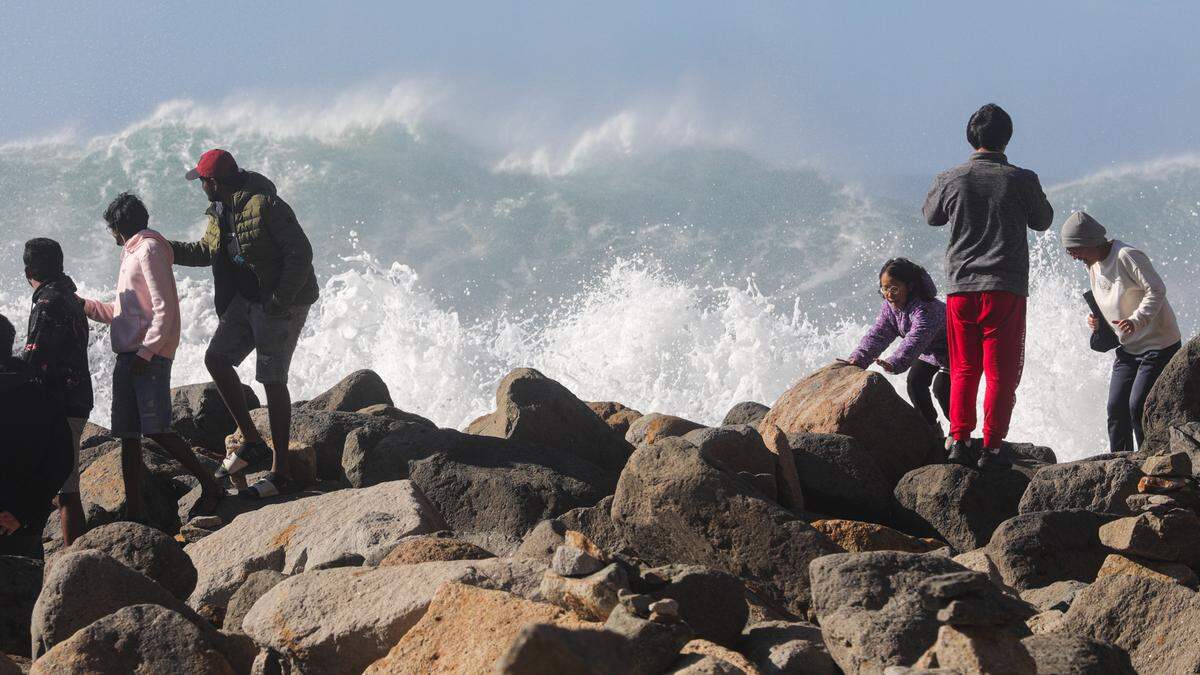
The spectacular power of the not-so-placid Pacific Ocean is on full display as viewers inch their way closer to wet rocks.
The problem is that tides change and sneaker waves can be much higher than a pattern observed over a short period of time.
I was reminded of that fact this week during a visit to the Rock. A sneaker set came in, drenching rocks that had been the perch of a family only a few minutes before.
That area had been dry for the hour that I had been there, and excited shouts could be heard from observers.
One time, I saw a man completely submerged by a wave that was at least a full body length taller than him.
A year or two apart from that, a boy of about 10 had the same thing happen to him.
Both the man and the boy were fortunate that they were able to get back from the brink, although they were soaked with salt water.
A quick archive search at Newspapers.com turns up a Nov. 7, 1983, story about waves injuring four 21- to 22-year-old men who got too far out on the jetty.
A woman was taken to the hospital after she tried to rescue her dog, washed out to sea by a wave on Dec. 4, 1989.
These days, folks have their attention splintered by cell phones. No selfie or text is worth turning a back on the sea.
Tim Ryan wrote this story about Morro Bay during a series of winter storms driving high surf, published in the Telegram-Tribune on Jan. 24, 1981. The article has been edited for length.
A test of wills with Morro waves
Harbor Patrol — risky job
To those who watched giant storm waves batter the Morro Bay breakwater this week, Harbor Patrol Officer Jerry Mendez appeared to be playing a game of hide and seek with the mountains of water.
Mendez, at the wheel of a Harbor Patrol boat, raced back and forth from the safety of the manmade bay to the exposed tip of the 1,885-foot-long breakwater. Waves as high as 25 feet broke nearby.
Part of the Harbor Patrol’s job is to keep an alert eye on navigation conditions at the harbor mouth. On hazardous days, this is better accomplished from water than from land.
Like a minnow being chased by a shark, the 11-year Harbor Patrol veteran dodged waves by gunning his 21-foot fiberglass boat from the swirling surf zone into the channel’s deep water areas, where the waves flattened.
“Driving the boat all day probably looks easy to most people,” he said from his boat, as it bobbed up and down in the channel. “But at the end of a day like this, I feel completely exhausted.”
Mendez and his two Harbor Patrol partners, Chief Officer George McSpadden and Dick Rodgers, have had one of the busiest weeks Mendez can remember. For more than a week, the waves at the 600-foot harbor mouth have turned the normally placid channel into what Mendez called “a frothing mess.”
“They’re the biggest waves I’ve ever seen in Morro Bay,” he said Monday.
Emergencies in Morro Bay harbor usually occur at the harbor entrance, marked by a black rock breakwater on the north and an 1,832 foot jetty on the south, known to local mariners as “the scorpion.”
The seaward approach to the entrance appears simple enough. A large sea buoy bobs gently in 50 feet of water about a quarter-mile west from the tip of the breakwater.
On the end of the breakwater is a 22-foot tower with a beacon. Marking the width of the 16-foot-deep channel are buoys about 10 yards apart.
But during the week’s onslaught of waves, the beacon went dark after several swells swept over it. And the sea buoy, built to withstand the severest of winter storms and in water considered too deep for waves to break, was buried several times under tons of white water.
By late Thursday afternoon, several multi-ton rocks had been knocked loose from atop the breakwater and were rolled into the bay.
Some people climbed down near the water’s edge to see how close they could get to the surging whitewater. Most of them ended up soaked.
“They’re our responsibility if they get swept into the water,” Mendez said.
Some boaters in the past have disregarded both the official and natural warning signs of an angry sea and met with fatal results.
Five people have died at the harbor entrance in the past year, and several other boats have run aground just inside or outside the entrance.
Fog, strong currents, shallow sandbars, heavy winds and large surf conditions have all contributed to the accidents.
Many people blame the Army Corps of Engineers for building what the critics believe is a poorly designed breakwater and jetty.
But local and federal officials disagree.
“Inexperience is what kills people,” said Rodgers. “And lack of respect for the ocean.”