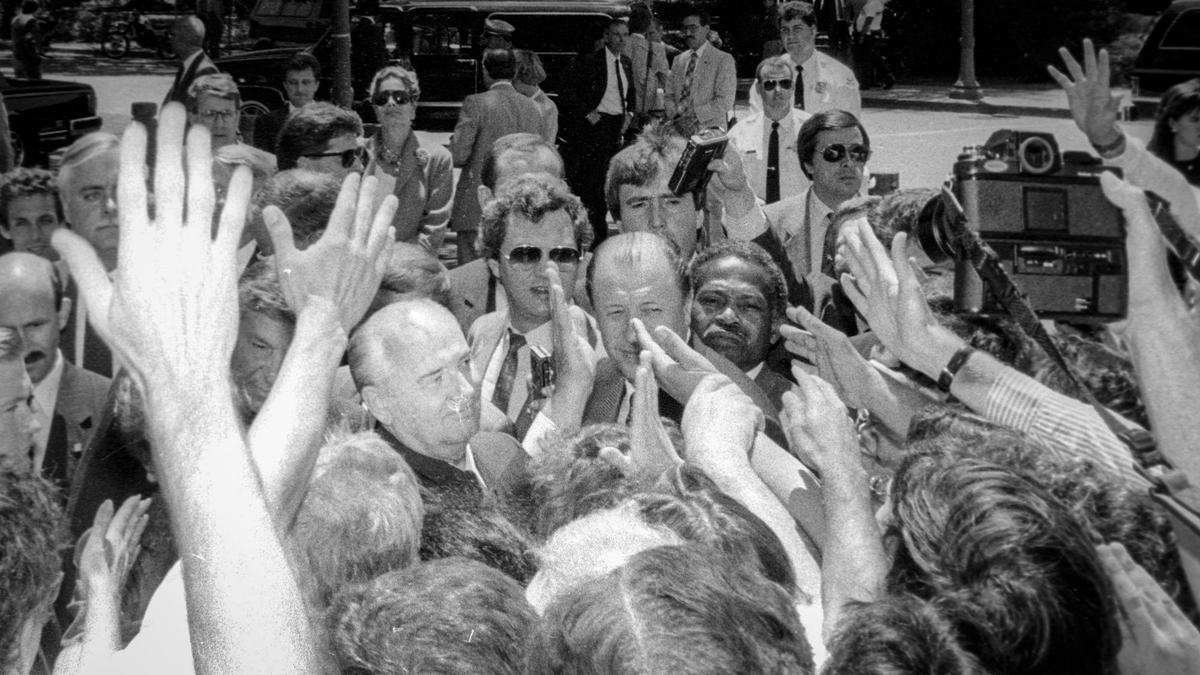
President of the Soviet Union, Mikhail Gorbachev at lower right visits Stanford University June 4, 1990. Behind and to the the left is California U.S. Senator Alan Cranston.
Jeffrey May
Mikhail Gorbachev, the last leader of the Soviet Union, died Tuesday at the age of 91.
Gorbachev was one of two sitting Soviet leaders to visit the United States. Then-Premier Nikita Khrushchev stopped by San Luis Obispo on a tour of the country in 1959.
Gorbachev was popular in the West. After decades of ossified authoritarians, he projected a more nimble, modern image.
On international trips, it was common to see Gorbahev accompanied by his wife Raisa, which made him seem relatable to Western eyes.
Gorbachev’s negotiations with then President Ronald Reagan on nuclear arms reduction set a new tone for the USSR’s relationship with the west. It was an acknowledgment that an endless arms race was a lost proposition for the Soviet empire.
“Glasnost” and “perestroika” — openness and restructuring — were words that entered the lexicon during his tenure.
Russian tradition dictated that a Soviet leader or tsar should stand solitary and absolute — and never negotiate, Galeev wrote on Twitter.
When the Soviet Union collapsed Gorbachev was blamed.
In the chaos that followed, old Russian hard liners wistfully looked back at the old Soviet regime, reasoning that at least life was predictable then.
in many ways, Russian President Vladimir Putin’s reign is an attempt to “Make Russia great again” and help the nation regain its superpower status.
I’ll remember Gorbachev’s time in office as a brief international moment where nuclear sabers weren’t rattled constantly.
Gorbachev visited Stanford University on June 4, 1990, on the final day of a tour of the United States.
Jill Duman wrote two stories about the tour stop that ran in the Telegram-Tribune the next day. This is one of them.
Amid a sea of hands, President of the Soviet Union, Mikhail Gorbachev visits Stanford University June 4, 1990. Jeffrey May
Gorby touch leaves impression
STANFORD — They were students and professors, housewives and computer researchers, waiting together for a glimpse of the man who has come to symbolize their hope of world peace.
And when the first car of the 50-car entourage bearing Soviet President Mikhail Gorbachev finally rounded the corner of the university campus shortly before noon Monday, the crowd of more than 7,000 gave a cheer that rang to the rooftops.
The sun was broiling, security was extreme and the Soviet president was more than an hour late. But the vast crowd of Gorbachev fans didn’t seem to care.
“I’ve been watching Gorbachev all my life,” Mike McDonough, a freshman at Stanford. “He symbolizes a guy who’s trying to do something good. He doesn’t make any bones about (the Soviet Union) having a lot of problems … but at least there’s hope.”
When Gorbachev stopped his official rounds to shake hands across police barricades, the crowd surged forward trying to return the gesture.
“I just looked at him, and I said ‘Welcome to the country,’ ” said Joan Crowley, a tremulous Sanford senior, who shook Gorbachev’s hand. “He took both my hands and he squeezed them together.”
“I just yelled, and he was grabbing hands,” said Bob MacLean, a Stanford Graduate student, who also shook the president’s hand. “He had a pretty firm grip.”
“All of a sudden, he was standing in front of me, looking directly at me, said David Schurman, professor of orthopedic surgery at Stanford Medical School.
Schurman got an opportunity to shake Gorbachev’s hand while he listened to the tail end of Raisa Gorbachev’s explanation of art work donated to the Soviet people by artists at Stanford.
Schurman said his impression of Raisa was that the Soviet first lady was more “intellectual” in her approach, compared to her husband’s “affectionate, human-to-human way.’
“It was evident to me that he (Gorbachev) was enjoying the crowd,” said Schurman. “He was receiving from the crowd as much as he was giving.”
Alexander Stepanov, a Soviet immigrant from Moscow who now works as a computer researcher for Hewlett Packard in Palo Alto, said he came to see Gorbachev despite the criticism he hears from relatives in the Soviet Union.
“He (Gorbachev) did change the world — there’s no question about it,” said Stepanov. “There is hope that the confrontation will end.”
President of the Soviet Union, Mikhail Gorbachev at lower right visits Stanford University June 4, 1990. Behind and to the the left is California U.S. Senator Alan Cranston. Jeffrey May
More than 6,000 Stanford students, faculty and staff won special lottery tickets that allowed them permission to stand within designated roped-off areas along the route the Soviet president traveled during his two hour stay on campus.
Others, like Stepanov, got tickets to standing areas on campus through friends at Stanford.
Still other people like one woman who asked not be named — actually bought tickets for as much as $100 just to stand on campus and watch Gorbachev walk by.
“I think it’s worth it,” said the woman, who works on the Stanford campus. “I’ll skip meals if I have to.”
Another 1,700 students, faculty and staff were lucky enough to win seats to Gorbachev’s address at Stanford’s Memorial Auditorium.
Those who weren’t so lucky were offered lottery tickets by fledgling capitalists, who decided to trade in their date with destiny for some good cold cash.
“I’m planning to go in myself if I don’t get $500,” said Jason Trachewsky, a Stanford electrical engineering major. “Some person I know got $1,800. Another guy got $1,000.”
But hundreds of other people were willing to just stand outside the perimeters of the cordoned-off campus for free — just to watch history in the making.
“I’m really hoping he’s going to pull one of his crowd stops right here,” said Harold Tarpley, a psychiatrist who came from Fresno — in the hope of seeing the Soviet president.
Standing with his wife outside the Secret Service checkpoint at Stanford, Tarpley reflected on how he thought Gorbachev had changed the world.
“I was never frightened of Russia, personally,” said Tarpley. “I never thought Russia was the problem. He’s made me right about that.”
Louise Orlando, a Santa Clara housewife, saw only a blurred glimpse of Gorbachev as he whizzed past in a black limousine with a red Soviet flag.
“He was sitting forward and looking toward us,” said Orlando. “It was so fast. But he did look.”
David Middlecamp is a photojournalist and third-generation Cal Poly graduate who has covered the Central Coast region since the 1980s. A career that began developing and printing black-and-white film now includes an FAA-certified drone pilot license. He also writes the history column “Photos from the Vault.”