‘The finest I ever saw.’ SLO bridge withstood floods, bootleggers and a live cow
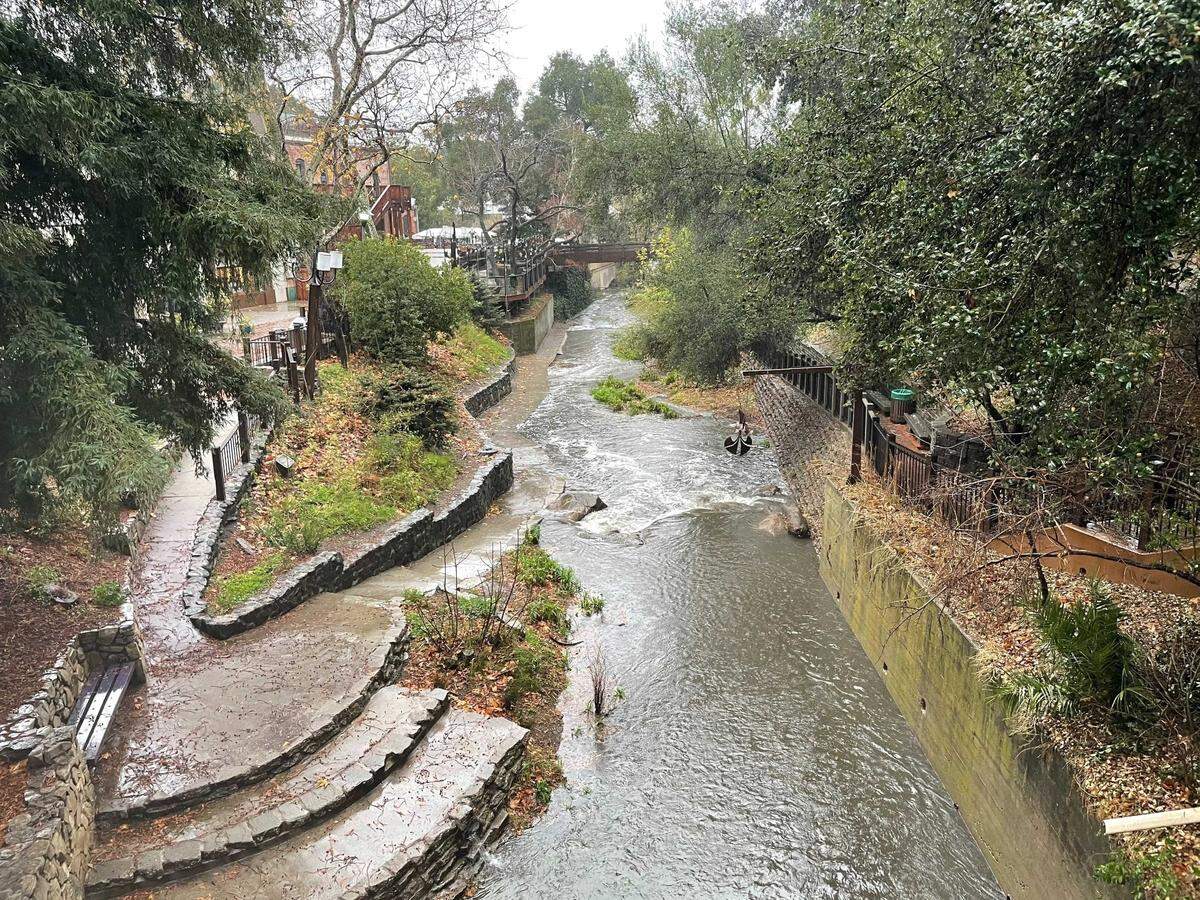
The Marsh Street Bridge over San Luis Obispo Creek is one of those crucial connections taken for granted, until they break.
Detours prompted by the construction of a brand-new replacement bridge served as a reminder of how much infrastructure underpins our lives. The new bridge opened this year.
Two concrete bridges crossing San Luis Obispo Creek were built in 1909.
One bridge was at Marsh Street, while the other was on what is now known as Johnson Avenue near the current site of San Luis Obispo High School. A wood bridge there was demolished by floods that year.
As early as 1874, the city recognized that Marsh Street was destined for importance. Property owners agreed that the street should be surveyed at 70 feet wide.
As The Tribune wrote on May 30, 1874, “The spirit of progress appears to have at last entered the breasts of our townspeople.”
The town had built three first-class bridges in the early 1870s and was about to build two more. San Luis Obispo was a “thriving burg,” the newspaper reported.
A decade later most of those bridges were gone, washed away by epic flooding in November 1885.
Those with long local memories recall the floods of 1969 as the high-water mark in San Luis Obispo, but imagine 48 hours of 1969 compressed into 12 hours of 1885.
In one six-hour period, 9 inches of rain fell, more than an inch an hour on average.
The Marsh Street bridge was the first of several lost to the “insatiate maw of the creek.”
It took years to replace the Marsh Street bridge, as the little cow town of San Luis Obispo had limited resources.
In January 1887, The Tribune complained of impatience and resentment that the bridge had not been rebuilt. The land across the creek was largely undeveloped but there was horse racing track and baseball grounds and “well calculated for residence property.”
In January 1909, flooding prompted the city board of health to tell people to stop filling the creek with garbage. The Jan. 15, 1909, weekly edition of The Tribune said a live cow had been washed downstream and was unlikely to have survived the walled tunnel under town.
That prompted the town to build something strong enough for the automobile age.
John B. Leonard of San Francisco designed the concrete 1909 bridge on Marsh Street. It was well engineered, and stood for more than a century through various floods that demolished lesser structures.
City attorney Norton called plans “the finest I ever saw.”
There was one construction-related accident in December 1909. when H.C. Balderas ran into the barbed wire fence blocking the approach in the dark. His face was gashed on the cheek and temple.
The Tribune said the bridge was “about complete” by mid-December 1909 “and will be able to hold up the circus elephants next year and possibly the editorial dignity that got it all barreled up in the cement. It is a fine bridge.”
Until then, most bridges in the area were wood or steel.
Electric lamps were placed and lit on the bridge in March 1910.
If the bridge could talk, it would tell one more story.
The weekly Tribune of Oct. 23, 1923, said that a bootlegger kept a stash near the bridge in a tunnel tall enough for a man to stand in at the entrance. It was covered by a screen of willow trees.
Police Chief W.F. Cook thought it was a distribution point for several hundred cases of scotch whiskey smuggled ashore near Pismo Beach.