A 22-foot-tall cowboy guards McLintocks restaurant in Pismo Beach. How did he get there?
Any conversation about the most popular restaurants in San Luis Obispo County will include F. McLintocks Saloon and Dining House.
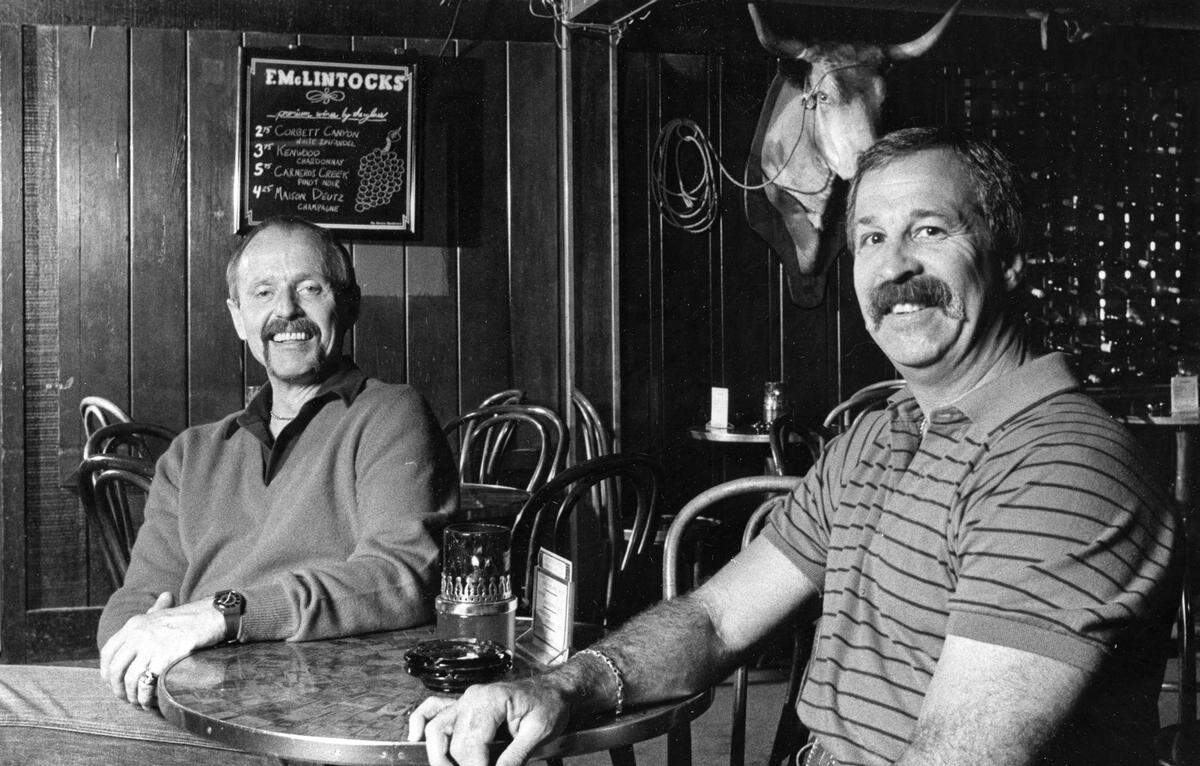
Co-founder Bruce Breault, who passed away this week, helped build a powerhouse brand.
A July 1993 Telegram-Tribune article said that six independent restaurants in San Luis Obispo County were among the top 500 nationwide in terms of total sales the previous year. The list included F. McLintocks in Pismo Beach and San Luis Obispo, and sister restaurant Izzy Ortega’s Mexican Restaurant & Cantina in San Luis Obispo, which has since closed.
The original F. McLintocks location, which opened in Shell Beach in 1973, was No. 30 in the nation with annual sales of almost $6 million, the article said.
Breault and his fellow co-founder, Tunny Ortali, knew that the steakhouse’s appeal extended beyond who was running the kitchen or what was on the walls.
Going to F. McLintocks is an experience. And the restaurant chain took every opportunity to expand on that experience.
When a busboy came up with a showy way of pouring water, he wasn’t reprimanded. The other servers were trained in the high water pour.
Another innovation occured when the pine tree in McLintock’s Pismo Beach parking lot was attacked by bark beetles.
Most would have ground up the stump and added a parking space to the lot. The McLintocks owners decided to carve a cowboy statue.
The wooden sculpture has survived arrows and been restored after termites weakened the base.
Tribune columnist Tom Fulks, then a Telegram-Tribune reporter, wrote this story about the famous cowpoke on June 25, 1983.
He’s a rugged cowhand
Sculptors turn dead tree into eternal statue
His dark steely eyes stare out to sea, seemingly unimpressed that he has at last been set free.
This is a serious dude: a stern-faced, 22-foot tall cowhand who looks like he means business. He’s not the type to brag about things, and hell would freeze over before he revealed the many secrets he has come to know over the years.
Had it not been for the careful strokes of a chainsaw-wielding wood sculptor — Eusebio Dalay, 66, of Monterey — this cowboy might never have been freed of the bark that covered him for so many years.
The Monterey pine in which the cowboy was entombed was planted by rancher O.T. Buck on his pastoral Shell Beach site more than 80 years ago.
Later, the tree served to shade the front of a seaside gambling and pleasure saloon owned by the late Mattie Smyer, who, according to legend, purchased the ranch from Buck with earnings from a successful brothel she ran near the oilfields of Taft.
Smyer is reputed to have turned the Buck ranch into one of the most profitable brothels on the Central Coast during World War II.
The saloon was sold in 1973 to Bruce Breault and Tunny Ortali, who remodeled the structure and grounds and named it F. McLintock’s Saloon and Dining House.
While they are happy to discuss their thriving business and its steady growth, Ortali and Breault don’t like to talk too much about the saloon’s previous owner.
But they do tell people the pine was planted in the same month Mattie was born, and that it died of beetle infestation shortly after Mattie died several months ago.
Today, there stands the stoic cowhand, showered in light by powerful lamps at night, exposed to the sun and weather by day.
It juts straight up from the ground behind a white picket fence, next to American and California flags that welcome visitors. Until it died, the tree — bedecked with shimmering lights and leafy limbs — stood as a landmark for the thousands of motorists who traveled U.S. 101.
Carved on the base of the sculpture for posterity are the words: “By Burlwood Ind. Inc., Eusebio Dalay, 6-16-83.
Dalay, a master woodcarver who left for the United States from the Philippines two years ago, knew how to make a portrait.
This coarsely-cut cowboy stands a little pigeon-toed with the slightly bowed legs of an experienced horseman. The model for the wooden cowhand was taken from a large lamp that sits in the lobby of the restaurant.
Being as authentic as possible, Dalay reproduced a spitting image of the statue. The sullen-faced cowboy sands with his thumbs in his belt, rifle at his side, bandanna around his neck and bullets and six-gun slung low around his waist.
He also wears the traditional hat, vest, chaps, boots and bushy mustache, and stands on a saddle. He faces the ocean with the determined expression of a contemplating cowpoke scanning the horizon.
Though Dalay was the master carver on the project, he received help from Burlwood president George Buck and vice president Joe Vallaire.
Dalay used several chainsaws to carve out the rough image of the sculpture, then broke out his chisels and hammers to do the detail work.
The Burlwood crew had to erect a scaffolding around the tree to carve it — an unusual twist for Dalay since he usually carves sculptures out of smaller pieces of wood.
When the sculpture was finished it was painted to preserve the wooden cowboy from rotting.
Though he may not be as graceful as the shady tree, the cowhand will no doubt continue to be an attraction as he stands silently watching over freeway travelers.