Wobbly walls and weak arches: SLO County Hall of Records was ‘disgrace to the community’
Mystery bricks were uncovered recently during excavation to upgrade a downtown San Luis Obispo bus transit center.
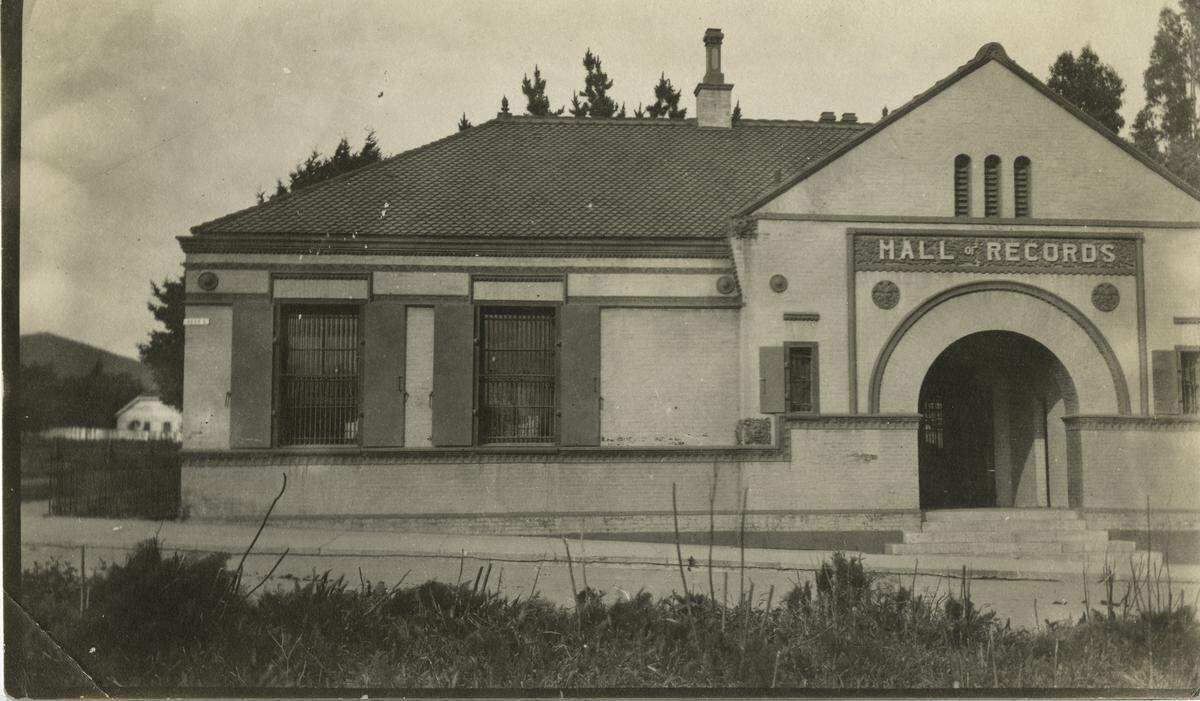
Those bricks likely belong to the rotten foundation for the San Luis Obispo County Hall of Records that used to wobble on the corner of Palm and Osos Streets.
According to research by Lynne Landwehr, the Hall of Records building was built in 1888 after the Greek Revival-style courthouse building next door ran out of room.
The courthouse started small but moved to larger and larger quarters as San Luis Obispo County grew.
In 1850, court was held in a room in Mission San Luis Obispo.
The courthouse and jail later moved to Captain William Dana’s two-story adobe near the corner of Monterey and Court streets in San Luis Obispo, according to Annie Morrison and John H. Haydon’s “History of San Luis Obispo County.” (Court Street is now a pedestrian mall that runs between Monterey to Higuera streets in front of Thai Palace and Peet’s Coffee.)
Dana’s dilapidated building did not have the gravitas expected of a county courthouse.
The adobe, called Casa Grande, had a sheet iron roof and timbers hauled by oxen from Cambria. It was the first hotel in town.
Lawyer and Tribune founder Walter Murray called it “a marvel of repulsiveness, and the courtroom with its wretched appointment a disgrace to the county.”
The San Luis Obispo Pioneer wrote in September 1869 that a grand jury report called the county jail unsafe, unsanitary and unfit for occupation.
The San Luis Obispo County sheriff had no irons to detain prisoners and the adobe privy at the end of the courthouse was apparently too small and stench filled the adobe. It was “a nuisance of the worst kind,” the Pioneer wrote.
“They recommend the construction without the building, but within the outer walls, a new privy, sufficiently large and commodious for the end designed,” the newspaper reported.
“It is also recommended that the jail, both inside and out, be kept in a cleaner condition, and particularly that all rubbish and offal be removed from the jail-yard,” the Pioneer reported, “as its present appearance is decidedly offensive to all who visit the same, if not absolutely prejudicial to the health of its inmates.
It was a big deal when a Greek Revival-style courthouse was built in 1873, the first county courthouse constructed for that purpose.
The land for the building was donated by wealthy banker J.P. Andrews and Ernest Cerf, according to Myron Angel’s “History of San Luis Obispo County.” Andrews would build the brick building that still stands across the street and it was likely good for property values to have the courthouse nearby.
The jail and sheriff were in the basement.
Within 15 years, the growing county ran out of courthouse space. The on-the-cheap solution was a poorly built, architecturally mismatched Hall of Records.
The building had barely reached 21 years when severe problems began to show.
In Dec. 11, 1909, San Luis Obispo Telegram reported the grand jury was investigating conditions at the Hall of Records.
“The foundations have evidently given away at some point, as the walls on one side are badly out of plumb,” the Telegram wrote.
A Feb. 26, 1909, headline featured creative spelling: “Bracing up the Hall of Records, Which Wabbles.”
The San Luis Obispo County Jail was also criticized by the grand jury as unsafe and unsanitary.
As the San Luis Obispo Tribune wrote on March 14, 1910:
“HALL OF RECORDS
The Hall at Records is receiving the attention of the carpenters[.] In the storm the old building became weakened and another arch was about to collapse. The front wall of the building is also weak, A few more such storms and the building may take a notion to fall out on all four sides, thus leaving Recorder Mahoney and his force to work in the open air.”
Though the county was growing, it still had rural doldrum days.
As The Weekly Tribune wrote on June 21, 1910:
“IT WAS A DULL DAY.
(From Friday’s Daily.) It was unusually dull at the Hall of Records yesterday and County Recorder Mahoney did not receive a single document for filing during the entire day. This is a matter of record as it has never happened to be that way but once before since he has been in charge of the office.”
Built in the era of gas lamps and fireplaces, the Greek Revival courthouse was stately, but it was quickly an antique.
By March 3, 1911, the Tribune reported that the courthouse windows were in such bad shape that bailiff Hankenson had to whittle pegs to drive into the window frames to stop them from rattling in a gusting spring winds.
“The Supervisors are arranging to renovate the old barn, but with a building used as the Court House is, and where the plaster keeps falling from the walls, only a new structure can supply the public with what is really needed.”
The Hall of Records was in even worse shape, the walls were propped up with timbers. The Tribune called the buildings “a disgrace to the community.”
By July 11, 1911, Hall of Records repairs had taken place and the bricks were being covered in plaster.
The paper endorsed a bond to build a new courthouse but it would be decades before the buildings were replaced.
The Greek Revival courthouse building was demolished in 1940 as construction of the new, Civic Moderne-style county courthouse on Osos Street began to devour the block.
Construction magnate and Madonna Inn co-founder Alex Madonna won the low bid to demolish the old courthouse building, and he turned a profit by selling the bricks. He used a bulldozer to knock down walls, then used them as ramps to reach the higher levels.
The Civic Moderne building was constructed with funding from the federal Works Progress Administration and the county. It almost fills the city block.
When the top-floor jail opened in 1942, it only took a few months for two inmates figure out how to break out. They used a combination of weak welds and knotted bed sheets to escape.
Although the Greek Revival building only lasted 67 years, the Civic Moderne courthouse has been in continuous county service for 80 years.
Photos of the Osos Street courthouses can be seen at CourthouseHistory.com.