
Cal Poly increases drug testing for football players this year
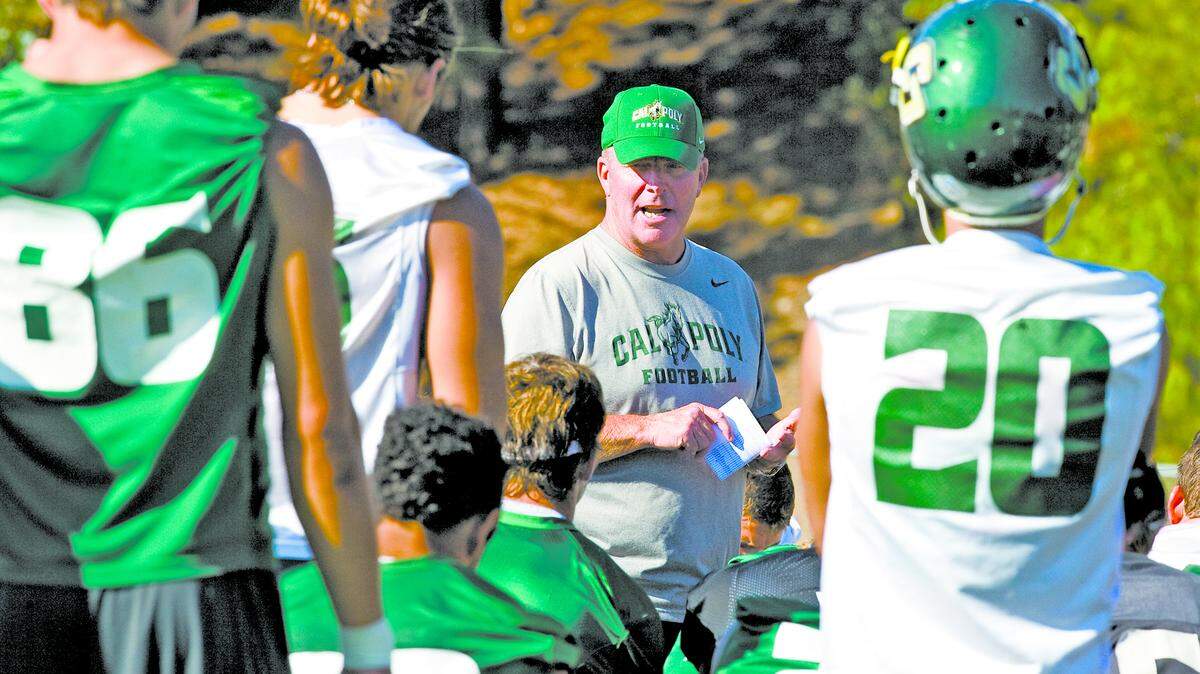
Since five Cal Poly football players were arrested in August and charged in connection with an alleged attempted armed robbery, the university has dramatically increased its drug-testing efforts.
Last school year, Cal Poly tested 41 student-athletes for drugs, spending about $2,000. In the past three months alone, it spent more than $14,000 to conduct 197 tests on its 550 student-athletes, according to athletic director Don Oberhelman.
He expects that 550 to 800 additional tests will be conducted by the end of this school year, which would cost at least $40,000 more.
Furthermore, the athletic department has strengthened its drug awareness program and is revising recruiting strategies.
So far, few of the tests have shown positive for drugs, according to documents The Tribune obtained from Cal Poly.
In September, 149 tests were performed on student-athletes, documents show, including all 105 football players, Oberhelman said, with 12 testing positive for a substance banned by the NCAA.
An additional 48 tests have been performed by the university since then, Oberhelman said, resulting in five more positive tests.
Nine of the positive test results were excused by doctor’s prescriptions, and the remaining eight were positive for marijuana alone, he said.
The NCAA also independently tested 27 Mustangs at random from different sports during the fall quarter, Oberhelman said, and none had positive results. In all, there were eight unexcused positive tests — or 3.6 percent of the total 224 performed.
I don’t know that I have a conclusion yet with this sample size,” Oberhelman said. “I think we need to do more testing, but it’s less than 4 percent of the students we’ve tested have come back positive for anything,” he added. “I think it’s hard to be happy with any number other than zero, but I also think it shows the value of testing in terms of behavior modification.”
Because more than 100 of the tests were conducted at random, some athletes may have been tested multiple times, but federal law prevents the release of individually identifiable health information.
Cal Poly’s on-campus drug and alcohol educator Theresa Fagouri said the national average of marijuana usage for 18- to 24-year-olds in higher education is about 15 percent.
The results are in contrast to estimates made in the wake of the August arrests. The consensus then among eight recent former football players considered marijuana use to be widespread on the team with some believing the rate of use to be anywhere from 40 to 60 percent, they said.
The alleged robbery
Cal Poly’s drug testing program was called into question in August when five football players were named in an alleged drug-related robbery at a fraternity.
Senior slotback and returning offensive MVP Kristaan Ivory, sophomore receiver Cam Akins, sophomore cornerback Cortland Fort, redshirt freshman cornerback Dominique Love and slotback Jake Brito have all been charged with several felonies in connection with an Aug. 10 attempted armed robbery at the Delta Sigma Phi fraternity house.
All five have pleaded not guilty and are awaiting a preliminary hearing in January.
Akins has been charged with allegedly brandishing a gun and demanding money or drugs from fraternity members that night. Fort was arrested after allegedly trying to flee in a car as police arrived. Love, Ivory and Brito were not at the scene but were later arrested on conspiracy charges.
All five were suspended indefinitely from the football team. Fort left the area and has played six games for Riverside City College. The four others remain enrolled at Cal Poly, according to the university.
Gear McMillan, the former Cal Poly chapter president of Delta Sigma Phi, is also being prosecuted on charges of possession and sale of marijuana and amphetamines.
Increased drug testing
Three days after the alleged robbery, documents show Cal Poly entered a contract with The National Center for Drug Free Sport to beef up testing.
That organization is responsible for conducting drug tests for the NCAA, NFL, NBA, PGA Tour, LPGA and Minor League Baseball. Cal Poly’s contract calls for it to spend up to $27,000 this academic year, and Oberhelman said there is flexibility to spend more if needed.
Athletes who have already tested positively will be regularly tested. The others will be selected randomly by Drug Free Sport from official rosters. According to the athletic department’s drug policy, a single positive test for street drugs — everything except performance-enhancing drugs — requires additional drug education and counseling. A second positive test results in an automatic one-year suspension. A third results in expulsion from all teams.
"I was never opposed to getting drug-tested," Cal Poly linebacker Nick Dzubnar said. "It's made the team be more focused. Guys shouldn't be doing it (drugs) in the first place, especially when you're going to a top college like that.
“I think we should continue it,” he added. “It makes them (the guys) not get in trouble and stay out of trouble. … We've done well throughout the season, if they continue it, we’ll continue to do well."
Each test cost the athletic department $71, Oberhelman said.
That’s $21 more than Cal Poly said it paid previously for a standard test so it would include results for a wider range of substances, including benzodiazepine, the psychiatric prescription drug used in Xanax.
“I think the testing is working up to this point,” Oberhelman said, “and we’re going to continue aggressive testing to make sure that our students have that backing to make that better decision, to have that in the back of their head that, ‘Oh, I’ve got a lot at stake here, and if I make a bad decision, it could cost me my scholarship and my ability to play the sport that I love.’ I want them to think about that.”
Strengthening drug awareness
Oberhelman said in addition to testing, the department has upgraded its drug-awareness program, requiring student-athletes to spend additional hours meeting with educators and law enforcement on and off campus.
An outside consulting firm has also been contacted to perform an external review of the football program’s culture to help determine what further measures will be taken. Oberhelman said that investigation should conclude before June 2015.
With the conclusion of the football season last weekend, Cal Poly will turn its full attention toward recruiting. Junior college prospects are able to sign in December. High school recruits will do the same in early February.
Both football coach Tim Walsh and Oberhelman said this year’s events have prompted them to rethink recruiting strategies.
“We have to make sure we’re trying to find guys that fit here in every way and want to be here,” Walsh said. “It can’t be mom and dad wanting them. It can’t be us wanting them. It’s got to be the player, and he’s got to be able to explain and demonstrate to us exactly why he wants to be at Cal Poly.
“That’s the most important thing, the kind of person who wants what this place can offer you and understands what this place can offer you, and I think that’s going to be a huge emphasis.
“Not that we didn’t do it in the past, but it’s going to be more forthright by us, coming out and really putting the young man on the spot. Why do you want to be here?”
This story was originally published November 29, 2014 at 7:22 PM with the headline "Cal Poly increases drug testing for football players this year."