
SLO County police departments have surplus military gear in their inventories
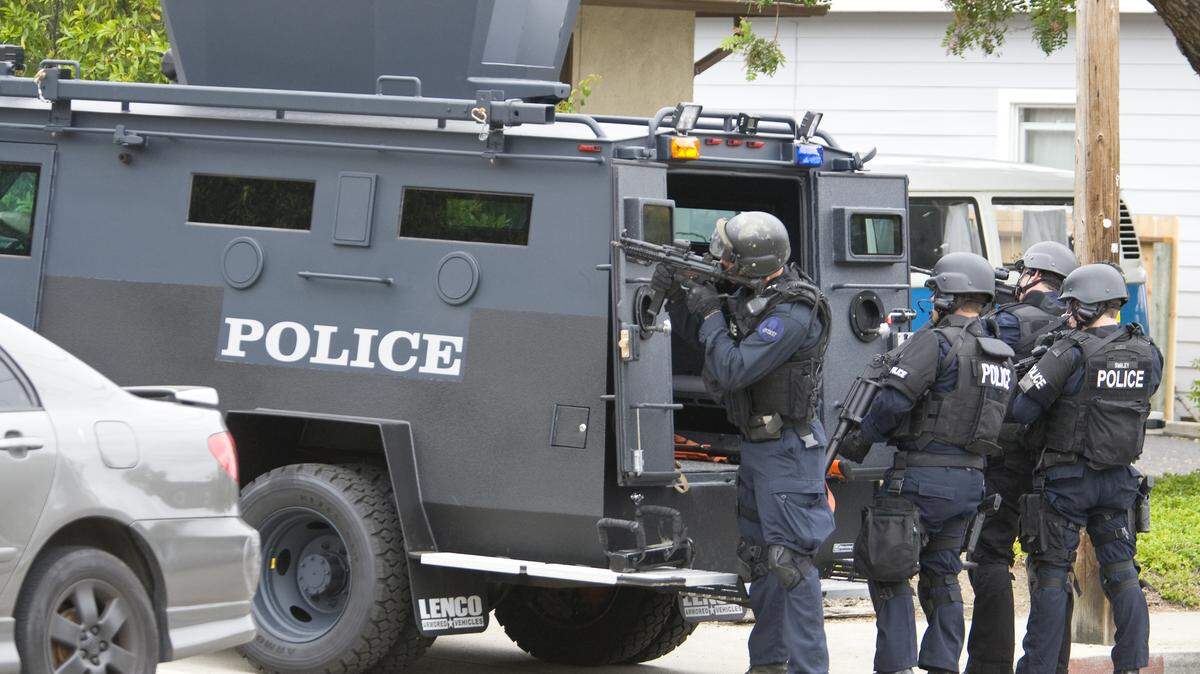
Law enforcement agencies in San Luis Obispo County are among thousands nationwide that have taken advantage of surplus equipment programs to add military-grade weapons and gear to their inventories.
Over the past 20 years, federal and private grant assistance programs have routed a range of items including assault rifles, armored vehicles, night-vision goggles, clothing, tools and more to local agencies, which must decide what’s appropriate for their needs and how to use it.
“I believe there’s an inherently violent component to law enforcement that is a reality,” San Luis Obispo police Chief Steve Gesell said. “And without the proper tools, we fail in our ability to prepare and deal with these situations.”
Records requested by The Tribune from the county and its seven cities show departments have accepted far more clothing and surveillance items than military-grade guns and vehicles — and in some cases are even giving weapons away to agencies outside the area because they are not needed.
Nevertheless, these kinds of equipment hand-downs and images of heavily armed police officers advancing on protesters in Ferguson, Mo., last month have opened a dialogue about how small police forces acquire and deploy tactical gear more commonly associated with the battlefield than the streets of Everytown, USA.
Bang for the buck
Equipment received by local law enforcement through federal and state grants represents only a portion of their overall inventories, as procuring equipment, maintaining and replacing it are tasks routinely handled though agencies’ general budgets.
What sets the granted items apart is that they are mostly acquired free.
County agencies primarily get surplus equipment through two programs.
The 1033 Excess Property Program is administered by the Defense Logistics Agency (DLA), a division of the U.S. Department of Defense, which among other duties disposes of surplus military property and either attempts to reuse it through the federal government or donate it to state and local governments.
According to the DLA website, the agency has put more than $2.2 billion worth of property back to use in the past four years.
Since its creation following the terrorist attacks of Sept. 11, 2001, the Department of Homeland Security has also provided equipment and money for a variety of purposes, including law enforcement. San Luis Obispo County has received more than $5.6 million from the DHS grant program that between 2004 and the fiscal year ended June 30, 2013.
The DHS grant program is administered through the county Office of Emergency Services, which tries to identify uses that will benefit the county’s overall preparedness as opposed to simply benefiting law enforcement, said Vince Morici, the county’s emergency services coordinator.
The big recipients
Of local agencies, the San Luis Obispo Police Department and the San Luis Obispo County Sheriff’s Office received the most equipment from grant programs.
As the lead agency in the county’s Regional SWAT Team, SLOPD has received the highest number of assault rifles of any agency since 2003 — 14 AR-15s and M-16s — nearly 200 rifle scopes, 559 sets of nightvision goggles and infrared image intensifiers and transmitters, hundreds of jackets, vests and backpacks.
A Lenco BearCat, a $174,933 armored personnel carrier larger than a Humvee yet smaller than a Mine-Resistant Ambush-Protected vehicle (MRAP), was also awarded to the department for the SWAT Team in 2011. Gesell said he understands the intimidation factor involved with armored vehicles and said he and his staff weighed different options when deciding which vehicle to request.
“I had to judge the climate in San Luis Obispo,” Gesell said. “I wasn’t going to take a Humvee, and I didn’t think we needed an MRAP.”
The vehicle is used during all SWAT operations and allows for officers to safely approach a targeted area, Gesell said.
The department also has received equipment from the Department of Justice’s Edward Byrne Memorial Justice Assistance Grant since 2003, including some of the AR-15 rifles, scanners, Tasers, audio/video recording devices, computer monitors, a rewiring of an interview room, and funding for overtime for neighborhood and downtown foot patrols.
The Sheriff’s Office did not receive any firearms from the 1033 program, but it did receive two Humvees; more than 400 rifle accessories such as parts, scopes and magazines; more than 100 night-vision goggles and infrared transmitters and receivers; 18 binoculars; 25 bayonet knives; a long-range acoustic public-address system, tires for the Humvees and other miscellaneous items.
Between 2003 and 2013, the vast majority of the Sheriff’s Office federal law enforcement funding came from the Department of Homeland Security. Among the most notable items: the BearCat, four trucks, four ATVs, a pontoon boat, a Rogue Patrol boat, two mobile command trailers, eight pepperball launchers, three tactical Tango rifles, a.50-caliber sniper rifle, license plate readers and Tasers.
The county Bomb Task Force, run by the Sheriff’s Office, also secured through the Department of Homeland Security a $287,000 Total Containment Vessel, a unit designed to safely contain certain conventional explosives; $47,000 in upgrades to the county’s remote control bomb robots; and $6,500 for a Segway personal transporter to carry fully suited bomb technicians.
The program also funded $445,000 for dispatch upgrades, $164,000 for reverse-911 notification system and upgrades, $150,000 for a surround-sound video shooting simulator, and $29,898 for portable Diablo Canyon security cameras.
In April, the Sheriff’s Office also accepted $493,013 from the Operation Stonegarden Program, which is administered by the California Governor’s Office of Emergency Services. The grant included $342,813 for a 27-foot-long Defender Class response boat to tow drug-smuggling skiffs known as pangas off the shore when they land on the county’s coastline.
The rest of the Stonegarden grant paid for a thermal-imaging camera, mobile license plate readers, sensor kits and night vision goggles for the Sheriff’s Office.
Other local recipients
The Arroyo Grande Police Department was the third-largest recipient of federal surplus, including two Humvees in 2010 and a Ford F800 truck in 2012, according to its inventory. It also received four night-vision and infrared goggles, which were deemed inoperable and returned, a number of jackets, safety glasses and backpacks, as well as public works items such as a leaf blower and a five-bench set of mobile bleachers for special events.
Three local police departments — Grover Beach, Pismo Beach and Paso Robles — have transferred to other agencies assault rifles they received through the 1033 Program. Grover Beach recently transferred four unneeded M-16s it received in 2003 to an agency outside the county, according to police Chief Jim Copsey.
The Pismo Beach Police Department transferred four M-16 rifles to the San Luis Obispo Police Department for the Regional SWAT Team in December 2013, and the Paso Robles Police Department transferred its five federally obtained assault rifles to the Hercules Police Department in August.
Pismo Beach received two night-vision goggles in 2003 and one military-grade Humvee from the Santa Maria Police Department in December 2013. That vehicle has yet to be placed in service.
According to city records, the Atascadero Police Department received just one set of night-vision goggles from a federal grant in May 1998.
The Morro Bay Police Department is the only local department to not receive any law enforcement equipment through federal programs.
Some are alarmed
The events in Ferguson, Mo. — where an unarmed black teenager was killed by a police officer sparking weeks of unrest and a heavily armed police response — has focused attention on militarized law enforcement action. But the hand-down of equipment from the military to police had already begun to raise red flags.
In June, the American Civil Liberties Union released a report, “War Comes Home: The Excessive Militarization of American Policing,” which found that more local agencies were taking advantage of surplus military-grade equipment and deploying it for operations that would historically be considered low-risk.
Among the findings of the two-year investigation was that the majority — 62 percent — of deployments of military-grade equipment by the local police forces surveyed were for drug-related search warrants and inordinately targeted ethnic minorities.
The report highlighted a May 2014 incident in Wisconsin where SWAT officers executing a “no knock” search warrant at the home of someone suspected of making a $50 drug sale threw a flash-bang grenade through a window, burning and critically injuring a 19-month-old child. The boy survived and no drugs were found or arrests made, according to the report.
Similar stories fill the report, which concluded that the use of wartime tools during police operations actually increases the risk of a violent outcome.
Peter Bibring, director of police practices and senior staff attorney for the ACLU, said the report doesn’t conclude that there aren’t practical uses for some of the equipment at the local level, but that there should be clearer policies in place defining how and when they can be used — “so that a Humvee obtained for search and rescues is not used for protests or search warrants.”
“The problem with these programs is one of mission creep — once you have a hammer, everything starts to look like a nail,” Bibring said Monday.
The police perspective
Local law enforcement officials, however, disagree.
San Luis Obispo Chief Gesell said that even drug searches have the potential to put officers in great danger.
Gesell pointed to a March 2014 incident in Pismo Beach where a man barricaded himself inside his parents’ home and fired upon officers outside. Earlier that day, members of the SWAT Team held their first training session with the department’s new Lenco BearCat.
With the vehicle, officers were able to approach the home, and through the vehicle’s PA system, successfully persuaded the suspect to surrender. No one was hurt in the incident.
Gesell said he understands public concern over programs like 1033, but in reality, patrol officers have long carried tactical rifles bought with general funding.
“We’re not in the business of being outgunned,” Gesell said. “The irony is, when there’s chaos, the public depends on us to take care of it.”
Tactical equipment, whether paid for out of the general fund or provided free from the federal government, have become a necessary part of modern policing, Undersheriff Tim Olivas added.
“We’re a paramilitary organization. We are, by our very structure,” he said of the Sheriff’s Office. “Does that mean we’re military? Well, no. We’re tasked with providing for the safety of our community, and if we don’t provide for the safety of our deputies, we can’t provide it for the community.”
County Supervisor Adam Hill, whose district includes Diablo Canyon nuclear power plant, said the board tends to review requests for grant equipment from a budgetary standpoint and will typically defer to the sheriff’s expertise on his department’s needs.
“It’s rare that we’ll turn something down unless there are strings attached,” Hill said.
Public perception
Despite one’s feelings toward donated surplus to local police, images such as those from Ferguson have put a sour taste in the public’s mouth, said Allen Settle, a political science professor at Cal Poly and former San Luis Obispo mayor and City Council member.
“Things of that nature in this day of social media really erode public trust in police. Luckily, we haven’t seen that on the Central Coast. But then again, we don’t have near the racial split and embedded distrust of police that Ferguson does,” Settle said.
Following Ferguson, President Barack Obama ordered a U.S. Department of Justice review of programs that provide equipment to local law enforcement, including the 1033 Program, the Associated Press reported Aug. 18. Congress held its first hearing on the issue Tuesday.
But what that review will entail or when it will be complete remains unclear, as does whether groups such as the ACLU will play a role.
“We’re encouraged by the level of public dialog over these programs and the attention brought to this problem since Ferguson. But at the end of the day it’s also a problem that in part belongs to local jurisdictions to resolve,” Bibring said.
He added that the issue ultimately rests with residents deciding whether the equipment is consistent with a community’s values and how they want their neighborhood policed.
“And (residents) can’t make those decisions if they don’t know what’s going on,” he said.
This story was originally published September 10, 2014 at 4:59 AM with the headline "SLO County police departments have surplus military gear in their inventories."