
Plan to fix up old SLO cistern would benefit steelhead trout
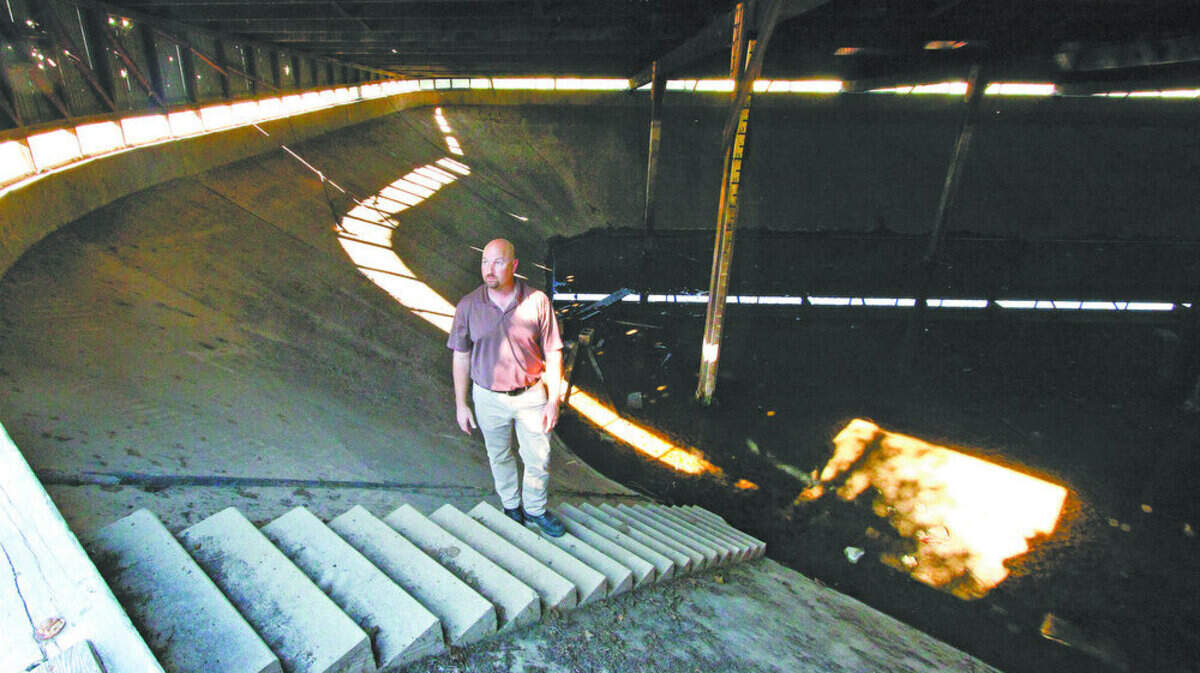
Just northeast of San Luis Obispo sits a rusting relic of the city’s past — a huge cistern that was once a vital component in the city’s water system.
City biologist Freddy Otte has a plan in the works to refurbish the dilapidated structure. But, instead of providing drinking water, the cistern would benefit threatened steelhead trout in nearby San Luis Obispo Creek.
“This project is all about taking an unused existing structure and repurposing it into a beneficial use,” Otte said. “It’s another way to help the fish.”
The cavernous structure is an underground concrete-lined reservoir covered by a corrugated metal roof. It is located off Fox Hollow Road just south of the city’s Reservoir Canyon open space.
Otte estimates the cistern could hold as much as 2 million gallons of water. This water would be used to prolong stream flows in San Luis Obispo Creek during summer months to benefit a number of aquatic species, most notably steelhead.
The cistern would be the latest in a long series of restoration projects that are returning steelhead to their historic place in San Luis Obispo Creek’s ecosystem. By the 1960s steelhead had been eliminated from the creek, but now they spawn as far upstream as the foot of the Cuesta Grade at Stagecoach Road.
As Otte envisions it, the bottom of the cistern would be lined with plastic. The metal roof — conveniently slanted — would be repaired and equipped with a water collection system to catch whatever rain falls on it. Panels could be added to the roof to increase its surface area to catch more water.
According to Otte’s calculations, if two and a half inches of rain were to fall on the roof, a little over 44,000 gallons would be captured. With the panels, the amount of water would grow to 55,000 gallons.
A pipe would connect the cistern to San Luis Obispo Creek, which sits just 40 feet away. Water from the cistern could be gradually released to keep the stream flowing at crucial times, such as when steelhead are spawning or when their juveniles are ready to migrate downstream.
How much water would be released and how quickly will vary from year to year depending on how much rain falls in a given year, Otte said. Wet years may require no releases, while dry years could require all 2 million gallons.
Two million gallons is not a huge amount of water for stream flows but could be enough to benefit steelhead during the late summer months when water in the stream is at its lowest, said Matt McGoogan, a fisheries biologist with the National Marine Fisheries Service.
“Adding a little flow to the creek sometimes is all it takes to maintain surface flow and maintain pool depth,” McGoogan said. “These pools are where steelhead would be hanging out and over-summering.”
The project is still in the planning phase, and Otte does not know exactly how much the project would cost and when work could begin. Meredith Hardy, a fish habitat specialist with the California Conservation Corps, estimates the work could be done for $100,000 or less.
Otte wants to get those details worked out as soon as possible in order to be ready to apply for state and federal grants to help defray the cost. Shortfalls in grant funding could be made up from the city’s natural resources and utilities department budgets, Otte said.
“I want to be shovel-ready as soon as possible so we can be ready to apply for funding when it becomes available,” he said.
The cistern project comes as the Coastal San Luis Resource Conservation District is in the middle of its three-year “Storm Rewards” program, which offers rebates of up to $999 to homeowners in San Luis Obispo, Arroyo Grande and Nipomo who design their homes to capture and use rainfall to irrigate their gardens.
The cistern project and the Storm Rewards program are all part of a growing trend to find ways to capture rainfall in drought-plagued California, said Nicole Smith, the conservation district’s conservation programs manager.
“I think that a lot of the conservation groups are talking about ways to catch the water in the winter and store it for use during the summer,” she said. “I think you are going to see a lot of projects like that on the landscape in the coming years.”
The cistern was part of a pre-World War II system that provided water to San Luis Obispo before Santa Margarita Lake and its pipeline were complete in 1941 and began meeting the city’s water needs, Otte said. Reservoirs in Reservoir Canyon and at Old Stagecoach Road were also part of the defunct system.
About the trout: Steelhead in San Luis Obispo
Steelhead are an anadromous form of rainbow trout. That means steelhead, like salmon, spend most of their lives in the ocean but spawn in freshwater rivers and streams. During historic times, San Luis Obispo Creek teemed with the large, iridescent fish.
Development and a lack of strong environmental regulations caused the population of steelhead to crash in the early- to mid-20th century. In 1966, George Nokes, a state pollution bioanalyst, toured San Luis Obispo Creek just downstream from Mission Plaza and found it to be “an open sewer.”
In a scathing report to the Central Coast Regional Water Quality Control Board, Nokes said he “counted 89 pipes, culverts and drains of various sizes which opened to San Luis Obispo Creek. We observed 10 of these pipes discharging untreated waste directly into the stream.”
In addition to massive pollution, the creek suffered from water diversions that reduced stream flows, invasive species, sedimentation and various weirs and dams in the creek that blocked steelhead and other fish from migrating upstream.
Since then, the city of San Luis Obispo, working in concert with a variety of state and federal agencies and local conservation groups, has brought the creek back to life. Otte, a fisheries biologist, said the comeback of steelhead in San Luis Obispo Creek is a remarkable success story.
A 2008 assessment put San Luis Obispo Creek’s steelhead population at 37,000 fish, most found in the lower reaches of the creek. However, some spots in the upper reaches of the creek, such as Cuesta Canyon County Park just north of San Luis Obispo, also have good spawning habitat.
Because it flows through a city and farms, San Luis Obispo Creek will never be pristine, but it can be restored to something resembling its former glory. The cistern project is the latest step in that process, Otte said.
“The stream is the most beautiful part of downtown, so keeping it clean is an absolute priority,” he said.
This story was originally published February 20, 2015 at 4:32 PM with the headline "Plan to fix up old SLO cistern would benefit steelhead trout."