
Meeting on Phillips 66 project in Nipomo draws over 200 people
As more than 200 people settled into their seats in a Nipomo conference room on Tuesday, a video of a crude oil train rolling through Auburn, Wash., started playing on a large screen.
For nearly two minutes, the crowd watched as one black railcar after another noisily passed by.
Members of the Mesa Refinery Watch Group had organized the meeting to curry opposition to a plan by Phillips 66 to install tracks so it can deliver crude oil to its Nipomo refinery by rail. The plant now receives crude by pipeline.
One by one, group members took turns detailing significant and potentially disastrous impacts that they believe the proposal could have on San Luis Obispo County.
“Approving this project would change the very fabric of our county,” Martin Akel said. “My friends, protect yourself. Take action and take it now.”
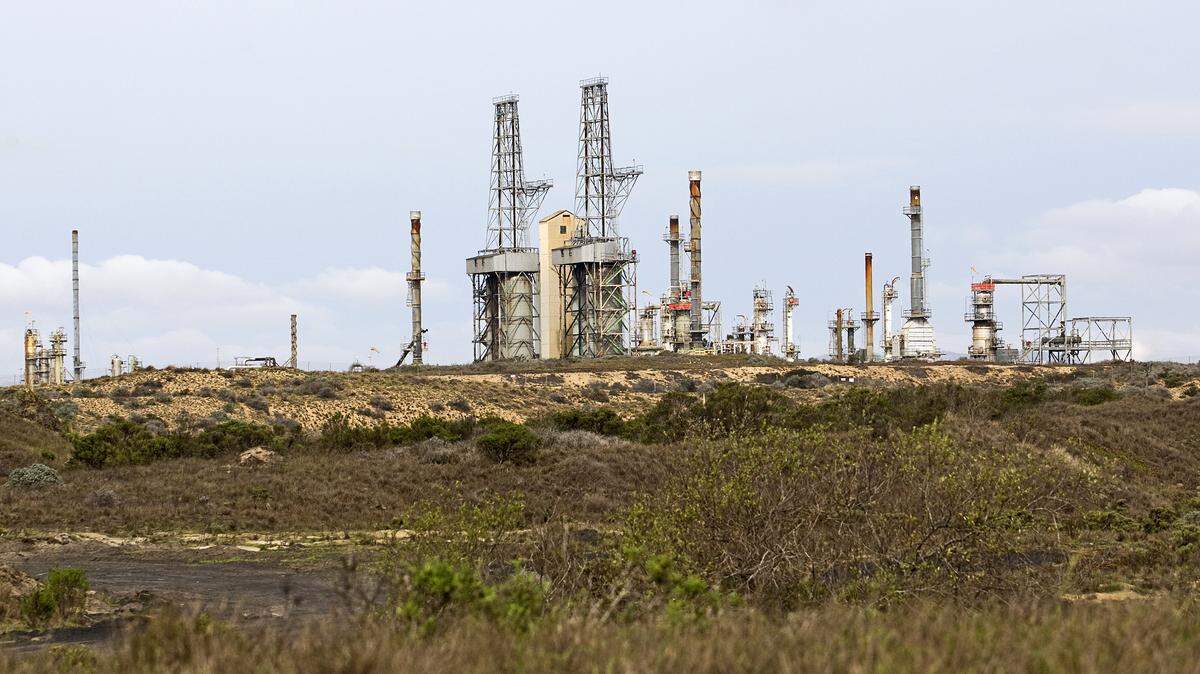
Oil company Phillips 66 has proposed adding 1.3 miles of track to an existing rail spur, including five parallel tracks, an unloading facility and on-site pipelines for trains to deliver crude oil to its Nipomo refinery for processing.
Phillips 66 anticipates unloading up to five trains a week with about 80 tank cars each, with a maximum of about 250 trains arriving each year.
Crude oil would be transferred from the new unloading facility to existing storage tanks via a new on-site, above-ground pipeline. Each train is expected to be at the refinery between 10 and 12 hours.
No crude oil or refined product would be transported out of the refinery by rail.
With comments due Nov. 24 on a revised environmental impact report on the project and a county Planning Commission meeting set for Jan. 29, Mesa Refinery Watch Group members are trying to drum up as much public opposition to the project as possible.
No county planning officials or Phillips 66 representatives spoke during the presentations. A Phillips 66 spokesman said Wednesday that the company plans to submit comments on the revised EIR.
Wednesday’s gathering at Trilogy at Monarch Dunes was advertised as a citizens’ action meeting for people to learn how they can help “derail the rail project.”
And judging by the large crowd and enthusiastic response for the speakers, many attendees agreed with concerns about possible air quality, noise and odor impacts, as well as the potential for rail accidents that could cause oil spills, fires or explosions — not just in Nipomo, but anywhere along the Union Pacific mainline.
“How can anyone be in favor of this?” said Janet Pelkey, who came to the meeting with her husband, Jim, to learn more about the project.
What's at stake
Opponents believe that Phillips 66 is trying to dramatically transform its business model locally by creating a new, high-intensity operation to generate higher profits by bringing in lower-cost crude oil for processing.
“We have nothing against higher profits except when they cost us our way of life,” Akel said.
But Phillips 66 officials maintain oil production in California is dropping, and bringing in crude oil by rail from a wider range of sources would allow them to offset any reduction in deliveries from its current suppliers.
“Phillips 66 is working to ensure the long-term viability of the Santa Maria Refinery and the many jobs it provides,” company spokesman Dennis Nuss wrote in an email Wednesday. “Protecting our people, our environment, and our communities guides everything we do and those values will be applied to this project as well.”
Phillips 66 is now looking for alternate sources outside California for reliable supplies of competitively priced crude oil, he wrote.
“However, there are no pipelines that connect the refinery to these alternate sources of crude oil, and the refinery does not have a marine offloading facility,” Nuss added. “The solution is to utilize and enhance our existing rail facility to enable rail delivery of crude oil.”
Nuss said the process used to refine the crude oil will not change, nor will the project generate an increase in production.
Opponents said the oil-by-rail proposal would bring a more intense activity to the refinery than the “benign activity of delivery of crude by pipeline,” group member Tom Ryan said.
“In its place it (Phillips 66) would put intense operations that increase the health risks to citizens along with noise, light, visual and other outcomes,” Ryan said.
Opponents said that diesel exhaust fumes from the locomotives would exacerbate air quality issues on the Nipomo Mesa, which violates state standards an average of 65 days per year because of high particulate levels.
Safety concerns
One of the main points of the opponents’ presentation Tuesday centered on safety and the risk of an oil spill, explosion or derailment that could damage county residents’ quality of life.
Currently, no more than six freight trains and six passenger trains pass through San Luis Obispo County each day on the Union Pacific's Coast line.
Freight trains already carry crude oil as well as lumber, vehicles and hazardous materials, according to the environmental report.
A crude oil train traverses the county as it moves from San Ardo to Los Angeles two to three times a week. It has been in operation about 20 years.
But, Mesa Refinery Watch member John Anderson said, “More trains equal more risk.”
Trains could enter California at five locations and, depending on the route, would arrive at the Phillips 66 refinery either from the north or from the south, according to the revised environmental impact report.
Trains coming from Northern California would generally pass through the Union Pacific rail yard in Roseville, near Sacramento; while trains traveling from Southern California would likely pass through the Colton rail yard in San Bernardino County.
A hazards analysis estimated the average incident rate of a release of 100 gallons or more of oil from a train traveling between the Phillips 66 refinery and rail yards in Roseville or Colton would be once every 46 years to 76 years, depending on the route.
The probability of an oil release anywhere along the rail line in California would be greater — estimated at once every 19 years to 31 years.
Project opponents urged residents to pressure county planning commissioners to adopt a “no project” alternative, where crude oil shipments would continue to be delivered to the refinery by pipeline.
The South County Advisory Council, which advises county planners and supervisors on projects, recently discussed the project as well and sent comments to county officials.
“This project provides more disadvantages to the community in terms of adverse health issues than advantages such as added jobs,” Richard Wright, the public safety representative on the council, wrote in his comments.
This story was originally published November 12, 2014 at 6:35 PM with the headline "Meeting on Phillips 66 project in Nipomo draws over 200 people."