
Future State Parks rangers train at Camp San Luis Obispo
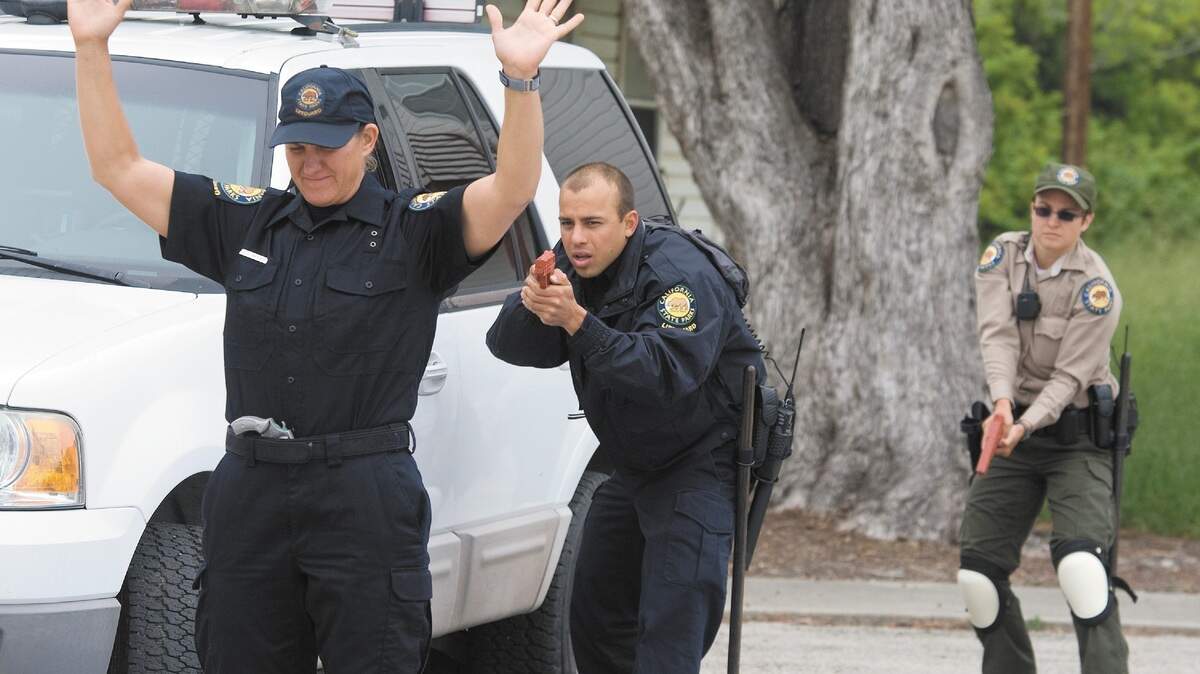
With weapon drawn, the cadet ordered the suspect to come out of the building with her hands up. The suspect had a gun in her waistband, and the cadet directed her to lie on the ground before he searched, cuffed and disarmed her.
The procedure was a training exercise at Camp San Luis Obispo, and the guns were all plastic replicas. But for 30 State Parks ranger cadets, that scenario could soon be a real life-or-death emergency.
Starting this year, Camp San Luis Obispo is the official law enforcement training center for the State Parks Department’s Ranger Academy. The camp’s first class of cadets will graduate June 7 after six months of rigorous training in all aspects of law enforcement.
The new rangers will be sent to park facilities throughout the state, where they will protect public safety as well as California’s diverse natural and cultural resources. More than 270 state park facilities stretch from the snows of the Sierra to the teeming beaches of Southern California and encompass nearly 1.4 million acres and almost one-third of the state’s coastline.
“They are going to have rich and varied careers,” said Juventino Ortiz, the academy’s coordinator. “We also want those careers to be safe and enjoyable.”
This variety was one of the reasons Cadet Leigh Collins, 24, of Grass Valley wanted to become a ranger. Both of her parents were rangers who taught her hiking, camping and backpacking.
“I grew up around state parks,” she said. “I like the fact that no two days are the same and that there’s the potential for a lot of excitement.”
Of this year’s class of 30 cadets, eight are lifeguards who receive the same training as rangers. Lifeguards help keep park visitors safe along more than 280 miles of coastline and 625 miles of lake and river frontage.
“I’ve got the best of both worlds,” said Cadet Eric Steele of La Habra, who worked as a seasonal lifeguard before joining the academy as a lifeguard cadet.
Both cadets said the hardest part of the academy is balancing their personal lives with the rigors of training. In the first week of training, cadets are put under a lot of stress and are forced to go with little sleep.
“It’s totally different to experience it yourself rather than hear about it from someone else,” Collins said.
The requirements for park ranger recruits include having a minimum of 60 units of college courses and being at least 21 years of age. Most are young and looking to make a career in State Parks. The average age of cadets in this year’s class is 28.7, Ortiz said.Each cadet class selects its own motto. This year’s motto is “Trusted to Serve — Honored to Protect.”
New roles for rangers
Ortiz is a 30-year veteran of the State Parks Department, with most of it spent on the Central Coast. He has witnessed the evolution of rangers over the years.
Gone are the days when rangers could confine their activities to leading nature walks and giving campfire talks. California parks get 85 million visitors each year, and they do not leave their problems at home.
Rangers also typically work alone in remote areas, where backup can be an hour or more away.
Like all rangers, Ortiz has dealt with a wide range of law enforcement situations, including traffic accidents, domestic violence and drug and alcohol abuse. For this reason, all rangers are qualified under the state’s Commission on Peace Officers Standards and Training.
Cadets must hone their skills in what trainers call critical incidents. These include making felony car stops, searching buildings, arresting combative suspects and responding to terrorist attacks. Cadets must even learn how to subdue a suspect after having been hit with pepper spray.
“Five months ago, they had no idea how to do any of that,” Ortiz said.
The need for such rigorous training was vividly demonstrated in 2001, when a ranger used a shotgun to subdue a suspect who had killed two campers at Morro Strand State Beach. Soon thereafter, rangers added AR-15 assault rifles to their arsenal of weapons.
This need for six months of law enforcement training is one of the reasons the ranger academy was transferred to Camp San Luis Obispo. Previously, the academy had been at the Asilomar Conference Grounds near Pacific Grove.
The department had been eyeing Camp San Luis Obispo as a new home for the academy for nearly five years. In one central location, the post has all the facilities the department needs, including barracks, dining halls, firing ranges and training courses.
“There are a lot of logistical benefits to having the academy here, which should save us some money,” Ortiz said. “Training is what they do here at Camp SLO.”
Like all state agencies, State Parks has its problems, mostly budgetary. Seventy park units, including Morro Strand State Beach, are earmarked for closure unless local groups step forward to run them.
The state’s budget crisis also means there is less money for the ranger force. The department has 725 ranger and lifeguard positions, but only 505 of them are filled because of budget constraints.
This story was originally published May 5, 2012 at 11:03 PM with the headline "Future State Parks rangers train at Camp San Luis Obispo."