
What’s to know about Central Coast elephant seals this summer
.JPG "This female has several cookie cutter shark scars that started her molt. Cookie cutter sharks are small sharks, 18 inches or so, that bite into the blubber, twirl around to take a plug, and leave behind that distinctive circular scar. A good blubber meal, but not a threat to the seal.")
Lots of females and young seals remain on the beach, but a few young bulls have shown up. The older bulls will follow, and males will dominate the beach for the summer.
The bulls are returning to molt their skin, as the females and juveniles are finishing their molt.
The process is the same: the old brown skin peels off, starting around the eyes and ears, old scars, and other body orifices. Then the belly and sides and back peel off.
It takes an average of 32 days. Seals arrive and leave on their own, individual schedules, so they are always arriving and leaving.
The new skin and hair underneath is gray. The hairs are short, but soon stand up and grow longer. Look for pearly gray seals next to brown and tan seals.
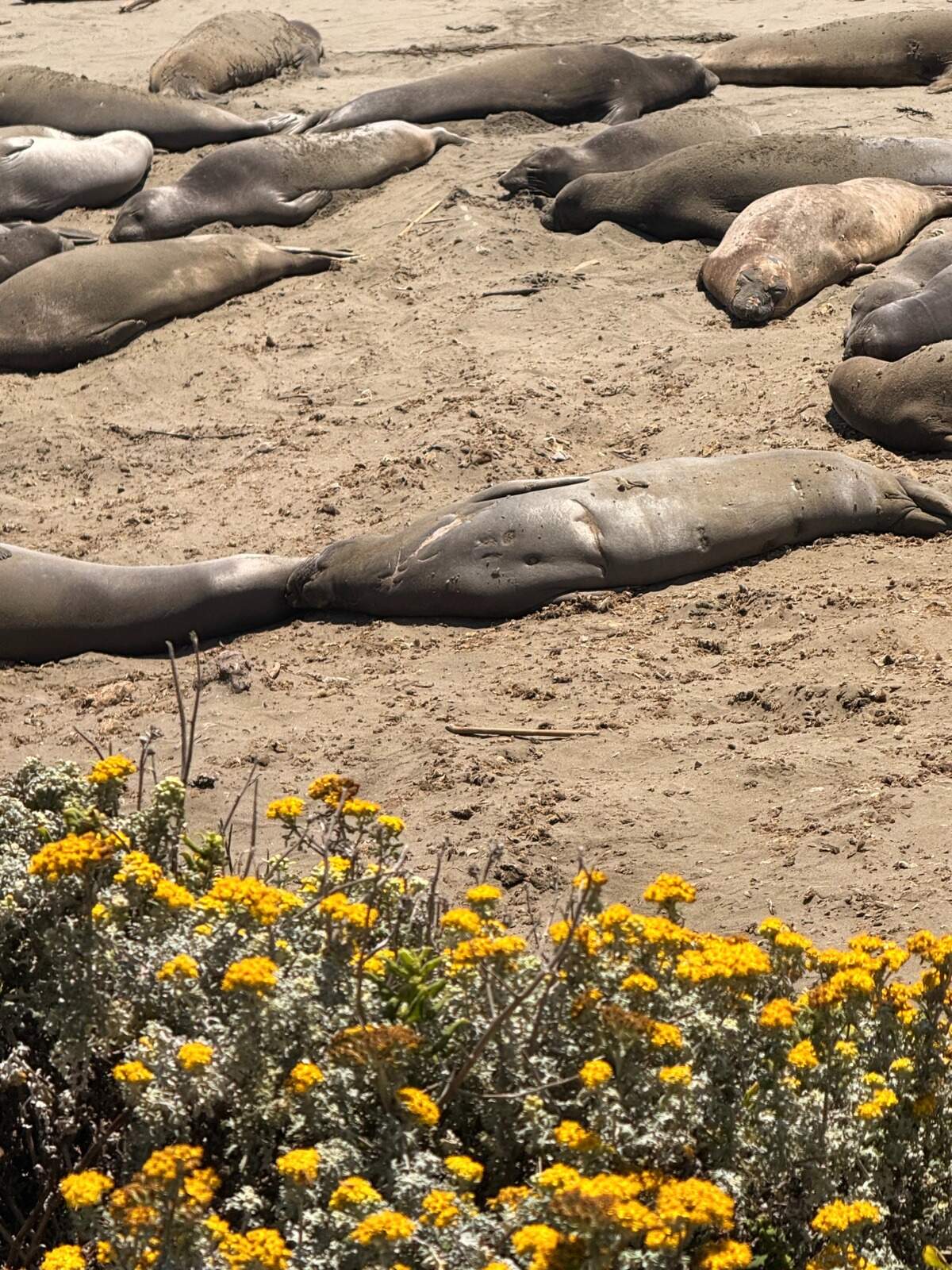
Leaving to migrate north
Juveniles and females leave the beach for their foraging grounds, along the continental shelf and out in the open ocean. The juveniles will return in the fall, for six weeks or so of rest.
The females are on their long migration. They will have around eight months to put on weight and gestate a pup. They will return in January, when they come back to give birth.
The bulls aren’t at their highest weight, but they are in good condition. Young bulls, 5 to 6 years old, not yet in the breeding population, may spar with each other. Older bulls, not so much.
Their sex organs shrink, and they stop producing sperm and sex hormones during the summer.
The beach is quieter than during the winter breeding season. They’ll all leave the beach by late September, giving them three or four months to bulk up before returning in November and December for the breeding season.
Visitors enjoy seeing the big males. Their size, over two tons, and more than fifteen feet long, is always awe-inspiring. Their floppy noses and pink chest shields are a sight to remember when they get home.
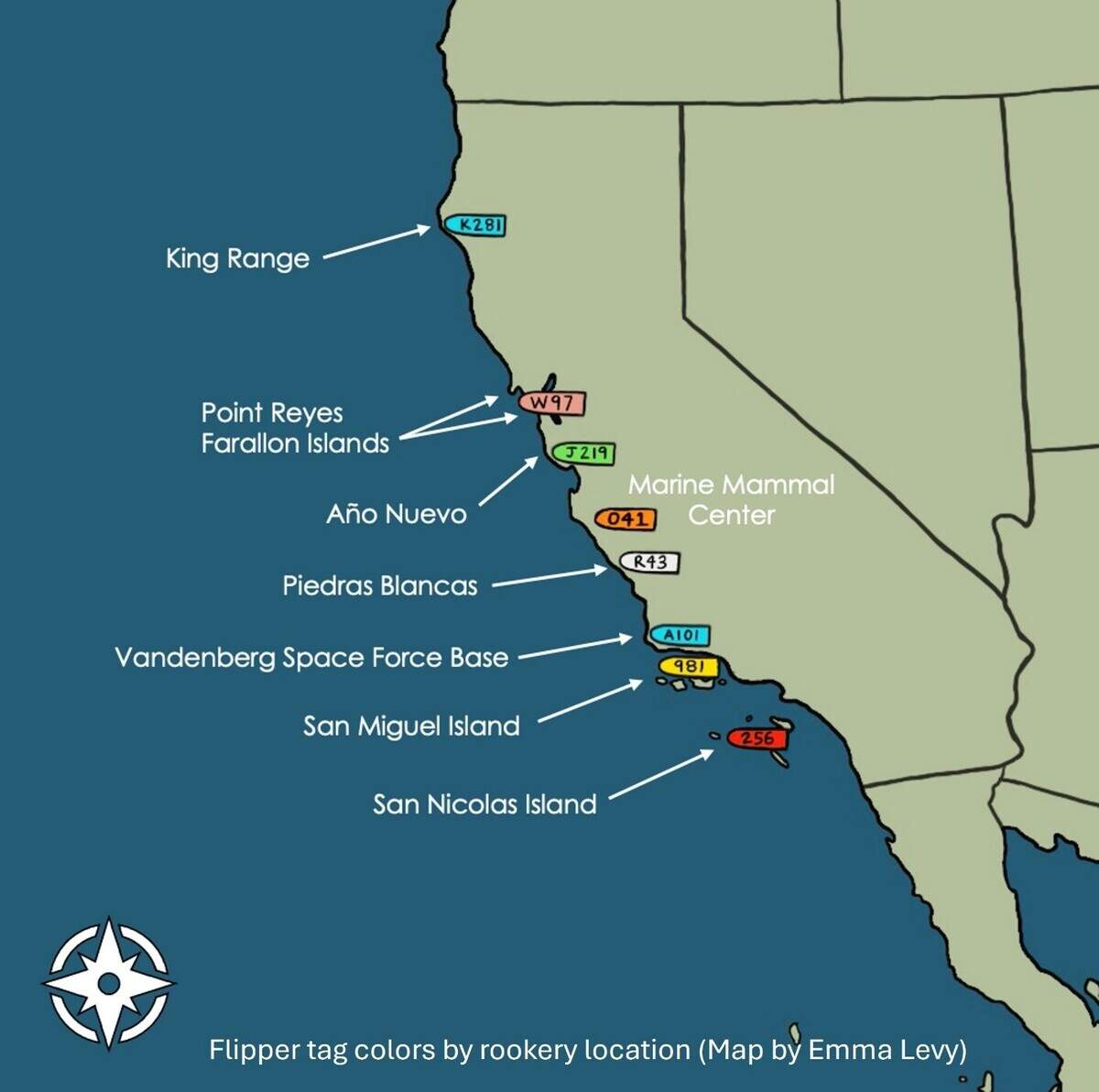
Cal Poly tagged seals
Katie Saenger, Cal Poly master’s degree student, defended her thesis to an appreciative audience at Cal Poly’s Fisher Hall in San Luis Obispo recently.
What great weaners she tracked! Each one took a different route — in some cases, more than one migration.
Officially titled “Movement of weaned northern elephant seal pups during their first at-sea foraging migration,” she put tracking devices on a total of 25 pups over three years, 2022-24.
See their tracks here for the first five in 2022; here for the ten in 2023; and here for 2024.
Vandenberg Space Force Base paid for the study, so the first five seals were tagged there and named for Vandenberg launches. The next ten, five tagged at Vandenberg and five at San Nicolas Island, got names of local animals and plants. The third year had an astronomical theme, which included one named for Neil deGrasse Tyson.
Although most of the seals congregated in the Central Coast area, Monarch went all the way to the Aleutians and back on her first migration. I’ve written about her amazing journey.
Unfortunately, since the battery on her device died, her data was not included in the data analysis, since it counts as an “incomplete trip.”
Not to say it is insignificant! What a champ.
Aurora actually turned south, on her second migration. She was one of the seals who left on her first migration, then hauled out on the beach, and then left again. This behavior was not previously identified, so Katie and the tracking devices revealed that weaners may take two or, in one case, a third migration.
The seals swim back to places where they found plenty of fish to forage on. They are learning about their ocean home, and how to survive in it.
Fox circled the Channel Islands. Frog spent some time in San Francisco Bay.
All these seals now have flipper tags to identify them in future, blue for Vandenberg and red for San Nicolas. Other colors signify other rookery locations.
I’d love to know what becomes of Monarch. Will she become a supermom? Will Aurora explore Mexico and focus her beach life there? What’s in store for Seal deGrasse Tyson?
Katie said that following these seals through their lives is her dream study.
Because the seals molt their skin every year, there’s no way to mark them permanently, except for the small blue flipper tags, or place permanent tracking devices on them.
.JPG "TMMC release Laurie Miller IMG_0360 (3).JPG")
TMMC releases rehabbed elephant seal pups
The Marine Mammal Center recently released two rehabbed elephant seal pups at Leffingwell Landing in Cambria, Rocky and Carnation.
As seals that have been rescued and rehabilitated, they have orange flipper tags.
The event emphasized TMMC’s work to interconnect marine mammal care, humans, animal populations and the ocean. The problems of individual marine patients draw a direct line to global marine health and human wellbeing.
“Our work is aligned with One Health, a collaborative approach to global wellbeing that recognizes the interconnections among people, animals, plants and their shared environment,” the center said in a prepared statement.
Inviting the public to see rehabilitated seal patients released back to the ocean advances the center’s mission by engaging public support and encouraging donations.
“Threats to our ocean cannot be addressed by simply rescuing more animals. We cannot return healthy animals to a sick ocean and expect them to thrive,” the statement said.
Federal funding to support marine mammal research has been cut. Proposed legal changes, such as to the Marine Mammal Protection Act, would reduce protection and the government’s ability to defend marine mammals. The deep-water ocean monitoring system that has provided information about ocean health, climate, fisheries and coastal flooding for ten years is being dismantled.
The center seeks support to “strengthen its capacity as marine mammal first responders, train more wildlife health professionals from around the world, and engage more children and adults as ocean stewards.”
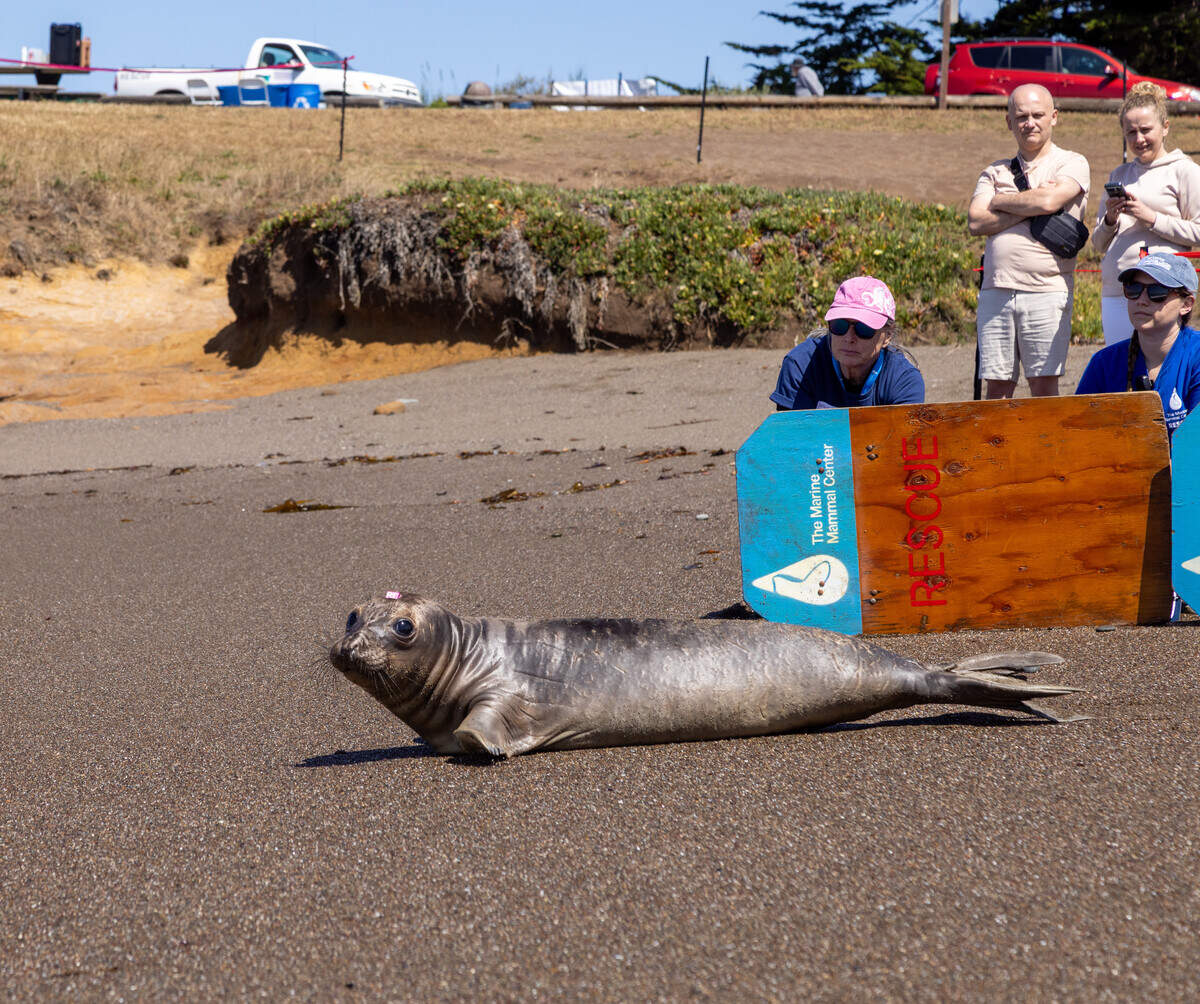
Rocky and Carnation take different paths
Sea lions always rush for the surf. Elephant seals, not so much.
Carnation took his time, but once a wave splashed over him, he was off.
Rocky wasn’t ready to go. He held back, stayed on the beach, even turned around once.
Waves washed over him, rolling him around. He didn’t seem to like that. Once in the water, he would swim free, but at the surfline, he was rolled, again. He headed for his namesake, the rocks.
Eventually, TMMC volunteers recaptured him in an animal carrier. They put him in the van and brought him to a more isolated beach, where he returned to the ocean.
Would he rejoin his companion? Would either of them care? Elephant seals are solitary when they are out at sea. What do elephant seals think?
The seals get to keep those secrets, for now. But I’m looking for those flipper tags …