SLO County fishermen catch salmon for first time in 3 years. ‘They’re having fun’
For the first time in three years, Morro Bay fisherman Mark Tognazzini sailed into the harbor this month with a catch of wild Chinook salmon.
The state reopened the commercial salmon fishery on May 1 after a three-year hiatus, and the fishermen who survived the closure readied their boats and dashed out to sea to catch their share of an icon of the Pacific coast.
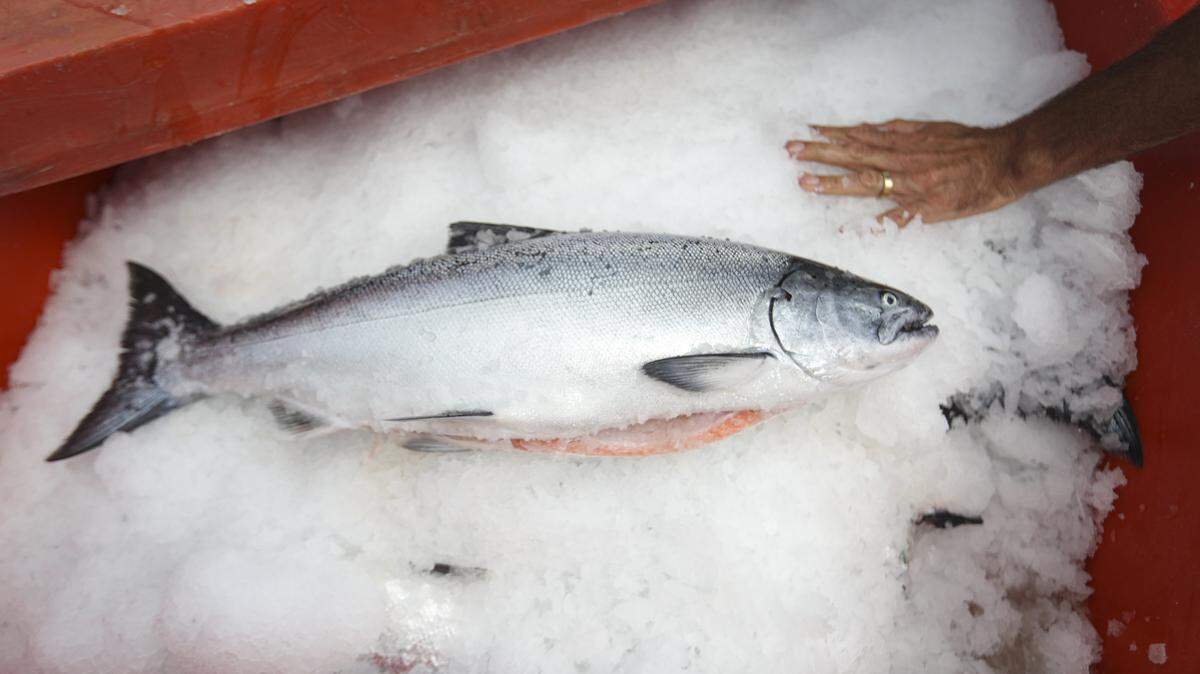
Tognazzini said he’s glad to be catching salmon again from the Bonnie Marietta, the boat he built in 1981. The silver fish glinted in the sun as he loaded them onto the dock, ready to be sold at his family’s fish market, Tognazzini’s Dockside Too.
“When it’s flat calm and the fish bite, it’s an amazing experience,” he said. “When the fish don’t bite, and it’s shitty weather, it’s a miserable job.”
From May 1 to 6, fishermen across the state caught about 16,975 salmon, according to the California Department of Fish and Wildlife.
After a two-day break to allow the California Department of Fish and Wildlife to tally the number of salmon caught, the fishermen launched for another five days of fishing on May 9.
The state will allow cycles of five to seven days of fishing with two-day breaks in between until Sept. 2 or until the fleet meets the statewide catch limit of 83,000 salmon.
The limit is generally lower than the amount of fish caught each year since the 1970s, according to data in the Pacific Fishery Management Council’s Review of Ocean Salmon Fisheries.
During the fishery’s peak of 1988, fishermen caught 1.3 million salmon off the coast of California. Prior to that, the catch ranged from about 500,000 fish to 870,000 fish per year, the data said.
Then, the catch started to decline. During the 1990s, California salmon fishermen caught between about 160,000 fish and about 680,000 fish annually. The 2000s were more difficult, as the catch didn’t rise above 480,000 fish. The state temporarily closed the fishery in 2008 and 2009.
Starting in 2016, the statewide catch ranged between 42,326 fish and 271,489 fish per year, the data said.
This season, fishermen can harvest 160 salmon per vessel per week, and the fish must be at least 27 inches long. Also known as king salmon, these fish are the largest salmon in the Pacific Ocean.
People can fish from Point Arena in Mendocino County down to the state’s southern border, but it’s unusual to find good salmon fishing south of Santa Barbara.
Fisherman glad to be out catching salmon again
On May 5, waves lapped against the dock on a clear day without much wind — ideal conditions for fishing — as Garret Rose loaded orange tubs of salmon into a truck to sell in Los Angeles.
Besides Rose and a handful of tourists, the dock was quiet — as the fleet was out fishing. About 40 boats fish out of San Luis Obispo County from the ports in Morro Bay and Avila Beach, he said.
Rose’s family owns and operates the Morro Bay Seafood Company on the Embarcadero. The company buys and sells locally caught salmon along with other seafood.
After a few days on the water, the fleet finally found salmon to fish, Rose said.
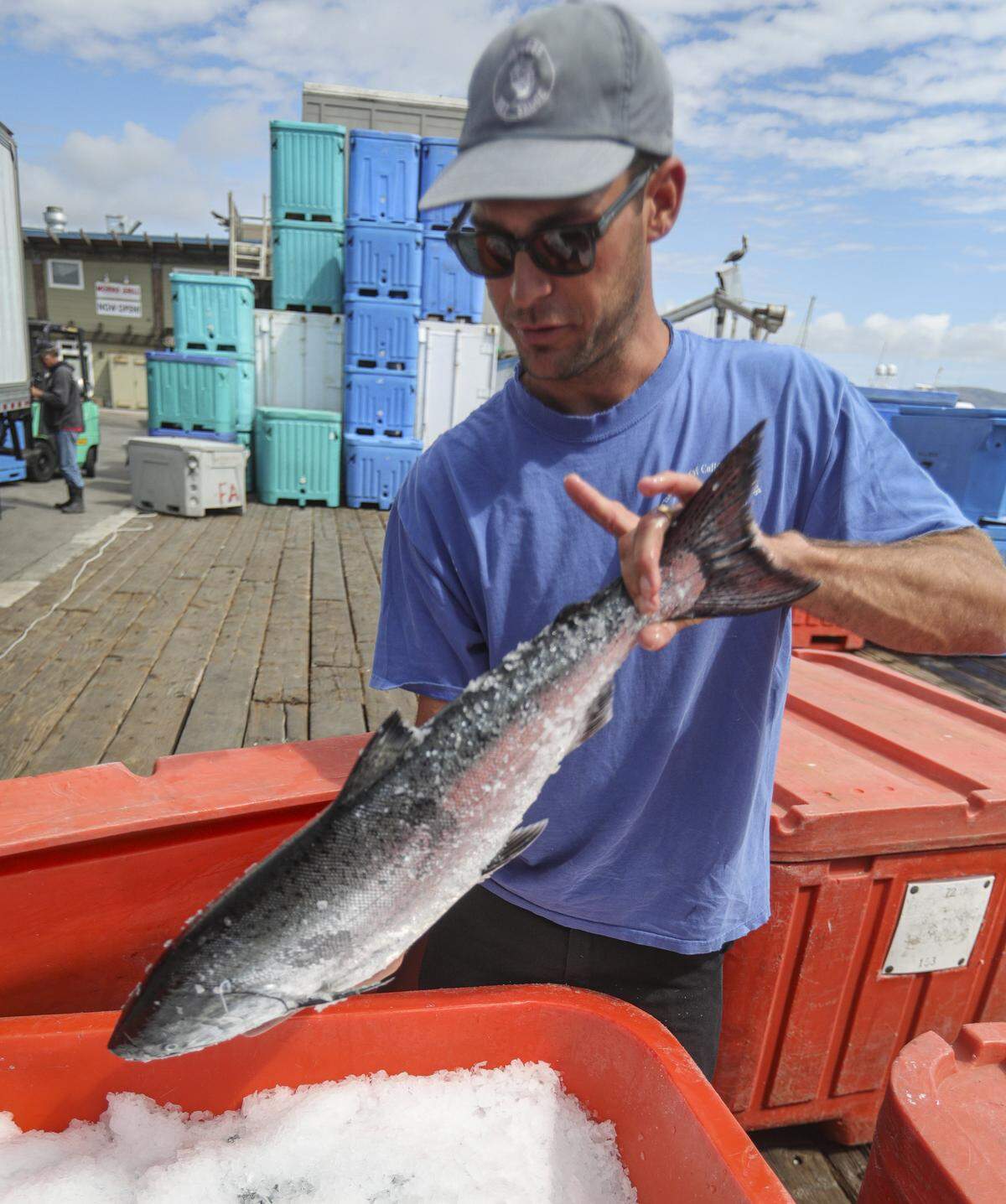
“It took them awhile to locate a body of fish,” he said. “I think there’s a very large biomass of king salmon in the ocean. Now, where they are, I can’t say. I wish I knew. I wish I knew right where they were all the time — because then it would be called catching, not fishing.”
This time last year, the seafood company focused on marketing ground fish like rock cod and crab in the absence of salmon. While he’s still selling cod and crab, Rose said he’s glad to be selling salmon again — and the rest of the fleet is, too.
“Guys that were sitting idle this time last year with not much to do are fishing salmon,” he said. “They’re laughing about it. They’re having fun.”
The three-year closure was hard on fishermen, though, and forced some people out of the industry.
“We have concerns about the way California manages this fishery,” Rose said. “We just saw three full-season closures. That’s unprecedented.”
Salmon fishery closed for three years
The Pacific Fishery Management Council first closed the commercial salmon fishing season three years ago because the Chinook salmon population was too small to be fished sustainably, according to environmental scientist Kandice Morgenstern, who is the ocean salmon project supervisor for the California Department of Fish and Wildlife.
Dams, water diversions and the degradation of water quality in streams and rivers contributed to the decline of the salmon population, according to an article in the North American Journal of Fisheries Management.
Then, a severe drought from 2020 to 2022 further harmed the population, Morgenstern said. Chinook salmon are particularly vulnerable to drought because adult salmon need cool, fresh, flowing water in rivers and streams to reproduce, and juvenile salmon need similar conditions to survive and migrate to sea, she said.
Luckily, the salmon population started to increase in 2023 and 2024 after strong rain seasons, and in 2024 when four hydroelectric dams were removed from the Klamath River in Northern California.
But it’s hard to pinpoint an exact cause for the improvement in the salmon’s population size, Morgenstern said.
“It’s not any one thing that causes salmon decline, and it’s not any one thing that causes the rebound of salmon either,” she said.
By April 2026, scientists estimated that the Sacramento River fall-run Chinook population would be 400,000 fish, and the Klamath River fall-run forecast was 176,000 fish, according to the California Ocean Protection Council.
This was finally a large enough population to accommodate commercial fishing.
Salmon fishermen are back in business
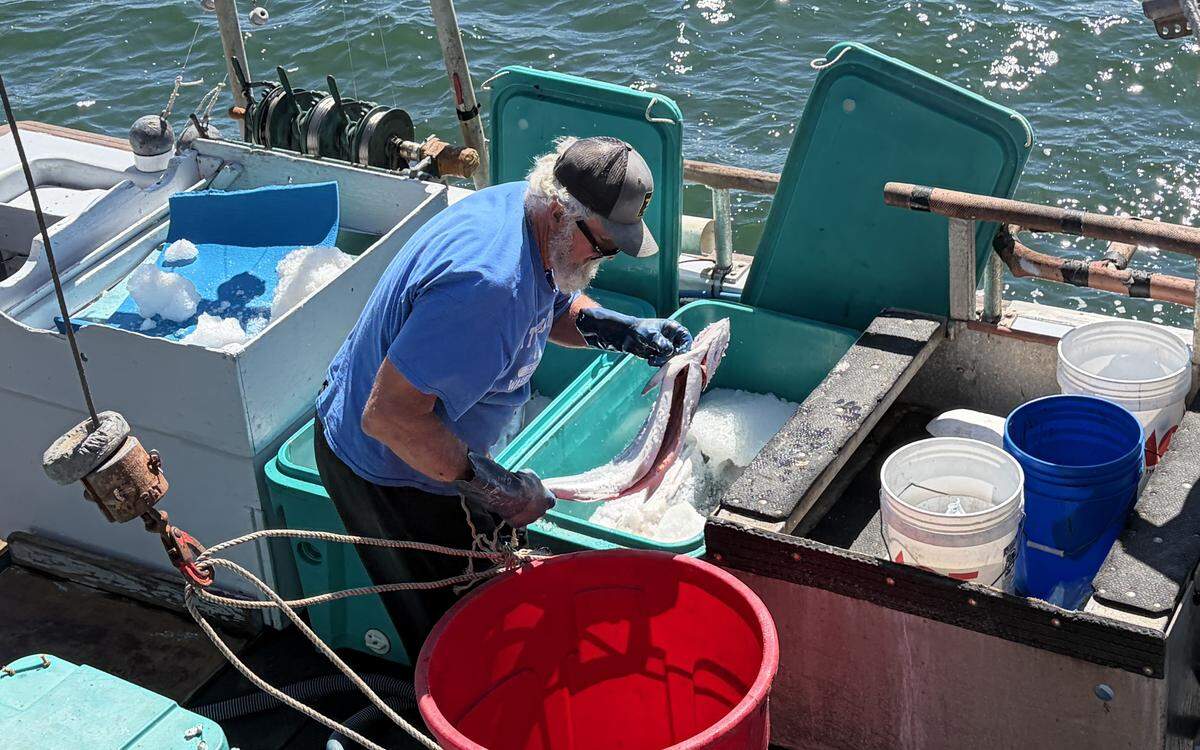
On May 6, Jeff French loaded his catch of salmon into a bright orange bucket, before it was hoisted onto the dock behind Giovanni’s Fish Market. Flags flying from the boat fluttered in the wind — wind that had pushed most of the fleet back into the harbor that afternoon.
French has been fishing out of Morro Bay for 53 years. He fishes from the Langosta II, a boat his father built for lobster fishing in 1966.
Salmon is a “pipe smokers’ type fishery,” he said. “You’ve kind of gotta be easy-going, not be in too big of a hurry. There’s a lot going on. There’s a cadence to it.”
French said it took about three days to find the cadence of the fishery again.
“The salmon are pretty fickle,” he said. “Everything has to be right, or they won’t bite.”
During the closure, he fished for rock cod in the summer and crab in the winter. He and his wife also started an egg business to boost their income.
“At my age of 69, our kids are grown, the house is paid for — it wasn’t as stressful,” French said. “But for the young guys that are up and coming, it’s not good. It was hard on them.”
During the hiatus, Tognazzini’s fish market sourced salmon from a fishermen’s co-op out of Alaska. Along with running the restaurant and fish market with his family, he fished for rock cod and albacore when it was available locally.
Tognazzini said he supported the three-year hiatus — as long as it was backed by good science.
“None of us want to catch the last salmon,” he said. “I want salmon to be here forever. I just want to catch my share when they’re available.”
But he acknowledged that the closure was difficult for the industry.
“It’s easy for me to say, because I have other sources of income,” he said. “But someone who relies on salmon for more of their income, it’s a tough blow. Real tough.”

Sport fishing returns for a longer season
Commercial fishermen aren’t the only ones benefitting from the rebounding salmon population. Recreational anglers are as well.
Last year, the recreational salmon fishery opened for only two days. But this year, it’s open from April 11 to Aug. 31, the state website said.
Unlike the commercial fishery, the recreational fishery has separate catch limits for each management area. San Luis Obispo County belongs to the Monterey and South Management Area, which stretches from Pigeon Point to the state’s southern border. There, recreational fishermen have a catch limit of 21,800 salmon, according to the California Department of Fish and Wildlife.
Between April 11 and April 30, recreational fishermen had caught about 2,328 fish in the Monterey and South Management Area, according to the latest state data.
Josh Talbott takes customers sport fishing on his boat, the Sunny Day, from the Harford Pier in Avila Beach.
During the first week of the season, the water was 61 degrees — which is unusually warm. Normally, the water is 49 degrees this time of year. The heat drove the salmon into deeper waters where recreational fishing gear can’t always reach, he said.
“The first part of the season was demoralizing,” Talbott said.
Meanwhile, many recreational fishermen were out of practice with their gear because they only fished two days the year prior — if they fished at all. There was a steep learning curve, he said.
After a difficult week, the water warmed up, and the salmon moved into shallower water that the gear could reach. By Wednesday, the water was 53 degrees, and the fish were biting.
“It feels like redemption when you get fish in the boat,” he said.
Where to buy fresh wild-caught salmon
People can buy locally caught Chinook salmon at fish markets like Tognazzini’s, Giovanni’s and the Morro Bay Seafood Company.
This fish is often identified as wild California king salmon. Depending on the shop, a whole fish sells for about $230, and a filet costs about $30 per pound.
You likely won’t find the fish at big-box grocery stores or even many local restaurants, Tognazzini said. Most of the time, when salmon is on the menu, it’s Atlantic farm-raised salmon, unless the menu says otherwise, according to Tognazzini.
“The tragic thing is most restaurants in our county won’t serve these king salmon,” he said. “It’s expensive, and a lot of chefs would rather serve a farm salmon.”
Oftentimes, Morro Bay’s fishermen sell their catch to brokers in Los Angeles, if they’re not selling to the public off their boat or to a local fish market, he said.
Tognazzini said he hopes the price of California king salmon will moderate so it’s more accessible to the public.
“Fish shouldn’t be an elitist product. It should be for the masses. People should be able to enjoy it,” Tognazzini said.
“The average person doesn’t have access to the bounties of the sea. Commercial fishermen just give them that access,” he added. “Somehow, we’ve gotta be able to keep it so it’s reasonable. Because fish in the ocean, that’s not my fish — that’s our fish.”
This story was originally published May 17, 2026 at 5:00 AM.