‘Icon of the ocean’: How scientists count gray whales migrating past SLO County
A pair of scientists set down their binoculars as fog drifted over the ocean and covered the rocky San Simeon coastline on a recent Thursday afternoon.
Normally, the scientists scan the horizon for Northern Pacific gray whales and their calves, who migrate from Baja, Mexico, to Arctic feedings grounds annually between March and May. But the team pauses the count occasionally when weather reduces their visibility.
A four-person team from the NOAA Southwest Fisheries Science Center arrived at the Piedras Blancas Light Station in San Simeon at the end of March to start counting gray whale calves.
The count started in 1994, and they’ve kept it up ever since, said Dave Weller, the director of the Marine Mammal and Turtle Division of NOAA’s Southwest Fisheries Science Center.
“They’re one of the most common marine mammals that people would see driving along the coast or from the beach,” Weller said. “For me, having grown up in California, they represent kind of the icon of the ocean in this part of the world. It’s a special place in my heart, and I think most of California feels the same way.”
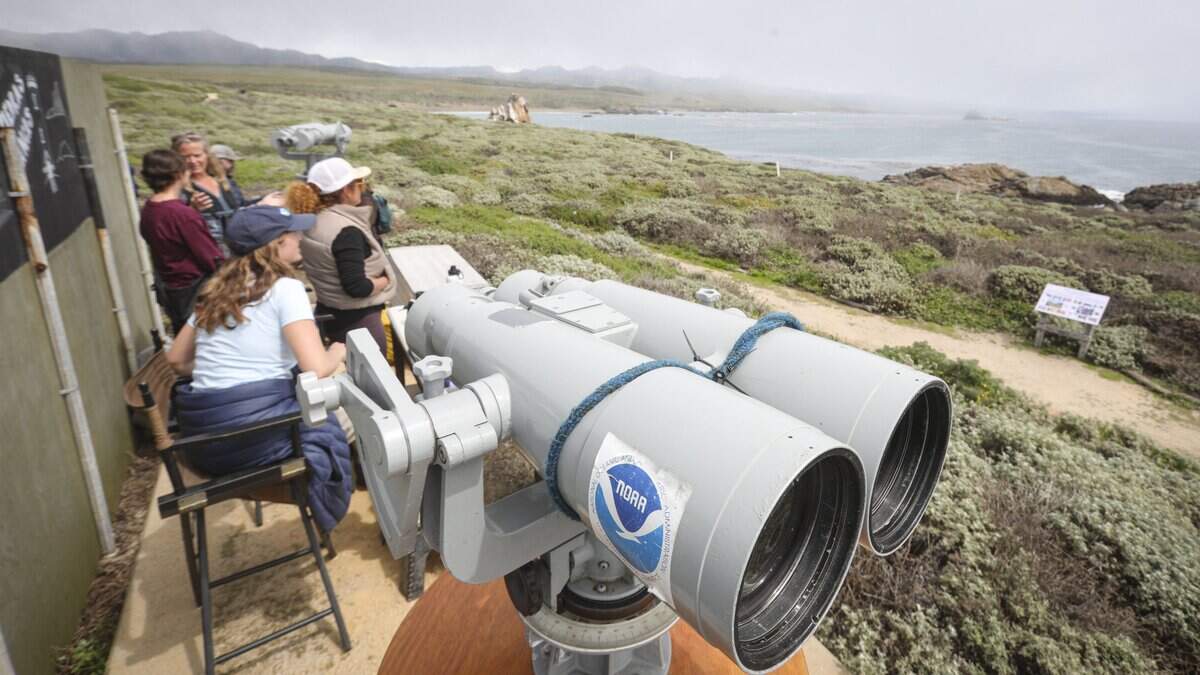
The team works from 7 a.m. to 7 p.m., with each person working two, three-hour counting shifts with a three-hour break in between each. At night, infrared cameras watch the horizon for gray whales.
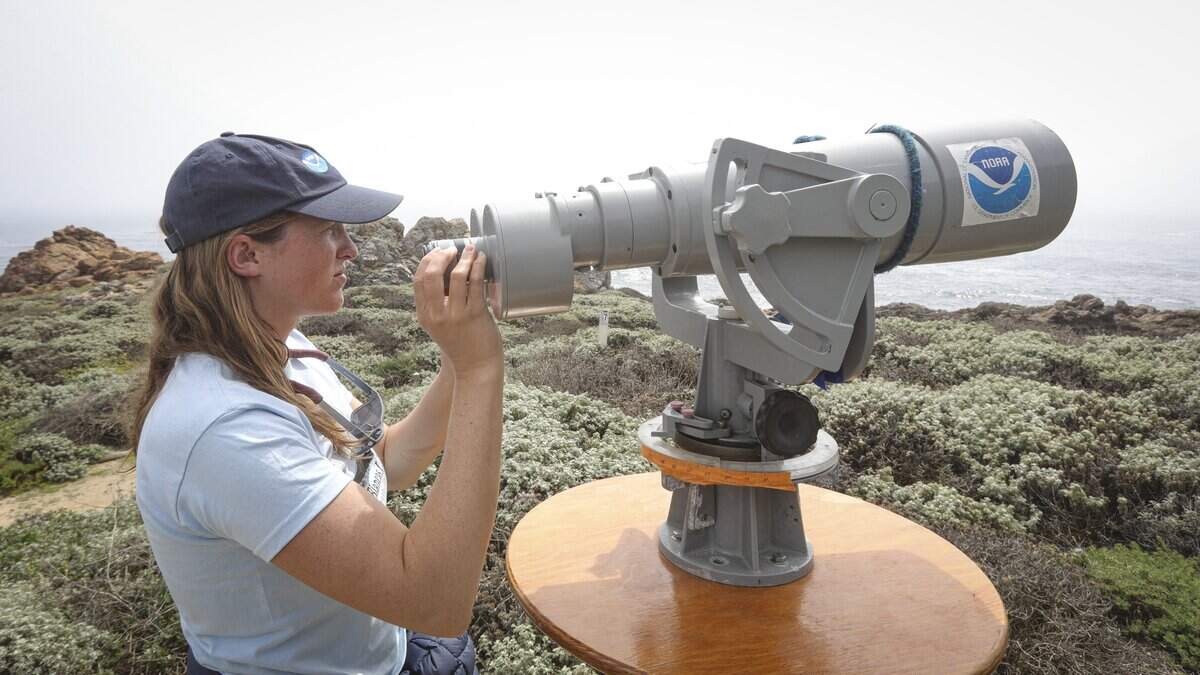
When Southwest Fisheries Science Center lab manager Vicky Pease scans the horizon, she looks for blow spouts from gray whales, which, unlike other whales, are shaped like a heart.
They use large binoculars with 25 power magnitude, which were designed to be used from the deck of a ship. The team nicknamed the binoculars “big eyes.”
Pease said it’s peaceful to watch the ocean.
“Being here, it’s very zen,” she said. “It’s beautiful.”

On April 9, the scientists counted two single gray whales migrating past the light station, she said.
At Piedras Blancas, the whales sometimes swim within 500 meters of shore — making them easier to spot.
“They’re swimming directly toward us as we’re looking down the coast,” Weller said.
He said it’s too soon in the season to estimate the size of the gray whale calf population — which can fluctuate year over year.
“There are certain environmental drivers that play into that variability, and a lot of it has to do with how much food is available,” he said.
In 2025, the calf population estimate reached an all-time low of 85, according to NOAA’s website. But the population has great variability. In 2004, the calf population was estimated at 1,528, then in 2010, the estimate was 254 calves, according to NOAA.
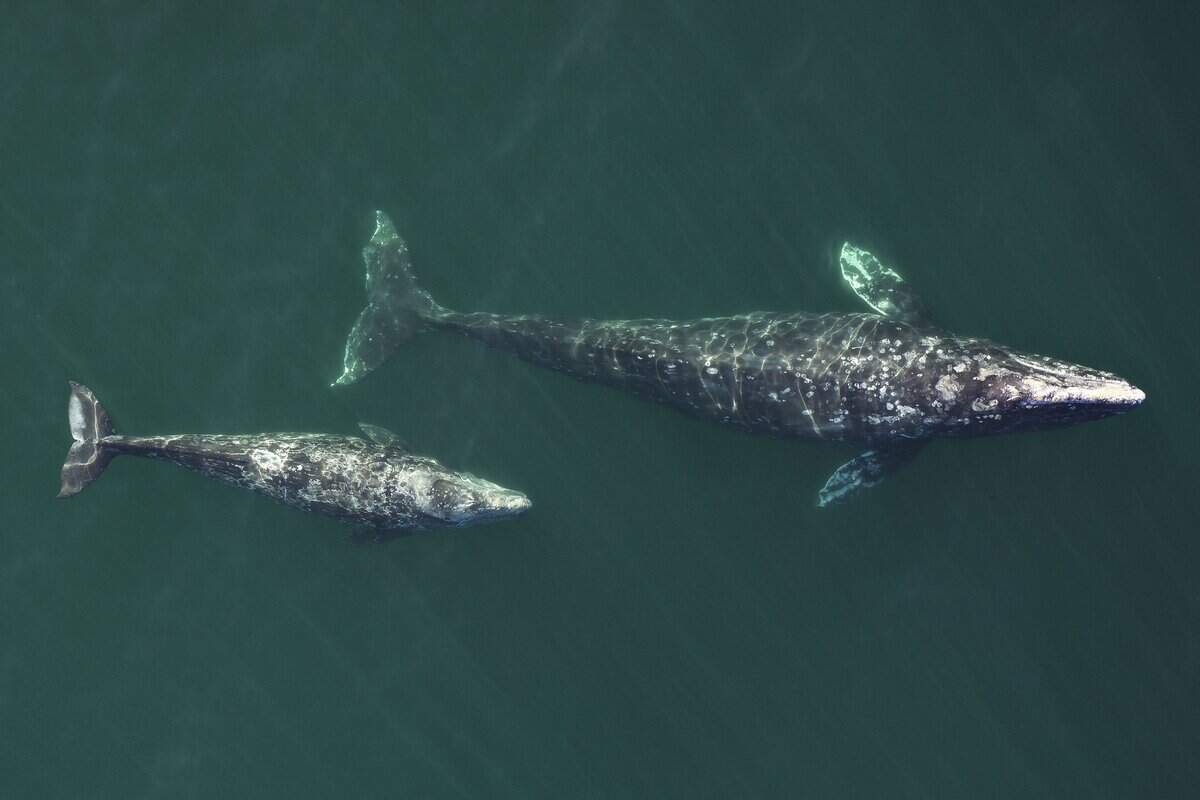
The Northern Pacific gray whale population spends the winter in Baja, Mexico. There, female gray whales give birth and nurse their calves, Weller said.
In mid-Feburary, the females without calves and males start their migration north. Then, the mothers and their calves follow between March and May.
Weller said the number of calves born in the spring could be linked to the condition of sea ice in the Arctic the summer before they were born.
“In years when sea ice extends far to the south and prevents pregnant females from early season access to important feeding areas, fewer calves are born the following spring,” NOAA’s website said.
Weller said gray whales are important to study because they indicate the health of the Arctic environment.
As the global temperature warms, arctic sea ice melts more rapidly — changing the gray whales’ feeding grounds.
But Weller isn’t worried about the ability of gray whales to survive climate change, as the species lived through the transition between the Ice Age to the Holocene.
“I don’t have concern about the future of the species, but I have great scientific interest in how changes will influence species distribution, occurrence, numbers,” he said.
“I think they’ll be around,” he added. “They’re really resilient.”