New idea offered for Paso Robles basin water fee — and there’s no way out this time
Last year, managers of the Paso Robles groundwater basin were forced to abandon water use fees after a majority of property owners objected.
Now, they’re back with a new fee plan to cover the cost of state-mandated activity — but this time, property owners won’t have the chance to strike it down.
On Wednesday, the Paso Robles Area Groundwater Authority’s Board of Directors voted unanimously to take the first steps toward charging fees for groundwater use through a process created by Proposition 26.
Because the basin is considered “critically overdrafted” by the California Department of Water Resources, the Paso Robles Area Groundwater Authority is required to bring the basin into balance by 2040.
If created, the fee will cover next year’s operating costs, from preparing state-mandated reports to paying consultants, Paso Robles Area Groundwater Authority consultant Taylor Blakslee said.
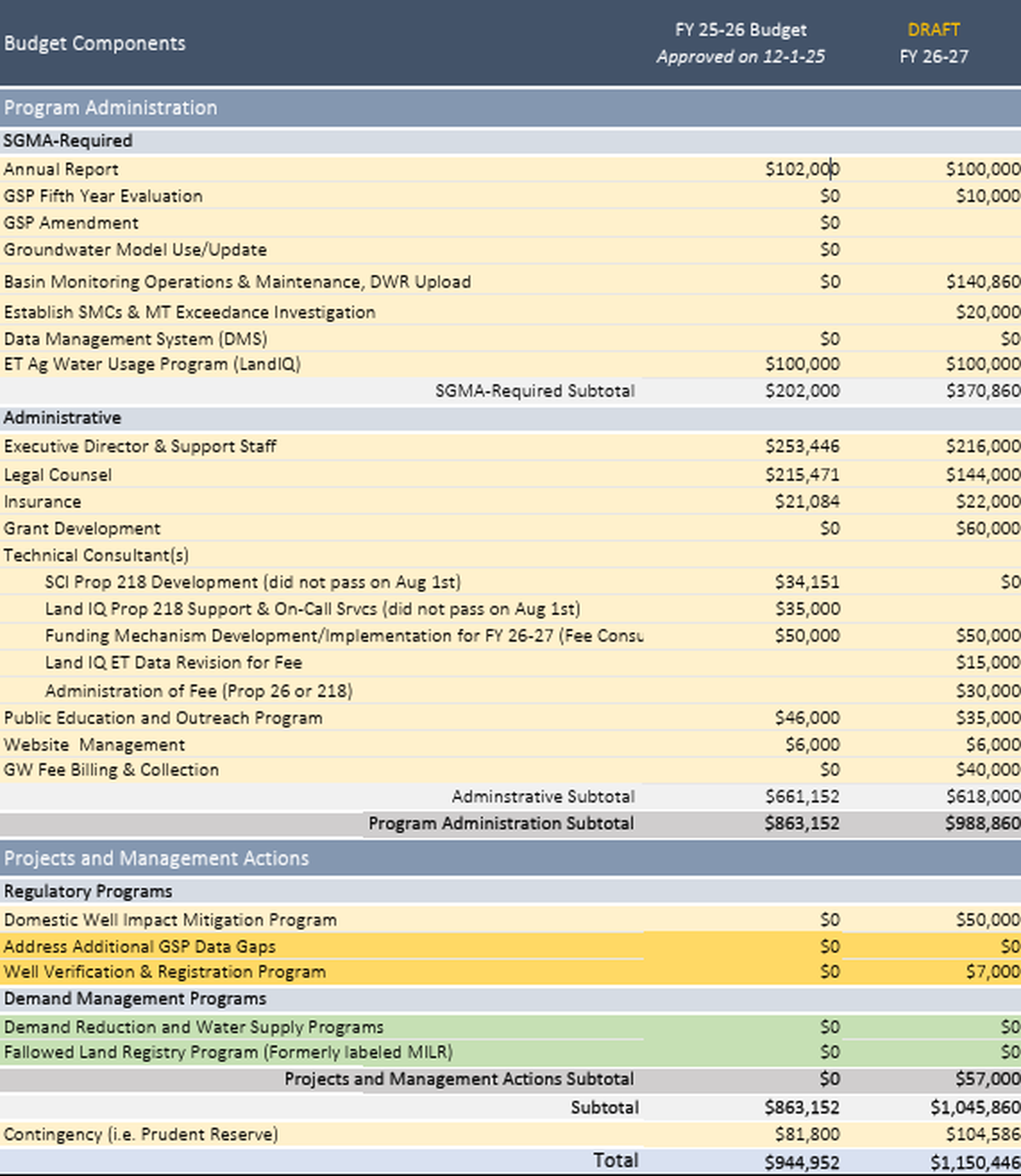
A recent draft of the 2026-27 budget proposed spending almost $1.2 million to keep the agency running and complete the necessary state-mandated tasks.
When the board adopts a final budget, the agency can set a fee that covers its costs, Blakslee said.
What’s in the draft budget?
The draft budget was divided among a variety of expenses for the fiscal year 2026-27.
It allocated $370,860 to state-mandated activities, including assembling the annual report on progress toward implementing the Groundwater Sustainability Plan’s goals, monitoring groundwater conditions and collecting evapotranspiration data, the report said.
The budget also identified $618,000 in administrative needs, including insurance, legal counsel, grant development, technical consultants and public outreach.
Staff recommended allocating $50,000 for developing a domestic well impact mitigation program and $7,000 for coordinating with the county as it develops a well verification and registration program.
Finally, the draft budget allocated $104,586 to the reserve.
The agency plans to hold public workshops to get feedback on the budget and proposed fees in March, Blakslee said.
Then, staff expect to propose a final budget and fee structure in March or April, he said.
The board will eventually vote on whether to adopt the budget and the fees.
How will the board levy the new fee?
Last year, the Paso Robles Area Groundwater Authority tried creating a water-use fee through the Proposition 218 process. The fees would have applied to commercial water users like farmers, brewers and municipalities. Ratepayers would have been charged per acre-foot of water they used.
According to Proposition 218, if a majority of impacted property owners protest a proposed fee, it cannot pass.
In August, 689 of the 1,283 impacted parcels submitted protests for the fees — the majority vote needed to stop the Board of Directors from voting on the rates.
That forced the board to look for another funding mechanism — or dissolve by June 30, Blakslee said.
On Wednesday, the board voted unanimously to direct staff to take steps to create a water-use fee through the Proposition 26 process.
Proposition 26 allows Groundwater Sustainability Agencies to impose fees on “groundwater extraction or other regulated activity, to fund the costs of a groundwater sustainability program, including, but not limited to, preparation, adoption and amendment of a groundwater sustainability plan and investigations, inspections, compliance assistance, enforcement and program administration, including a prudent reserve,” the water code said.
Proposition 26 does not include a protest process, so the board could pass those fees without permission from property owners.
Proposition 26 is more narrow. While the Proposition 218 fee could have been in place for five years, a Proposition 26 fee can only last for one year. Additionally, Proposition 26 fees can’t fund large projects like a Proposition 218 fee would have.
At the next board meeting, staff will give a presentation on ways to structure fees under Proposition 26.
Eventually, the board will vote on whether to charge a groundwater use fee; who would have to pay the fee and how to approach penalty fees, Blakslee said. It will also decide if the agency will charge a flat rate per parcel or a volumetric rate based on how much water a property uses, he said.