
Paso Robles residents fight vote for water basin governance. ‘It’s not us, it’s them’

The city of Paso Robles joined a countywide effort to create an agency that could charge fees for pumping water out of the Paso Robles Groundwater Basin, despite public outcry during a fiery City Council meeting Tuesday night.
The approved agreement paves the way for sustainable and collaborative management of the basin, which was determined by the California Department of Water Resources to be in “critical overdraft,” according to Paso Robles public works director Christopher Alakel.
Annually, pumpers use around 13,700 acre-feet more water than is returned to the basin each year. One acre-foot is enough water to cover a football field with one foot of water.
But dozens of community members voiced opposition to the decision — with some going as far as alleging that Paso Robles staff and officials were siding with special interests to take away their constitutional water rights.
“It’s not us, it’s them, and they kiss your tushies and they build your infrastructure that you pay them back for and they suck our water dry,” said one speaker.
What will the water agreement do?
Tuesday’s agreement creates a new framework for managing the water basin.
Currently, the basin is governed by five groundwater sustainability agencies within the jurisdictions that use the water. These include Paso Robles, San Luis Obispo County, the Shandon-San Juan Water District, Estrella-El Pomar-Creston Water District and the San Miguel Community Services District.
Each groundwater authority can set its own water-use fees — but there previously hasn’t been a way to set fees for users across the entire basin. That’s part of what the new joint powers agreement would allow.
A representative from each participating groundwater sustainability agency would have a seat at the table and a vote. Budget decisions, including setting fees, would require a supermajority vote and would be revisited every five years.
According to Alakel, the fees would be split up based on water usage.
Big agricultural growers would be charged one fee, municipal systems another and de minimis users — pumpers who annually use two acre-feet of water or less — would see a separate fee.
The Sustainable Groundwater Management Act prohibits agencies from imposing certain regulations on de minimis users, but under Proposition 218, if an agency charges some customers for a service like water, all customers must pay a fee proportional to the benefit that they receive from the service.
Because domestic users would benefit from the Joint Powers Authority, they’ll likely see fees.
The funds would ultimately go to support sustainable management of the basin, including administrative tasks like monitoring wells and writing annual reports.
In a January meeting, the Paso Basin Cooperative Committee — an advisory body comprised of groundwater authority representatives — got a first look at potential fee structures.
Under each proposal, residential users would pay between $34 and $37 per acre-foot of water used.
Domestic users typically consume less than an acre-foot per year, so they’d wind up paying less than $20 a year under the proposed structures, The Tribune reported in January.
Fees for agricultural and commercial users ranged from $64 to $246 per acre-foot. Farmers would be charged not for the water they pump, but for the water they consume.
The County Board of Supervisors recently approved the agreement in a tense vote, and the Shandon-San Juan Water District and the Estrella-El Pomar-Creston Water District have also signaled their approval.
The San Miguel district has yet to give the agreement its stamp of approval, Alakel told Paso Robles Councilmembers.
North County residents rally against the vote
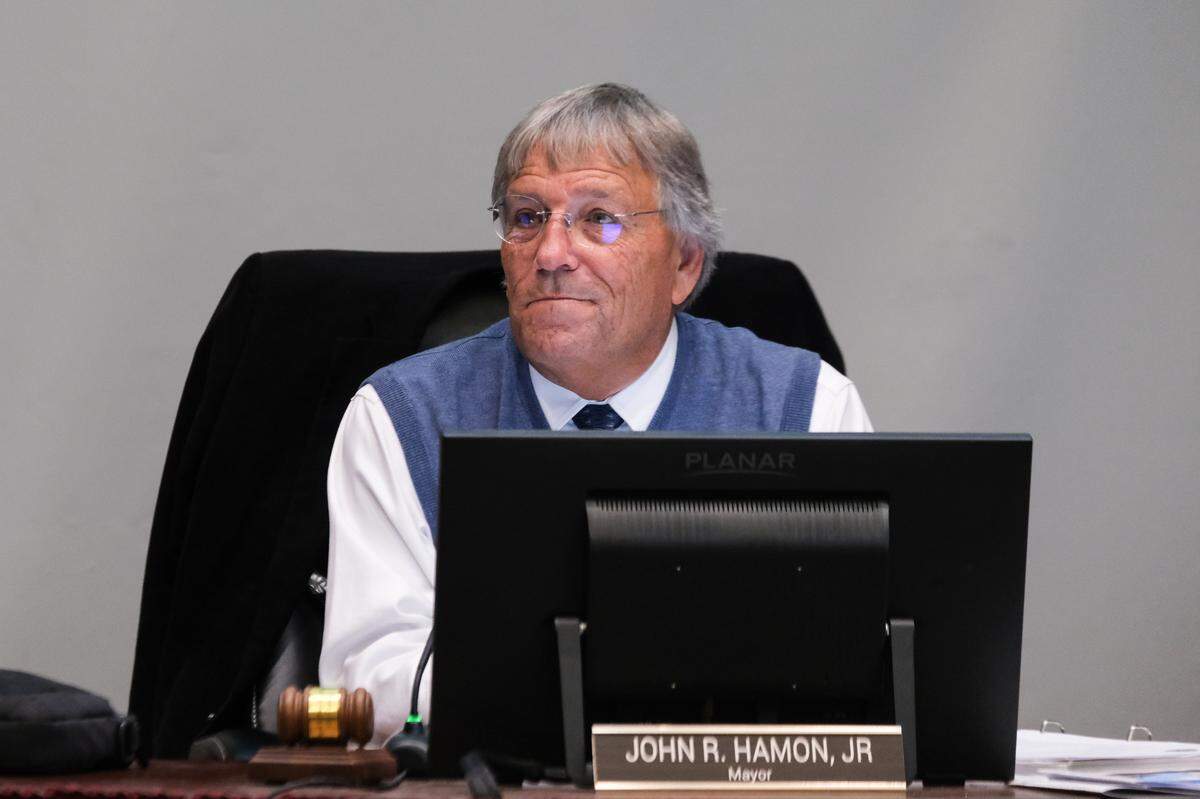
Dozens of North County residents showed up at Tuesday night’s City Council meeting to protest the adoption of the agreement — and the meeting got so rowdy that Mayor John Hamon was forced to call a recess after multiple warnings to the audience.
Most opponents were well-owners with concerns about being charged for their domestic water use, when big vineyards and ranches use far more, they said.
“You should be looking at who is really the culprit of this situation,” said Stephen Krauss. “It’s not we homeowners who try to just live our lives in a very simple way and try to abide by the rules and the regulations. It’s those that are from out of the county — that are out of the state — that happen to own the big wine vineyards.”
Many residents’ comments appeared to be rooted in their distrust in local government and special interests.
“There is no crisis here that we need to be freaking out about,” said Julie McCloskey, claiming that the basin is not in overdraft.
“I don’t care what the state says, I’m not going to hide from them,” she added. “Water is big money — billions — and trust me, the people who want to sell the water out of this water basin influence Sacramento and they are putting pressure on all of you to do this. It’s your responsibility to do the right thing here.”
Additional comments from McCloskey claimed that city attorney Elizabeth Hull and her firm, Best Best & Krieger, couldn’t be trusted due to the firm’s involvement in water rights litigation elsewhere.
McCloskey’s comments warranted vigorous applause from the audience, resulting in Hamon calling a 10-minute recess. Hamon had previously issued two warnings to the audience to prevent disruption.
Later in the meeting, Councilmember Chris Bausch asked Hull to respond to the allegations against Best Best and Krieger.
“BBK does do water work and we run a conflict check any time we take on a new matter,” Hull said. “So, if there were to be a conflict, it would have been identified at that point in time. So no, we don’t currently have any conflicts.”
Bausch interrogated Hull further, questioning if another conflict check should be run. Hull said there would be “no reason to” run an additional check.
“I will respectfully disagree,” Bausch told the city attorney.
Other commenters at Tuesday’s meeting urged the board to postpone the vote until the fee structure was solidified — but, as Councilmember Kris Beal pointed out, the fee structure can’t be established until the joint powers authority is in place.
Hilary Graves, vice president of the Estrella-El Pomar-Creston Water District and a supporter of the joint powers agreement, described some of the claims made by audience members regarding the potential fee structure as “misinformation.”
“The cost is known,” Graves said of the draft fee structures. “It’s public information. You can find all of it at the current Paso Basin Cooperative Committee website.”
City officials also tried to assure the audience that many of their concerns could be solved through the joint powers agreement.
“We need to be part of the process, otherwise decisions are going to be being made that ... we have no control over,” Alakel added. “At least while we’re sitting there, we have the ability to have an impact and control our own destiny.”
Most councilmembers echoed Alakel’s statements.
Hamon said he viewed the JPA as a protection for de minimis users, not a threat.
“It’s essentially gonna be a tool, a better voice, for the smaller folks out there,” he said.
The Council ultimately voted 4-1 to approve the joint powers agreement, with Bausch dissenting.
This story was originally published March 10, 2025 at 12:04 PM.
.JPG)