Switch to new clean energy provider hits some SLO County solar customers with big bills
Eligible residents in Atascadero and unincorporated areas of San Luis Obispo County have officially begun receiving power from a new, local clean energy provider — but some solar customers are not so satisfied with their unexpectedly expensive switch.
Since its formation in 2017, Central Coast Community Energy — or 3CE for short — has provided sustainable energy to more than 1.2 million people on the Central Coast, including residential, commercial and agricultural customers across six SLO County cities and neighboring counties.
After gaining approval from the SLO County Board of Supervisors in November, residents of Atascadero and unincorporated SLO County recently became 3CE’s newest customers.
The company auto-enrolled eligible customers at the end of last year for service starting on Jan. 1, promising clean energy at a lower cost.
But that was not the case for Atascadero resident and solar user Laurie Kirkpatrick.
When Kirkpatrick’s 3CE service started in the new year, she received a $1,563.71 end-of-service true-up bill from PG&E.
A true-up bill typically comes once a year as a charge from PG&E for customers whose solar production comes up short of their overall energy usage.
“I decided to give 3CE a chance because 3CE was touted as being better for the environment,” Kirkland told The Tribune. “I certainly hadn’t bargained for this!”
Kirkpatrick’s solar panels usually generate all the power she uses in a given year at home, so the “astronomical” true-up bill came as a complete surprise to her.
“Normally at this time of year, I would not be paying anything,” she said.
Kirkland spoke to at least 22 other solar customers with the same experience, some who received bills as high as $3,000, she said.
3CE is aware of the situation for their new solar customers and has vowed to help, but PG&E said it will not issue true-up refunds.
Meanwhile, Kirkland and other solar customers blindsided by the bills have been left in the dark.
So why are SLO County solar customers being charged so much for switching to 3CE, and what can they do about it?
Why are some solar customers facing expenses for switching to 3CE?
The costs solar customers are experiencing when they switch to 3CE are not out of the ordinary, 3CE director of communications Dawn Mathes-Park told The Tribune.
They represent outstanding, end-of-service PG&E charges for all energy transmission, delivery and generation that must be paid to the energy provider before the customer can officially switch to 3CE, Mathes-Park said.
All solar customers receive a PG&E true-up at some point in the year, but a change in service forces another true-up for all the energy used from the previous billing date to the end of service.
Customers who switched to 3CE received a second true-up bill in early 2025, but some solar customers felt cheated by the early charge.
Kirkpatrick’s usual annual true-up date is in October, by which time her solar panels generate all the energy she used over the year, often more, earning her a small credit of around $100, she said.
But when her “forced” true-up came in February as a result of the 3CE switch over, she was using more energy than she was producing due to seasonal impacts on her solar power generation.
The cost a solar customer is charged in their true-up has to do with the timing of the bill relative to their energy use and production.
During the winter, the shorter, often cloudier days mean that Kirkpatrick’s solar panels often produce less energy than in the spring and summer months. By fall, after two seasons of longer, sunnier days, her energy production and use evens out to net zero, Kirkpatrick said.
When Kirkpatrick received the extra true-up, she was in debt to PG&E for her energy use during the winter months, resulting in the $1,563 bill.
“I am concerned,” Kirkpatrick said. “How am I going to get reimbursed for that?”
The same thing happened to Terry Eselun.
Eselun has had solar panels on her home near Los Osos since 2022. Her annual PG&E true-up is also in October, but she received another bill in the new year for $357.
“We would normally not pay anything at the end of the year,” Eselun told The Tribune. “By then, we’ve generated a year’s worth of electricity.”
Central Coast Community Energy used to enroll customers in phases, but in January 2022 it transitioned to a single batch enrollment period, monthly billing and a standardized true-up month to create a “more streamlined enrollment and billing process for customers,” Mathes-Park said.
“Most customers’ experience is positive with this change,” Mathes-Park said.
But Eselun and Kirkpatrick felt misled by the promises of a cost-free transition to clean energy.
“You’re just led to believe that it’s not going to cost you anything,” Kirkpatrick said. “I feel that the literature received prior to this being rolled out failed to be completely transparent.”
How can solar customers facing large true-up bills opt out of 3CE?
Eselun and Kirkpatrick share the same frustration. Though new customers were told they could switch over to 3CE or opt-out of the service cost-free for the first 60 days, that has not been true in their experience.
Both solar customers plan to switch their service back to PG&E, but are not sure if they will face an additional true-up bill from 3CE, let alone getting reimbursed for their original PG&E true-up.
At first, Kirkpatrick wasn’t having much luck getting her questions answered by either energy company. But after attending online and in-person information sessions and contacting 3CE multiple times, she was able to reach an account manager, Jeff Railsback, who is working on getting her a retroactive opt-out and seamless return to PG&E as if nothing happened, she said.
“The retroactive unenrollment reverses the customer’s enrollment and the PG&E true-up charges,” Mathes-Park said.
But PG&E said that won’t be possible.
“Solar customers will not be reimbursed for a true-up,” PG&E spokesperson Neil Hebert told The Tribune.
Instead, PG&E will offer customers who return within 60 days the option to request a one-time change to their true-up date to get back to their previous annual billing cycle, Hebert said.
If the one-time change is not requested, the customer’s next true-up will happen one year from their forced true-up when they return to PG&E. The offer ends on March 1.
Additionally, customers who return to PG&E after March 1 may be charged a different rate — known as a Transitional Bundled Service (TBS) rate — for the first six months, sometimes more than 250% their original bill, but “customers returning to PG&E within 60 days will not be charged the TBS rates,” Hebert said.
Because the true-up bills are charged by PG&E, not 3CE, any reimbursement or billing adjustment will be up to PG&E to decide and handle, but 3CE is “working closely with the energy provider to resolve customer hardship,” Mathes-Park told The Tribune.
3CE will deal with solar customers on a case-by-case basis, Railsback told Kirkpatrick.
Mathes-Park said solar customers facing true-up issues should call 3CE right away to evaluate the specifics of their situation and determine if a retroactive unenrollment is a solution for them.
“Our goal at 3CE is to provide clarity and support throughout this transition to public, renewable energy for the Central Coast,” Mathes-Park said. “3CE has many benefits to offer, and we are eager to connect with our solar customers to go over their options.”
Mathes-Park told any solar customers experiencing hardship or with questions about opting out to contact their team directly at SouthSupport@3CE.org or to call 3CE at 1-877-455-2223.
How does 3CE supply clean energy to SLO County?
Before 3CE, most of SLO County’s energy needs were served solely by PG&E — and that won’t completely change.
The clean energy provider has a partnership with PG&E, which still handles the transmission, distribution and delivery of power as well as maintaining infrastructure like poles and power lines.
The difference is 3CE will be responsible for energy production.
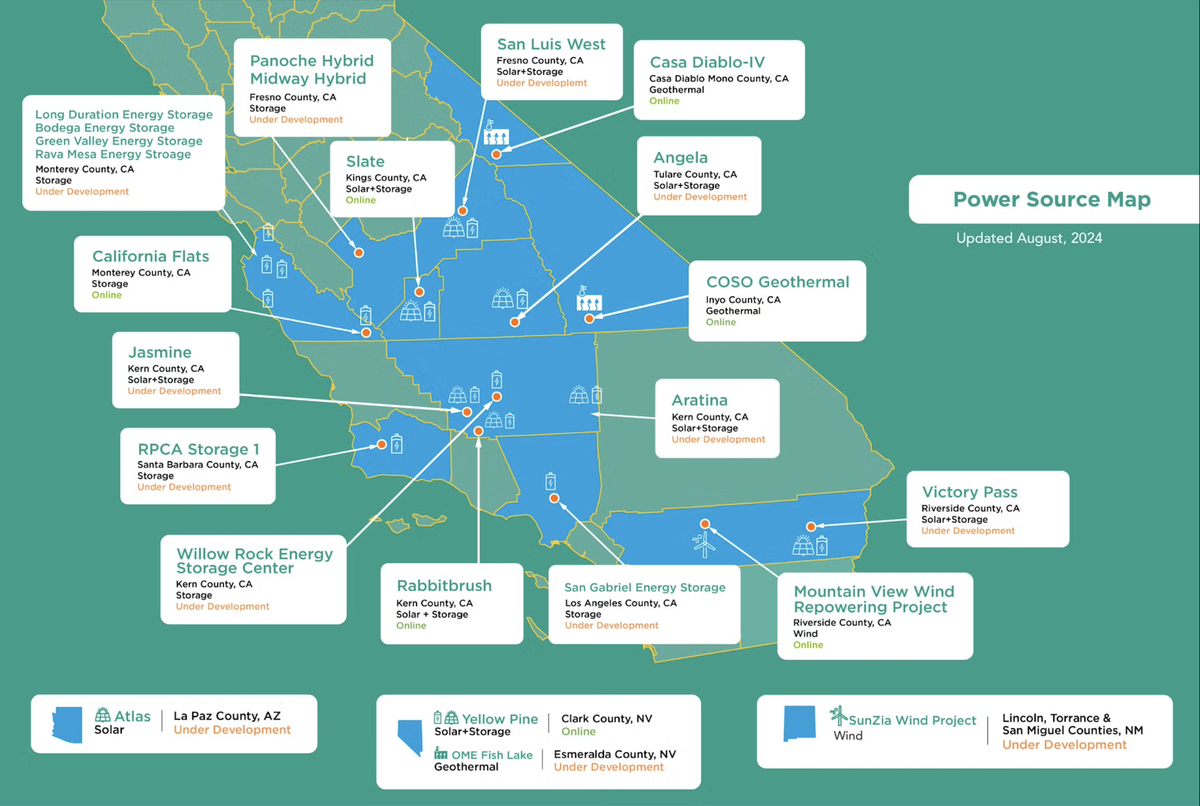
According to the company’s website, 3CE purchases its renewable energy from a network of wind, solar and geothermal power plants it has agreements with across Southern California as well as a few in Arizona, Nevada and New Mexico.
3CE aims to achieve 100% clean energy by 2030, 15 years ahead of the state goal. Enacted in 2018, Senate Bill 100 requires California to fully rely on renewable energy sources by 2045.
Central Coast Community Energy is on track to meet its goal of 44% clean energy use in 2024 and 60% by 2026, Catherine Stedman, chief communications officer of 3CE, told The Tribune in November.
3CE also provides Central Coast customers with an array of incentives and rebates for energy programs.
Last fiscal year, the company gave $4 million to help over 2,000 people purchase electric vehicles and also hosted other incentives to help fund 17 electric school buses and make new housing projects all electric, Stedman told the Board of Supervisors in November. Other eligible projects include home electrification and battery storage systems, as well as electric agricultural equipment.
If I do not have solar, will I be charged more for 3CE’s power?
In short, you shouldn’t.
Approximately half of the people living in the new coverage zones are eligible for service by Central Coast Community Energy — and if you didn’t opt out, enrollment in 3CE’s services already happened automatically starting on your first regular meter-read date after Jan. 1.
Because 3CE and PG&E work in tandem, both energy companies will continue to appear on customers’ electric bills.
Customers who switch over won’t actually stop receiving service from PG&E but rather will become a shared customer. For those households, 3CE will take over the power generation side of their bill while PG&E will continue to handle the transmission, distribution and delivery.
Shared customers’ energy bills will still come from PG&E, with a small adjustment that shows the generation fee paid to 3CE, not PG&E, at no additional cost.
In fact, with the exception of some solar users, customers might even save money by switching over.
According to the company, residential customers in 2024 paid on average about 17% less on their generation charges than with PG&E.
“By joining together with 3CE, Atascadero and unincorporated San Luis Obispo County are strengthening their voice in shaping the region’s energy future,” Stedman said in a news release. “This partnership empowers residents and businesses with greater local control, expands access to clean energy solutions and drives investment in programs that support long-term economic and environmental benefits.
For those who want to be serviced by Central Coast Community Energy, no action is necessary. The company has already begun providing power to eligible residents in Atascadero and unincorporated SLO County.
For those who choose to opt out, they can do so penalty-free until March 1, 2025.
After that date, a $5 opt-out fee will be applied for residential customers and $25 for commercial. Additionally, customers returning to PG&E may be charged a different rate for the first six months. Those who opt-out after March 1 cannot return to Central Coast Community Energy for one year, Stedman said.
In order to opt out, residents can either do so online or contact Central Coast Community Energy by phone at 1-877-455-2223 or via email at info@3ce.org.
Central Coast Community Energy has also purchased an office building at 1026 Palm St. in San Luis Obispo and will open a new space downtown next year, Stedman said.
This story was originally published February 27, 2025 at 10:23 AM.