Massive Nipomo housing project clears final approval hurdle — but legal fight is just starting

The Dana Reserve project cleared its final procedural hurdle Thursday afternoon.
At Thursday’s meeting, San Luis Obispo County’s Local Agency Formation Commission weighed arguments from developer NKT Commercial and members of the public as it evaluated whether Dana Reserve can be annexed into the Nipomo Community Services District’s water and wastewater service area.
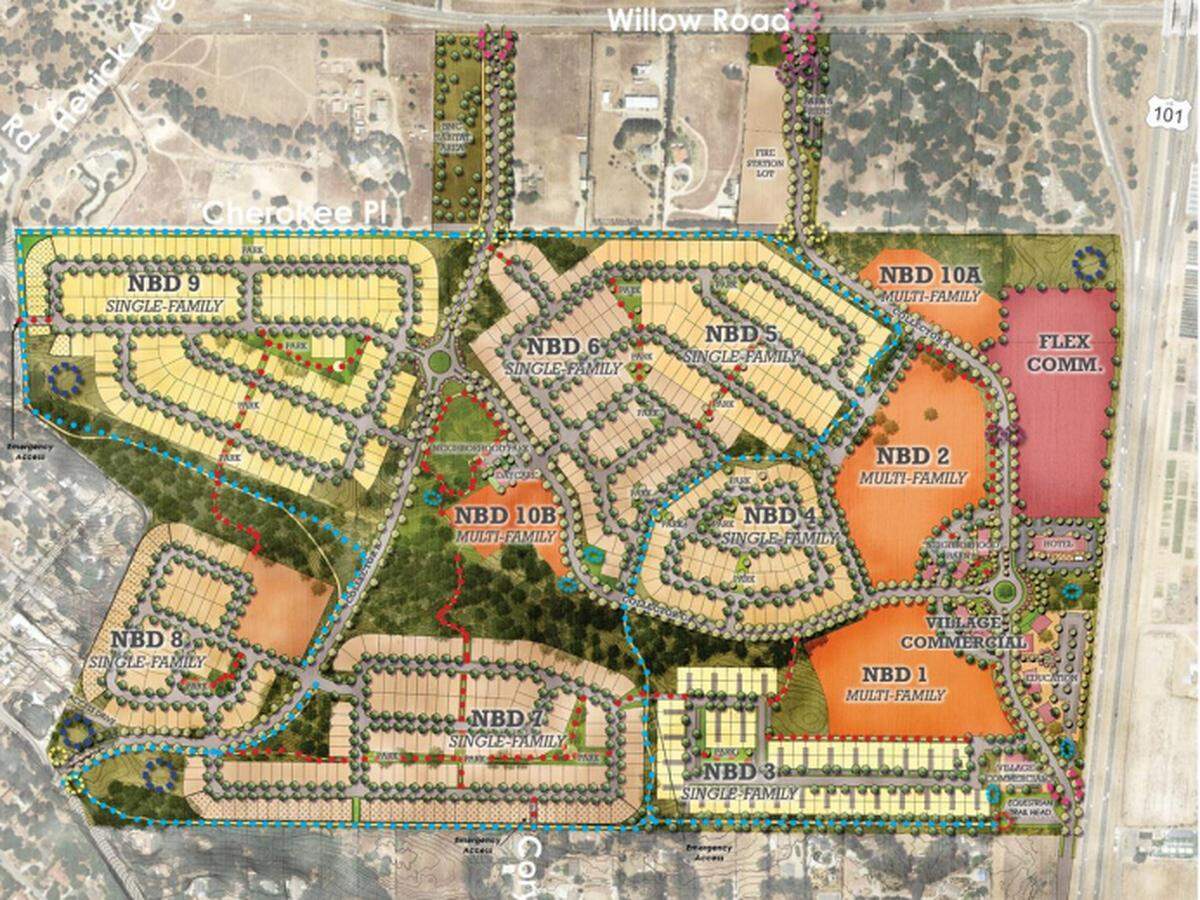
Approved in a 3-2 vote by the San Luis Obispo County Board of Supervisors in April — with supervisors Jimmy Paulding and Bruce Gibson voting against the project — Dana Reserve calls for the construction of roughly 1,470 units of housing on a 288-acre piece of land currently home to more than 3,000 mature oak trees.
While the Nipomo CSD previously approved the development’s tax agreement with the county, the annexation agreement and a plan for providing services at its Aug. 28 meeting, LAFCO still had to sign off on the Nipomo CSD’s annexation of the project area and find that the county’s environmental impact report was sufficient.
After several hours of public comment and deliberation, the LAFCO board voted 6-1 to approve the report and the annexation of Dana Reserve into the Nipomo CSD, with Paulding — who also serves on the LAFCO board — once again voting against the project.
Paulding said while he thought there were plenty of positives to the plan, he didn’t approve of the scale or potential impacts to the quality of life of residents living near the project site.
“Going back to the concept of balancing the need for housing with the need to protect natural resources and prevent urban sprawl, in this particular case there are 19 Class 1 impacts — that’s unprecedented for the area,” Paulding said. “We’re talking traffic, water, air quality, 3,000 native oak trees — I think that list is too long, and I subscribe to the community-supported alternative plan that tried to strike that balance, tried to scale the project back, and had hoped that the developer would be supportive of that.”

Why did LAFCO approve the annexation?
The plan from NKT Commercial features 417 market-rate single-family homes built by Trilogy Homes builder Shea Homes, 242 units of moderate-income housing, 290 units of missing middle housing, 315 units of workforce housing and a total of 206 low or very low-income homes.
That footprint requires the removal of significant portions of the existing ecosystem, resulting in 19 un-mitigatable impacts that had to be approved by both the Board of Supervisors and the LAFCO board.
Those formed the basis for many of the Nipomo Action Committee’s arguments against the project’s approval.
In its most recent comments opposing the project, a statement from attorney Babak Naficy said LAFCO should reject the county’s environmental impact report because of the discovery of a potentially distinct new species of manzanita recently uncovered by the California Native Plant Society.
In their comments, Naficy and the Nipomo Action Committee said the discovery of this potentially rare species should require a new environmental impact report that would include the manzanita as another unavoidable impact of the project, but the LAFCO board ultimately voted to approve the original report.
In an email to The Tribune, California Native Plant Society president Bill Waycott said the LAFCO board has had evidence of the new manzanita species since Sept. 19.
Waycott said the group’s efforts to document the discovery have been ongoing since 2021, with a peer review likely to come by the end of this year.
“It remains to be seen if the confirmed existence of this new species of manzanita on the Nipomo Mesa is significant new knowledge and would thereby require an amendment to the project’s EIR,” Waycott said. “As per calculations using satellite imagery and ground-truthing, less than 700 plants of this species are alive today, of which nearly half reside within the boundaries of the proposed Dana Reserve property.”
Meanwhile, LAFCO board member Debbie Arnold said the county is already doing a sufficient job striking a “balance” between the need for housing and development and preserving existing unique ecosystems.
“When we talk about urban sprawl, I know none of us want to just turn our beautiful county into something that looks like one of the high-density urban areas of our state, but this property will sit on the west 101, a major corridor that runs north and south in our state,” Arnold said. “That’s a big deal, and on two other sides, it’s pretty well-developed, but it does have the zoning that would justify from the long range viewpoint, that this was zoned for eventual residential.”

The LAFCO board was also less receptive to the Nipomo Action Committee’s arguments that the project would overexert the CSD’s capacity to supply enough water each year.
The Nipomo CSD gets its water from the Santa Maria Valley groundwater basin, which extends from Orcutt to Pismo Beach and provides water to northern Santa Barbara County, the Nipomo Mesa management area and the North County management area that includes Los Osos.
The Nipomo CSD, Golden State Water, Woodlands Mutual Water Company and Rural Water Company get an additional 650 acre feet water from the city of Santa Maria via the Nipomo Supplemental Water Project Water Management and Groundwater Replenishment Agreement.
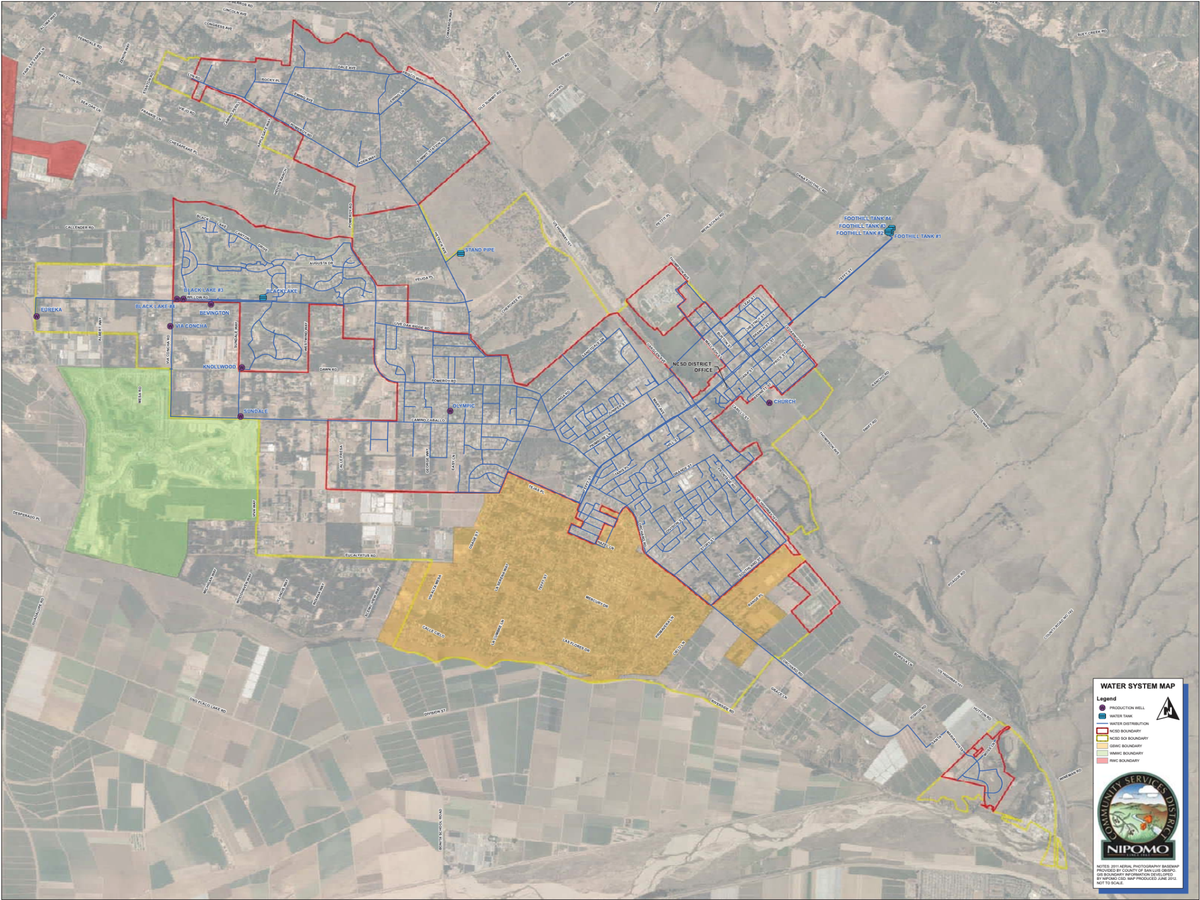
Each year starting in July 2025, the district must purchase 2,500 acre-feet of water from Santa Maria, compared to 1,133 acre-feet in 2023, according to the staff report.
Of that, a third will go to other service providers in the region, according to the staff report.
At full size, the Dana Reserve project will consume 377 acre feet of water each year, though the Nipomo CSD’s analysis of expected water levels in the year 2045 found that there would still be a surplus of 415 acre feet.
The NAC cited a passage of the the Supplemental Water Management and Groundwater Replenishment Agreement that specifically sets aside the supplemental water “exclusively for the benefit of the properties within the existing jurisdictions and service areas of the parties and in accordance with the judgment and stipulation.”
The LAFCO board ultimately sided with the Nipomo CSD’s evaluation that it would have sufficient water to accommodate the new development.
“I personally think as a commissioner, I owe a lot of deference to NCSD’s decision making when it comes to working through policies that are applicable in 2024, to the extent that they build upon what we’ve seen earlier but may no longer be the underpinning of today’s new policies,” LAFCO board member Marshall Ochylski said.
What’s next?
While Thursday’s approval was the last in a four-year series of presentations and hearings, one challenge still remains ahead of Dana Reserve.
A Nipomo Action Committee lawsuit launched shortly after the board approved the project will still likely precede any groundbreaking at Dana Reserve, and another lawsuit challenging LAFCO’s findings may still be in the pipeline, Naficy said.
Naficy said he was disappointed the LAFCO board relied on the same environmental report used by the Board of Supervisors, and that the newly-discovered manzanita did not play a role in its determination.
“The parties will be briefing the case between January and March, so sometime in April, maybe early May, we’ll have a decision on this,” Naficy said. “If there is a case against LAFCO, it’ll drag behind by about a year.
He added: “No decision has been made on whether this action will be challenged or not.”
In a statement shared with The Tribune, NKT Commercial CEO and Dana Reserve managing partner Nick Tompkins said he was “pleased and grateful for SLO LAFCO’s thorough review and approval, bringing us closer to realizing the vision for the Dana Reserve.”
“This project offers a full spectrum of housing, affordable daycare, down payment assistance, public transportation and priority for locals — helping young families, our workforce and others in need of a home,” Tompkins said. “As noted in public comment, delays hurt those most in need of housing. We remain committed to listening and look forward to resolving this lawsuit and bringing this much-needed community to life.”