Would Measure A-24 block Morro Bay battery plant project? New law could leave loophole
Among potted succulents and a thicket of spiky trees, Sylvan Dayspring planted a “Yes on Measure A-24” sign in her Morro Bay front yard.
Dayspring hoped the ballot measure would block a 600 megawatt battery storage facility proposed for the retired Morro Bay Power Plant property. She worried that the battery plant isn’t safe to locate next to the estuary, Morro Bay High School and tourist attractions on the Embarcadero.
“Everyone wants to have green energy, but the way that you do it has to be responsible,” she told The Tribune.
Texas-based energy company Vistra Corp. applied to the city to build the facility, which would either house batteries in three Costco-warehouse-sized buildings or in 174 individual enclosures — enough to power 450,000 homes, according to Vistra.
As of early July, Vistra was working through the permit process and waiting for approval from the city of Morro Bay and the California Coastal Commission.
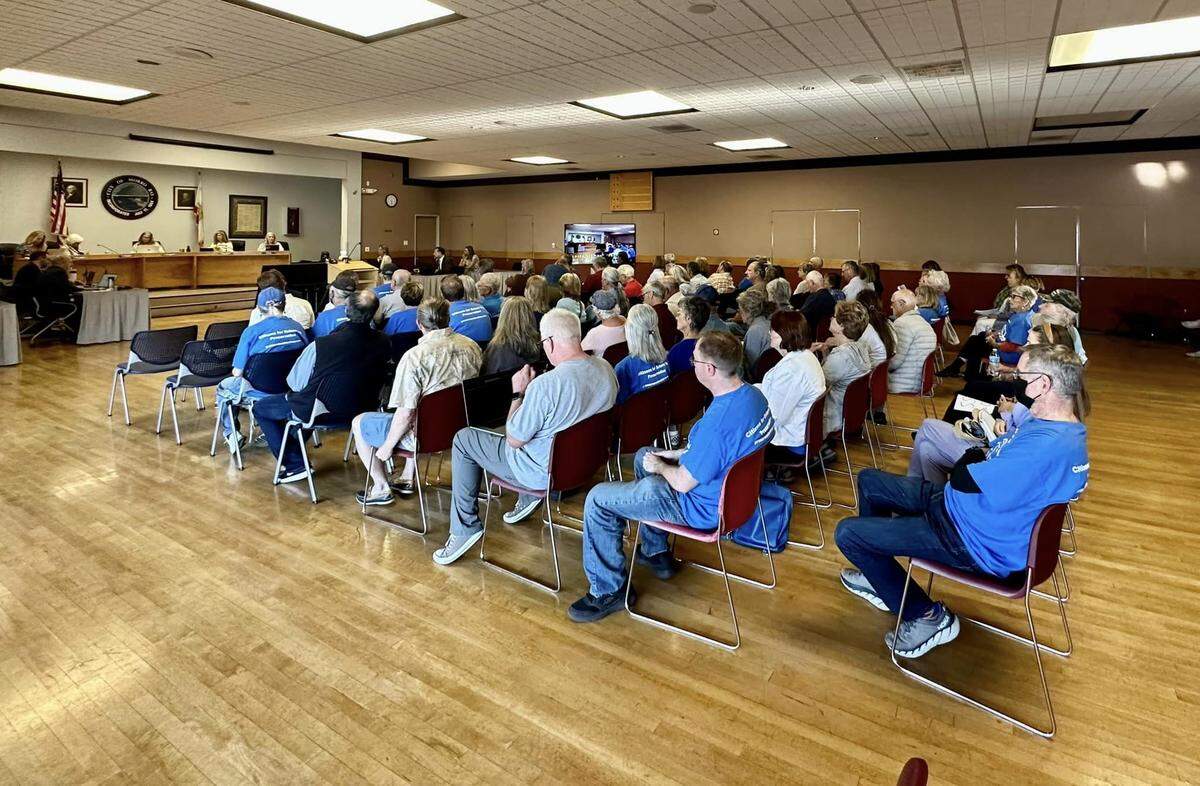
Last year, a community group called Citizens for Estero Bay Preservation mobilized to oppose the battery plant. While touting the slogan “No batteries by the bay,” the group gathered more than 1,000 signatures from registered voters to place Measure A-24 on Morro Bay’s ballot this November.
If passed, the initiative will freeze the land use on the property as visitor-serving commercial, blocking the City Council from approving the plant.
The ballot measure, however, would not necessarily halt the battery plant project.
A new state process allows companies to bypass local governments and apply to the California Energy Commission for approval of large renewable energy projects. If Vistra applied to the state for the battery plant, the commission could approve the project whether or not local zoning allowed it.
The Tribune took a look at how Measure A-24 would impact the battery plant as part of its Reality Check series.
What does the ballot measure do?
When Citizens for Estero Bay Preservation member Barry Branin first joined the group, he said his goal was to the block the battery plant.
Last summer, however, Branin became concerned that Vistra could sue the group if their stated purpose was to oppose the project — so the group broadened its goals, he said.
On Friday, Branin told The Tribune that the ballot measure is about land use — not the battery plant. He said Citizens for Estero Bay Preservation wants to prevent any industrial projects from being built on the power plant site, not just Vistra’s proposal.
“We don’t want any industrial use that would be detrimental to our tourist economy,” he said.
If passed, Measure A-24 would freeze the land use designation of the Morro Bay Power Plant property as visitor-serving commercial, which allows developments including hotels, shops and restaurants.
This would prevent the City Council from approving the battery plant — or any other industrial project on the property — as it would then not align with the designated land use.
Currently, a majority vote from the City Council can change a property’s land use designation. If the initiative passes, citizens would have to propose a ballot measure to be approved by a majority of city voters to change the property’s land use.
Branin said group’s objective now is to encourage development that supports Morro Bay’s tourism-based economy and give voters the authority to decide when the city’s land use changes.
“Our goal is to put the power in the people’s hands,” he said.
State energy commission could still approve battery plant
Vistra does, however, have a loophole for project approval.
Assembly Bill 205 allows developers to submit large renewable energy projects to the California Energy Commission for approval — bypassing local jurisdictions such as the Morro Bay City Council.
Under AB 205, the Energy Commission can approve a project that does not meet local land use rules if “the project is required for public convenience and necessity,” its website said.
In Morro Bay, the California Coastal Commission would have to approve the battery plant, too, however.
Energy attorney Brian Biering told The Tribune the law was created to push forward projects designed to support the state’s increasing energy demand while meeting renewable energy goals.
Raised in Los Osos, Biering attended Morro Bay High School — just down the street from the proposed battery plant site. He previously worked for the Energy Commission and now practices law in Sacramento with the firm Ellison Schneider Harris Donlan.
“The idea was, the state has an interest in energy projects,” Biering said of AB 205. “Nobody wants a power plant in their backyard, but we’ve got to have power plants somewhere.”
The process is still young, though. Gov. Gavin Newsom signed the law in 2022, and the commission hasn’t yet approved or denied a project through AB 205.
As of Friday, only the energy company ConnectGen had submitted a complete application to the Energy Commission.
The Texas-based company applied to build Fountain Wind, a 48-turbine wind farm that could produce 205 megawatts of electricity in Shasta County. The Shasta County Board of Supervisors voted down the project, then the company applied to the Energy Commission for approval, according to the Redding Record Searchlight.
Biering said Fountain Wind will show the state how the commission handles projects denied by local jurisdictions.
So far, the commission has held meetings in Shasta County to get input from the public on the wind farm, he said.
”They’re definitely working with the local jurisdictions, getting their feedback, holding meetings in the communities where the projects would be located and have always seen themselves as sort of a partner with other agencies,” he said.
According to Biering, Measure A-24 will likely push Vistra to apply to the Energy Commission to consider the battery plant.
In a statement emailed to The Tribune, a Vistra representative said the company was “aware” of the AB 205 process, “but has prioritized working on our local application, pending with the city of Morro Bay.”
Even if Measure A-24 passes and Vistra pursues that loophole, it would at least slow down the approval process, Biering said, as the Commission would need to review environmental impacts of the battery plant and consider if the state’s energy needs override Morro Bay’s land use rules.
In that event, staff from the California Coastal Commission and Energy Commission would likely work together to review the battery plant, Biering said, and both agencies should come to a similar conclusion about the project.
“It’s definitely going to make the proceeding more complicated,” he said.
Some say measure would give up local control
While some Morro Bay residents posted “Yes on A-24” signs in their yards, others oppose the measure.
About 60 people have joined the group Morro Bay Citizens Opposed to A-24, according to member Marlys McPherson.
The group didn’t take a position on the battery plant, but they do think approval of the project is inevitable. If the measure blocks City Council from approving the project, the group expects the California Energy Commission and Coastal Commission to push it through, anyway, she said.
“The whole purpose of AB 205 is to override NIMBYism,” McPherson said. “It’s a fairly new law, but it’s clearly designed to allow a company like Vistra to bypass the local government and ignore any zoning.”
Rather than block the project, McPherson said Morro Bay citizens should work with Vistra to pursue a project design that suits the community.
Vistra already agreed to tear down the Morro Bay Power Plant and its 450-foot-tall emission stacks, which could cost up to $50 million. The city could push for other community benefits and safety requirements, too, McPherson said.
However, if the California Energy Commission and Coastal Commission make the decision, there are fewer opportunities for citizen feedback.
“You are giving up local control,” she said. “It really takes the decision out of our hands.”
Whether or not the battery plant project existed, McPherson said freezing the land use would discourage future development on the power plant property.
McPherson thinks it’s unlikely that a developer would want to spend millions of dollars to buy the property, remove the power plant and stacks, then clean up the pollution to build a visitor-serving project like a hotel or aquarium.
The former tank farm area on the power plant site is polluted with total petroleum hydrocarbons (TPHs), which are fuel oils burned to generate electricity, as well as polycyclic aromatic hydrocarbons found in TPHs, according to a 2022 report from the California Department of Toxic Substances Control.
Unless the pollution is cleaned up, the 24-acre site could only be safely used for industrial or commercial purposes, the state agency said.
Additionally, McPherson doesn’t think a developer would petition voters to update the land use to accommodate a different industrial project — so the property will likely stay dormant and undeveloped if Measure A-24 passes.
“You can see it would discourage developers,” she said. “They have other choices.”
Branin, however, said he expects the Coastal Commission to reject the project because it conflicts with the property’s stated land use and jeopardizes coastal resources.
In a May 28 comment on the project’s draft environmental impact report, the California Coastal Commission advised the city to use the final report to investigate alternative sites for the project “that may not have the same coastal resource issues and hazards as the current proposed site,” it said.
Branin hopes a developer would clean up the pollution on the property for the sake of his grandchildren and the health of the environment, he said.
Dayspring, meanwhile, will support the ballot measure regardless of the AB 205 process. She said she hopes a “yes” vote on the initiative would pressure the Energy Commission and Coastal Commission to reject the project.
“If people really believe in something they can protect what’s beautiful,” Dayspring said.