
Young elephant seals join bulls at SLO County beach after migration. What’s next?
Young elephant seals are arriving at the Piedras Blancas rookery north of San Simeon for the fall haul-out.
They join the mature bulls who are completing their annual molt on the coast of northern San Luis Obispo County.
Meanwhile, a flock of Heermann’s gulls have joined the seals on the south beach.
These gulls nest in Mexico, but migrate north when it’s not breeding season. They are easy to identify, with their dark gray plumage and red bills.
The elephant seals are the main attraction at the viewpoint, but keep your eyes out for other wildlife.
Juvenile elephant seals back at beach after migration
The smallest seals are the heroes of the beach. They are last winter’s pups, the young of the year.
Any pup that survived that first migration, begun in the spring spring, has passed a major hurdle on he way to adulthood. Only about half survive.
They may be small, but they are winners in the test of survival.
Their skin is perfect, smooth and unscarred.
Bigger in size are the older juvenile seals — not yet mature, but getting there.
Males are more common among the juvenile population because they reach maturity at age 8. Females may be mature and pregnant as early as 2 years old, and most have reached maturity by age 4.
Young males and females look very much alike.
Around age 5, males begin growing out their noses, and get bigger than females.
The juvenile seals on SLO County beaches are the early arrivals for the fall haul-out, which features six or so weeks of rest in September through November.
They are synchronizing their timing with the rest of the seals, returning to the beach at predictable seasons.
Researchers track migration
In the spring, Heather Liwanag and her Team Ellie at Cal Poly tagged 10 weaned pups at the Vandenberg and San Nicolas colonies in the Channel Islands.
The satellite tags allow the team to see where the marine mammals go.
According to signals transmitted by the tags, the young seals generally headed north, along the same routes the rest of the seals take.
Most didn’t go as far as mature seals, but one, Monarch, swam to the Gulf of Alaska, a 4,000-mile trip.
Another seal, Fox, stayed closer to his home beach, within a couple of hundred miles of his Channel Island rookery.
According to researchers, the elephant seals dive and feed almost constantly, more than 20 hours a day. Satellite signals transmit only when the seal surfaces to take a breath.
Roxanne Beltran and her team at UC Santa Cruz are tracking first-year and older seals.
One 7-year-old female departed in June on her second trip, traveling 3,452 miles west. She went to the same location, the Hawaiian-Emperor Seamount chain, two years ago.
Constantly diving as she moves forward, she has covered about 50 horizontal miles a day.
As of mid-August, the journey has taken her 10 weeks.
The record for longest recorded ocean journey by an elephant seal is held by Phyllis, who swam 7,400 miles in 2017, nearly to Japan.
Juvenile seals arrive the Piedras Blancas rookery and depart individually, on their own schedules. Young seals will be on the beach through the end of November, and perhaps beyond.
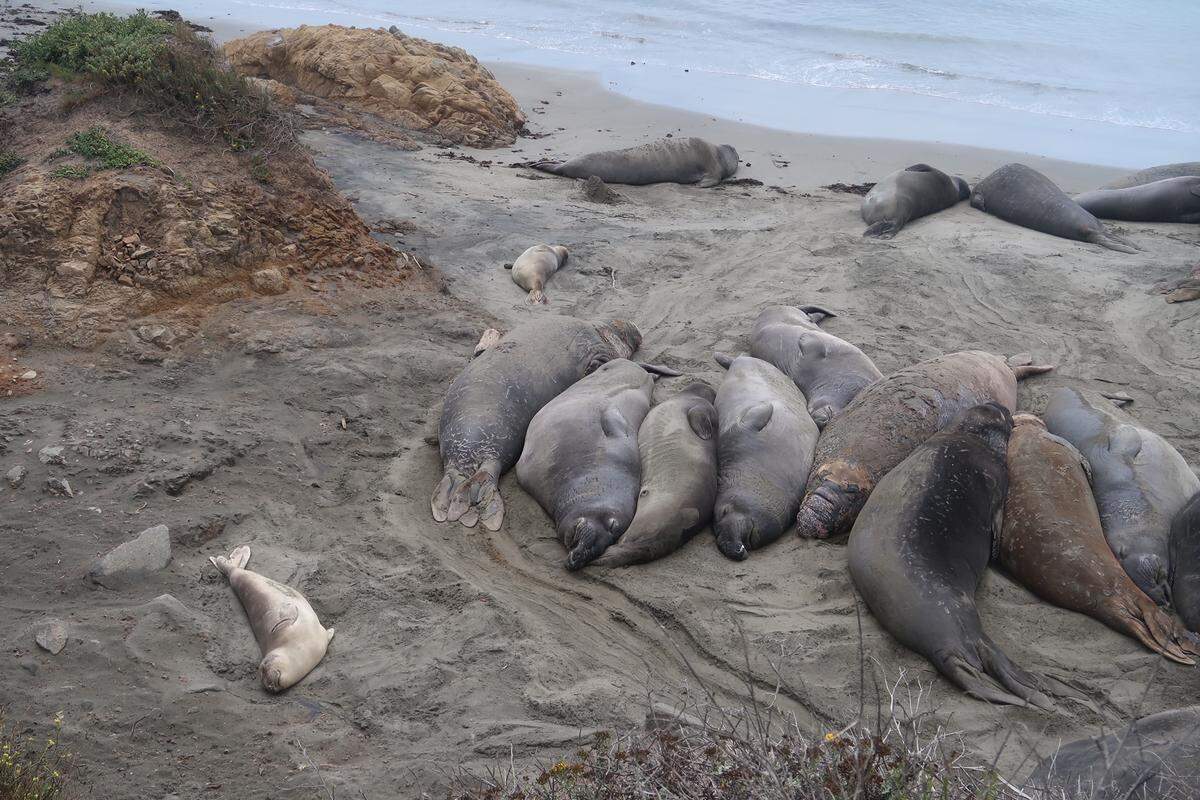
Bull elephant seals entertain visitors to Piedras Blancas rookery
The mature bulls are mostly done with their annual molt, last year’s skin peeling off to expose new skin underneath.
You can compare the size of the seal’s nose, known as a proboscis, to determine its age. The proboscis continues to grow throughout a seal’s life, so a bigger proboscis needs an older seal.
Although no adult females are on the beach for the bulls to fight over, they have been entertaining visitors with loud calling and bad-tempered sparring.
Mostly they sleep.
Every day, more bulls leave the beach, returning to the ocean to continue bulking up in anticipation of the breeding season.
Their next appearance on the beach will be in November and December. They arrive before the pregnant females, who begin to arrive in December.
The bulls will need all the blubber they can gain. They may go without food for as long as 120 days as they battle for dominance and breeding rights.