A snail found only near Morro Bay has rebounded from the brink of extinction
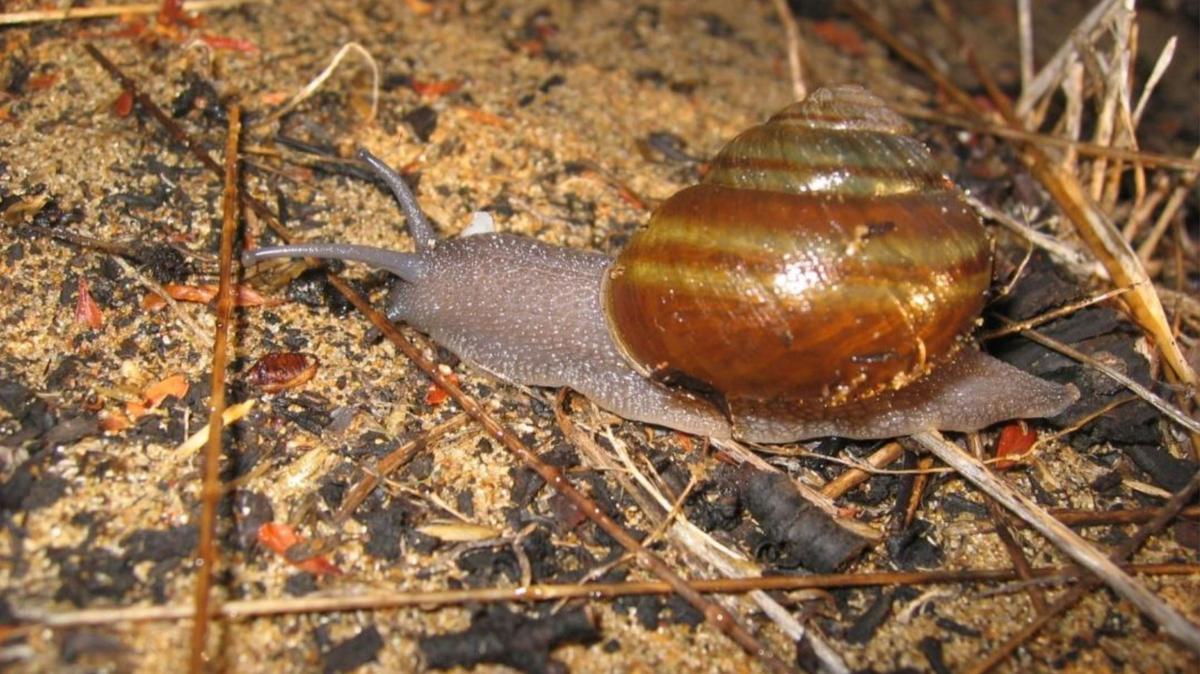
A snail found only in a small area of San Luis Obispo County is on the slow but steady road to recovery after being considered close to extinction for nearly 30 years.
The U.S. Fish and Wildlife Service has reclassified the Morro shoulderband snail, which lives solely in the Morro Bay and Los Osos area, from endangered to threatened.
The status change under the federal Endangered Species Act came Wednesday, about 28 years after the gastropod was first listed as endangered.
“This is good news for a laid-back, native SLO species,” said Jeff Miller, a senior conservation advocate at the Center for Biological Diversity and a Los Osos resident. “Like everything it does, this snail is moving very slowly and steadily toward recovery.”
The Morro shoulderband snail resides on about 6,520 acres located within the Elfin Forest Reserve, Sweet Springs Preserve, Morro Strand State Beach, Montaña de Oro State Park, Morro Bay State Park and Los Osos Oaks Preserve, according to Fish and Wildlife.
The small snail — its shell measures just barely an inch in diameter — is active during the rainy season or when dense fog shrouds the Central Coast. It resides in leaf litter or on the undersides of the lower branches of native dune scrub. It’s named for the dark, spiral band on the “shoulder” of its shell.
At the time of its listing of endangered in 1994, it was estimated only a few hundred existed. The snails that did were considered at high risk of extinction due to threats to their habitat from development, invasion of nonnative plants, parasites and competition from nonnative snail species.
Years of land acquisition in the area for conservation purposes, however, meant the Morro shoulderband snail’s critical habitat was better protected. To date, about 85% of the snail’s critical habitat is shielded from development, according to Fish and Wildlife.
Organizations such as the Morro Coast Audubon Society have also helped protect the species by removing invasive, nonnative plant species such as perennial veldt grass and blue gum at the Sweet Springs Preserve in Los Osos. Volunteers have done the same at the Elfin Forest Reserve.
Construction of the Los Osos sewer system provided a great opportunity for scientists to better study the snails, and researchers soon discovered that parasites and other snail competitors weren’t as significant threats as previously thought.
For example, researchers found the brown garden snail mostly eats live plant materials, while the Morro shoulderband snail eats primarily dead plant materials — therefore indicating the two would not need to duke it out over food sources.
According to the latest surveys, more than 2,200 Morro shoulderband snails were counted between 2012 and 2017.
“Recovery of this snail demonstrates that to save species from extinction, we have to protect the places where they live,” Miller said. “A bonus of saving the Morro snail is it helped in creating and protecting many of the local preserves and open spaces we all love, making life better for all on the Central Coast, from people to gastropods.”
Reclassifying the snail as threatened does not mean the species is completely safe, however, as it is still at risk of extinction.
“Based on our future scenario analyses, the species is still at risk in the future due to the potential for development and because the level of continued conservation efforts and habitat management is uncertain,” Fish and Wildlife wrote in its reclassification. “Currently and into the future, habitat loss due to development and habitat degradation, predominantly from invasive plant species, remain threats to the Morro shoulderband snail.”
The agency found that destruction of its habitat from development, wildfire and invasive plant species, as well as effects to its life cycle from changing climate conditions, pose the greatest risks to the snail today.
Invasive species removal and controlled burns may hurt the snails but are allowed within their habitat if granted permits from Fish and Wildlife.
“Exposure to fire can result in individual mortality; however, an evolutionary strategy has enabled the species to persist in these habitats,” Fish and Wildlife said in its reclassification of the snail.
The Morro shoulderband snail is one of several Central Coast species that has recently at least partially recovered while protected under the federal Endangered Species Act, including the peregrine falcon, bald eagle, brown pelican, snowy plover, California condor and southern sea otter.