Massive Central Coast marine sanctuary gets closer to federal protection. What’s next?
The Chumash Heritage National Marine Sanctuary is one step closer to becoming a reality, according to an announcement from federal officials Tuesday morning.
The massive proposed marine sanctuary has been in the National Oceanic and Atmospheric Administration’s nomination phase since 2015. It now officially moves to the designation phase.
That means NOAA is now looking at the potential sanctuary’s boundaries and soliciting public input on its scope.
Central Coast Congressman Salud Carbajal (D-Santa Barbara), U.S. Senators Dianne Feinstein and Alex Padilla of California and U.S. Representatives Julia Brownley (D-Westlake Village) and Jimmy Panetta (D-Carmel Valley) indicated their enthusiasm about the move on Nov. 9, along with several White House officials.
“I am thrilled the Biden administration has taken this step to protect our coastal areas from further oil and gas drilling and strengthen our state’s $1.9 trillion coastal economy, which is propped up by tourism and commercial fishing,” Carbajal said in a prepared statement. “Bringing the proposed sanctuary into the designation phase is the result of years of public engagement and I am grateful that we are one step closer to permanently protecting our coastline for future generations to inherit and enjoy.”
In his announcement, Carbajal praised the “steadfast leadership” of the late Fred Collins, chairman of the Northern Chumash Tribal Council. Collins, who died in October, was the applicant for the proposed marine sanctuary.
“(His) advocacy was instrumental in moving this project forward,” Carbajal said.
Violet Sage Walker, Collins’ daughter and the Northern Chumash Tribal Council’s chairwoman, said NOAA’s decision to advance the public process to designate the marine sanctuary was an important step forward.
“Successfully designating the Chumash Heritage National Marine Sanctuary will protect ocean life, sacred Chumash sites, strengthen Indigenous communities and serve as a model of environmental justice,” Sage Walker said in a statement. “Today’s announcement marks a major milestone after more than 40 years of tireless advocacy for ocean protection, and also represents the first tribally-nominated sanctuary in the nation. Today my father would be proud. This is one of the things he wanted to see the most.”
Cambria resident P.J. Webb, an advisor to the Northern Chumash Tribal Council, added that NOAA’s decision shows that even small movements have the power to create change.
“It is amazing to see a small grassroots Indigenous and community collaboration persevere through time and grow in size and scale to become a powerful symbol for what people can do if they care for our ocean and planet,” she said. “This growing wave of support can carry us to a better future for those who come after us.”
Should the Chumash Heritage National Marine Sanctuary be officially designated, it would be a large contribution to the Biden administration’s so-called “30x30” plan to conserve 30% of the nation’s ocean areas by 2030.
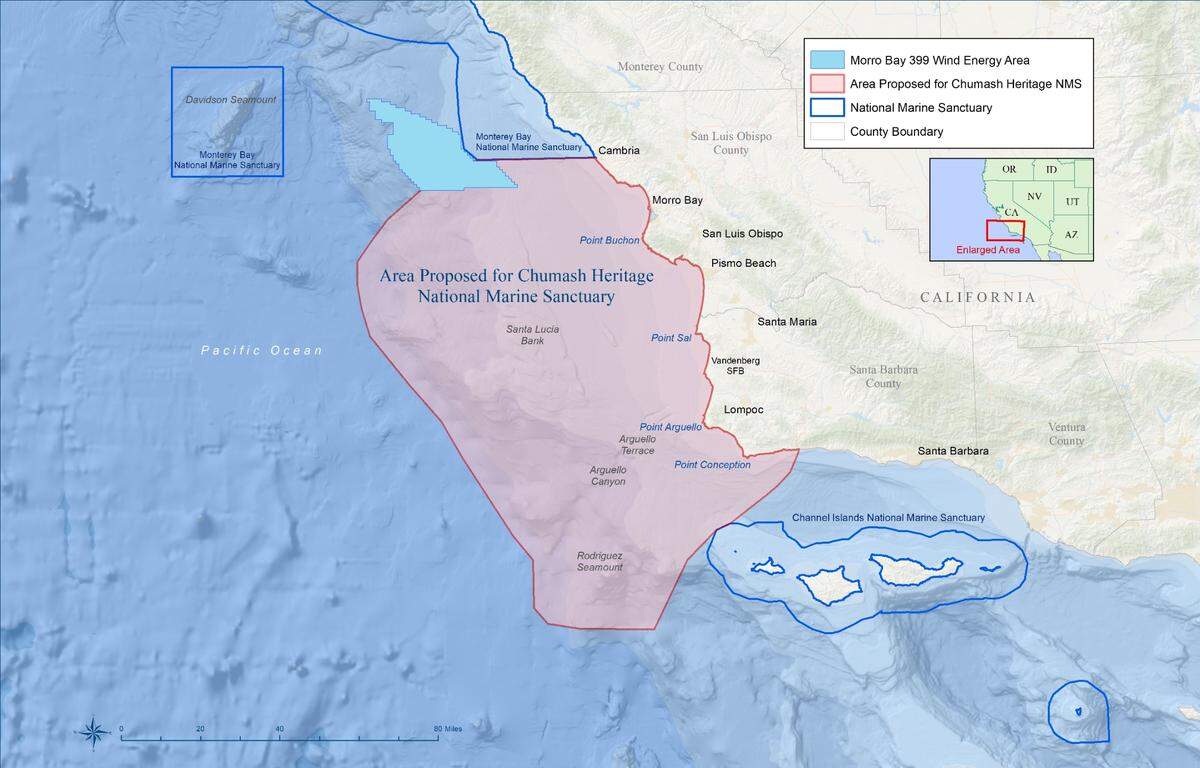
The proposed marine sanctuary stretches along 156 miles of California’s coastline from Cambria to just south of Point Conception. It expands far out into the Pacific Ocean, encompassing 7,670 square miles, according to NOAA.
The Chumash Heritage National Marine Sanctuary would sit between the Monterey Bay and Channel Islands national marine sanctuaries.
If approved, the marine sanctuary would offer federal protection for the area’s rich biodiversity and Chumash tribal history. It includes an area where the Chumash Peoples lived during a time when the ocean level was 300 feet lower.
The proposed sanctuary would encompass other aspects of U.S. history as well, such as the wreck of a Civil War-era ship.
“The proposed sanctuary will recognize and preserve Chumash tribal heritage, protect the area’s rich biodiversity and build resilience to changing ocean conditions,” Rick Spinrad, NOAA administrator, said in a statement. “This special section of coast supports a way of life for many communities that rely on commercial fishing and enjoy recreational fishing, kayaking, surfing, diving and wildlife watching.
“NOAA heard strong support from tribal leaders, a diverse set of groups, state officials and several members of the California congressional delegation for moving forward with this proposed national marine sanctuary.”
The protection would prohibit any future development in the sanctuary’s boundaries, including oil rigs and offshore wind farms. The nominated marine sanctuary’s boundaries were adjusted to exclude the 399-square-mile proposed offshore wind farm located off the coast of Cambria and San Simeon, known commonly as the Morro Bay 399 area.
“This administration is committed to taking a holistic approach to addressing the climate crisis,” Gina M. Raimondo, U.S. secretary of commerce, said in a statement. “Together, the Department of Commerce, through NOAA, and the Department of Interior, along with many partners, are increasing resilience by conserving and restoring the natural and cultural resources that benefit our country and our planet; working to reduce emissions by fostering clean energy like offshore wind; and supporting frontline communities by helping them build back smarter and adapt to the impacts of climate change.
“Proposals like the Chumash Heritage sanctuary and Morro Bay 399 Area are great examples of how we can advance these goals in conjunction with each other.”
Uses such as fishing, boating, diving and walking along the beach would still be allowed within the sanctuary’s boundaries.
“On California’s Central Coast, we have a chance to both harness the wind energy potential of our ocean and better protect the area’s extraordinary natural and cultural heritage,” Gina McCarthy, national climate advisor, said in a statement. “To tackle the climate crisis we must — and we will — move ahead simultaneously with conservation and smartly-sited clean energy production.”
Sen. John Laird (D-Santa Cruz) noted that the proposed sanctuary “will be great for people and wildlife.”
“(The proposed sanctuary will) generate an estimated $23 million in economic activity plus 600 new jobs,” he said in a statement. “It will safeguard the region from offshore oil expansion and prevent oil spills that have devastated beaches elsewhere. In short, the Chumash Heritage National Marine Sanctuary is a great idea, whose time has finally come.”
NOAA’s move to place the proposed marine sanctuary into the designation phase was welcome news to local environmental groups.
“It’s impossible to fully calculate all the benefits the Central Coast will receive as a result of the ecosystem-based management that a national marine sanctuary brings, as marine sanctuaries offer environmental protections other regulations don’t,” said Andrew Christie, director of the Santa Lucia Sierra Club.
Not all are strong proponents of the proposed marine sanctuary.
In a letter to NOAA in June 2020, the Alliance of Communities for Sustainable Fisheries wrote about the reasons Central Coast fishermen are opposed to the sanctuary.
“For fishermen ... having a NMS (national marine sanctuary) manage areas they fish will mean that they will always have to watch their backs, wondering what NMS management will do,” the letter said.
The letter also noted the already strong protections for ocean resources along California’s coast, including strict fishing regulations.
The Chumash Heritage National Marine Sanctuary is now in the first phase of the four-step federal designation process, known as the scoping phase.
NOAA is seeking public input on the sanctuaries boundaries as well as which resources could be protected and other issues the federal agency should consider.
Once comments are received, gathered and analyzed, the sanctuary may move into the sanctuary proposal stage, during which NOAA prepares draft designation documents including a draft management plan and draft environmental impact statement.
After that, NOAA opens up those documents for public review and may implement changes based on the comments received.
Then, NOAA makes a final decision on the proposed sanctuary and prepares final documents which may be reviewed by California’s governor and Congress. It will likely take about two to three years before any final decision is made, according to NOAA.
The public can comment on the proposed sanctuary designation starting Wednesday and until January 10, 2022, through the Federal eRulemaking Portal, www.regulations.gov. The docket number is NOAA-NOS-2021-0080.
NOAA will also host virtual public meetings on Dec. 8, Dec. 13 and Jan. 6, during which members of the public can offer oral comments.
A detailed description of the proposed sanctuary, as well as additional information about opportunities to provide comments, can be found at sanctuaries.noaa.gov/Chumash-heritage.
This story was originally published November 9, 2021 at 9:25 AM.