
More butterflies flock to Central Coast monarch grove — but it’s still at ‘all-time low’
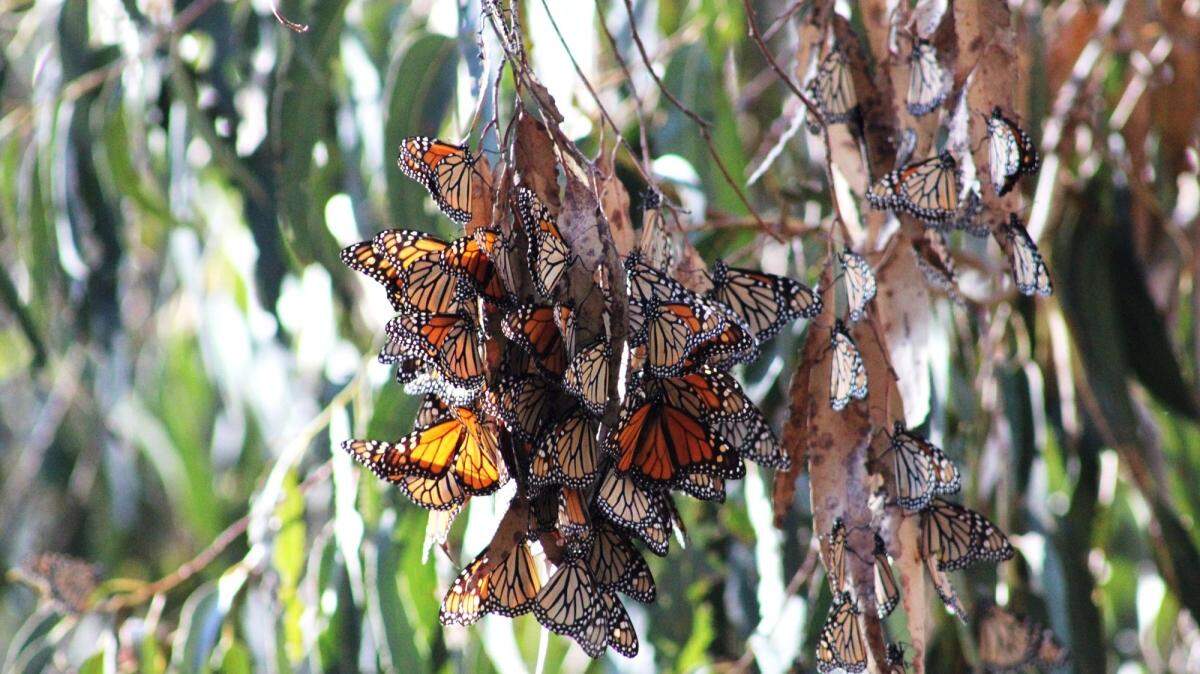
The most recent count of overwintering western monarch butterflies at Ellwood Mesa in Goleta shows an increase in the population compared to 2020, but the numbers are still at an “all-time low.”
The Pismo State Beach Monarch Butterfly Grove recently saw a 3,500% increase in monarch butterflies compared to the previous year, when volunteers spotted about 200 butterflies.
Meanwhile, the Ellwood Mesa butterfly grove hosted 16 monarch butterflies last year, and an early count this year showed 28 butterflies, according to George Thomson, parks and open space manager for the city of Goleta.
“We’re seeing more butterflies compared to last year, but nowhere near what we’ve seen historically,” Thomson said.
Approximately 47,510 monarch butterflies were observed at Ellwood in 2011, Thomson said, but the population has had a consistent decline since then.
According to the Xerces Society for Invertebrate Conservation, 60,750 monarchs were counted between all the butterfly groves at Ellwood Mesa in 1997, the earliest Thanksgiving weekend count recorded by the group.
Monarch butterfly counts at all overwintering sites in California also have been historically low the past few years, totaling approximately 1,914 monarchs throughout the state in 2020.
Thomson said that many different factors have contributed to the decrease in the monarch populations, such as droughts, climate change, and increased pesticide use, which have all led to the loss of habitat for monarchs.
Migratory western monarch butterflies come to Ellwood Mesa and other butterfly groves in coastal California, where they spend the winter, between October and February each year before heading to the foothills and into Nevada in the spring.
While early butterfly counts throughout the state are still resulting in historically low numbers, the Xerces Society has reported that these overwintering sites are starting to see greater numbers, with about 10,000 monarchs accounted for so far.
“We are overjoyed that migratory monarch butterflies have not disappeared from the Western U.S.,” Emma Pelton, a senior conservation biologist and western monarch lead for the Xerces Society, said in a news release on Oct. 21. “These early counts give us hope that, if we all work together, we can still bring western monarchs back.”
Thomson said that improvements are still being made to the Ellwood Mesa to bring back the monarchs, such as removing dead eucalyptus trees and replanting trees and native plants, as well as making improvements to trails and signage for public use.
The city of Goleta received a $3.9 million grant from the California State Coastal Conservancy in 2019 to implement its Monarch Butterfly Habitat Management Plan. In 2020, the grant was extended through 2023.
The city also hopes to expand its Ellwood Mesa volunteer program, which consists of advocacy and the docent program.
Thomson said that over the next four years, with the help of volunteers, they will be planting more than 100,000 native plants at the Ellwood Mesa/Sperling Preserve Open Space.
While planting milkweed is typically seen as a way to help monarch butterflies in other areas, Thomson emphasized that the plant is not recommended on the Central Coast or near other overwintering sites in coastal California.
He said that the monarch butterflies only stay here through the winter, and milkweed would encourage the butterflies to lay eggs in them, leading to a year-round population of monarchs. The Goleta area, and other overwintering sites, is not properly equipped for monarchs year-round, particularly in the summer.
Additionally, milkweed planted near overwintering sites, and winter breeding, can cause a disease in monarch butterflies called Ophryocystis elektroscirrha, which creates deformities in the butterfly’s wings when they hatch.
Although Thomson and other monarch experts don’t expect to see a huge increase in monarch butterflies this year, the small increases are creating hope.
“It’s encouraging,” Thomson said. “We have our fingers crossed.”