Much of SLO County is now in drought after dry winter. Are communities in trouble?
After a summer and fall of record-breaking heat, followed by a relatively dry winter, much of San Luis Obispo County is experiencing moderate drought conditions. And there’s no substantial rain in the local weather forecast.
Right now, the effects of the drought are hard to see. The hills surrounding San Luis Obispo and the North Coast are green as wildflowers pop up around the county and local reservoirs remain at good levels.
Local municipalities say residents don’t need to worry about any water cutbacks or restrictions for now — unlike much of the rest of the state.
But should the drought conditions continue, the combination of extreme heat and little rain may result in a long fire season.
“Every year, we’re getting more critical fire weather,” said Adan Orozco, Cal Fire public information officer for San Luis Obispo County. “We always prepare for the worst and this year is no exception.”
No ‘mini Miracle March’ in store for SLO County
Back in February 2020, local weather conditions looked much like they do now. San Luis Obispo County was abnormally dry, having received a countywide average of 7.5 inches of rain at the time, according to the National Oceanic and Atmospheric Administration.
Then came a “mini Miracle March,” as local PG&E meteorologist John Lindsey calls it. In March and April combined, San Luis Obispo County received an average of 6.78 inches of rain, according to NOAA — saving the county from plummeting into a drought.
This year, as the end of March nears, there is little to no rain on the forecast, according to Lindsey.
A total of about 0.25 inches of rain are predicted for April 5, 6 and 7, which is not even close to the “mini miracle” the county saw in 2020, he said.
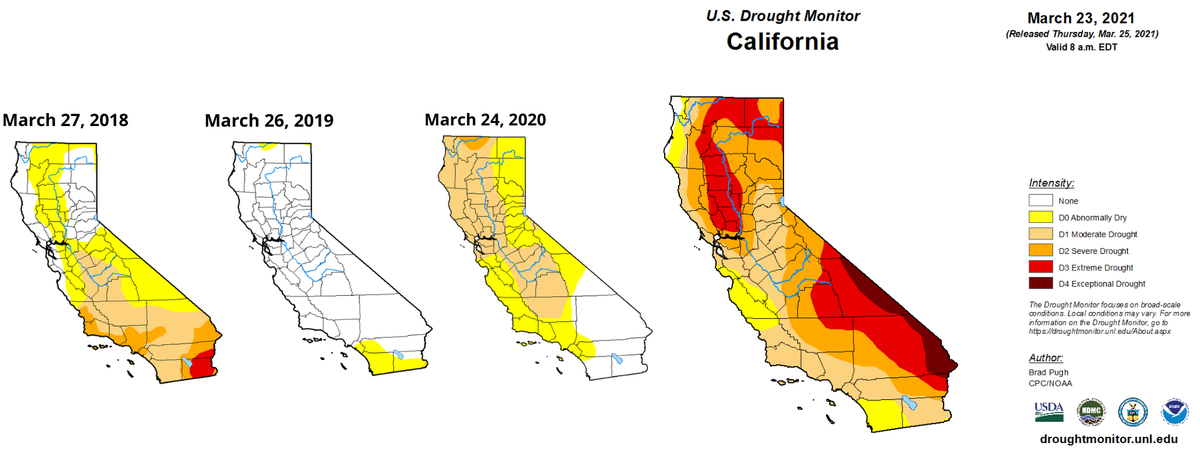
Despite the deluge brought by a major rain storm in late January, much of San Luis Obispo County is now in the low levels of drought conditions, according to the U.S. Drought Monitor.
North County areas are facing “abnormally dry” conditions, according to the Drought Monitor, while the rest of the county is in a “moderate drought.”
This means that the soil is dry, pasture growth is stunted, stock ponds and creeks are lower than usual and fire season has begun, according to the Drought Monitor.
It’s the first time since 2018 that the county has been in a month-long drought during March, which is typically the final month in the Central Coast’s three-month rainy season.
San Luis Obispo County is not the only area in California that is currently facing drought conditions. Conditions are much worse in other areas of the state, according to the U.S. Drought Monitor.
The California Department of Water Resources has warned cities and farmers who participate in the State Water Project that there will likely be restrictions and cutbacks soon should drought conditions persist.
Where do communities get their water?
In San Luis Obispo County, the communities of Avila Beach, Morro Bay, Avila Beach, Oceano and Pismo Beach subcontract with the county as part of the State Water Project, along with other agencies, such as Cuesta College, California Men’s Colony state prison in San Luis Obispo and San Luis Coastal Unified School District.
All other municipalities in the county manage their own water and receive water solely from local sources such as reservoirs and groundwater wells, and therefore won’t be subject to any water limitations from the state.
San Luis Obispo city officials say no water cutbacks or restrictions are in the future, largely thanks to the city’s conservation and water source diversification efforts over the last few decades.
Aaron Floyd, the city’s utilities director, said San Luis Obispo has about 10 years’ worth of water for its residents stored. That’s largely thanks to lessons the city learned after a massive drought struck the state from 1986 to 1992.
“When we came out of the big drought of the late ’80s, the community was down to about 18 months of water left at that time,” Floyd said. “Since then, the community recognized the need to have greater water security and resiliency.”
So San Luis Obispo invested in Lake Nacimiento water pipeline projects and a recycled water system to expand its water sources.
Right now, the city has about 37,000 acre-feet of water available to use, Floyd said. But typically the city only uses about 4,700 acre-feet of water in an entire year, he said.
Floyd said the city has been working to diversify its water sources to ensure it has a large pool to sip on. In addition to San Luis Obispo’s main sources of drinking water, Santa Margarita Lake, Whale Rock Reservoir and Lake Nacimiento, the city uses recycled water for most of its irrigation of parks and green spaces, he said.
Soon, the city will tap into the groundwater wells, which have gone largely untouched by the city for the last few decades, Floyd said. This will allow the city to pull water from the wells should the reservoirs run low, he said.
The city of Paso Robles predicts that its water supplies “will be sufficient to serve short-term and long-term water demands,” Kirk Gonzalez, the city’s interim water resources manager, wrote in an email to The Tribune.
To date, the area has gotten about 64% of the average precipitation it has historically received during the rainy season, Gonzalez noted in his email.
”Water storage in Lake Nacimiento is approximately 40% of total capacity and water levels in the city’s wells will not negatively impact water delivery in the immediate future,” Gonzalez wrote. “As such, the city doesn’t currently expect to require any special water use restrictions.”
On the North Coast, Cambria relies on well water for its drinking water source. The January storm brought well levels up, but not quite enough for Cambria Community Services District general manager John Weigold to completely relax.
“While our well levels rose significantly as a result of the rain, we are really only at historical average for this time of the year,” Weigold wrote in an email. “We will need to keep close tabs on the well levels, particularly if dry conditions persist.”
Should drought conditions persist and worsen, the state could impose mandatory water cutbacks, as it did during the last severe drought in 2015 to 2017.
What are SLO County reservoir levels?
One indicator of the severity of a drought is how full reservoirs are in the county.
In San Luis Obispo County, lake levels look good early in the drought.
Lake Nacimiento northwest of Paso Robles is at 41% capacity, while Santa Margarita Lake is at 71.5% capacity and Lopez Lake near Arroyo Grande is at 39.2% capacity. Whale Rock Reservoir near Cayucos is at 78% capacity.
These capacity levels are lower than what they were immediately following the January storm, and much lower when compared to the previous March.
Lopez Lake had received 13.35 inches of rain during the rainy season as of March 2020, compared to 10.65 inches to date during the 2020-2021 rainy season.
San Luis Obispo Parks & Recreation Superintendent Ken Klis said that the area will need another few good showers of rain to raise the level of Lopez Lake.
However, that doesn’t necessarily mean that the lake will start running out of water for the municipalities it serves, he said, which include Arroyo Grande, Avila Beach, Grover Beach, Oceano, Pismo Beach and Shell Beach.
“The only time we’ll start having negative impacts here would be three or four more years of drought,” Klis said. “That’s when we start getting into a critical situation.”
Drought conditions are ‘concerning,’ Cal Fire says
The lack of rain has caused the grasses in the eastern part of San Luis Obispo County to remain dry and brown. And while grasses closer to the coast turned green, they didn’t grow as tall as they normally do, Orozco said.
Cal Fire has been working to create fuel breaks and maintain fire roads in case of a fire, he said.
The agency will hire about 95 new seasonal fire fighters before the fire season begins, he said.
Drought conditions in much of the county are “concerning,” Orozco said. “When we get hot days like we’re getting this week with the wind, those grasses will start to dry out a lot quicker. With the little precipitation, the grass crop is not as tall as it was last year, but it will still be dangerous when it’s dry because the fires move a lot faster with the shorter grass.”
For now, Floyd said he advises residents to conserve water when possible.
He also noted that it is a good idea to check any irrigation systems you may have in your yard for leaks that could have shown up during the winter months.
San Luis Obispo residents can win $3,000 toward their home utility payments, water saving fixtures and hundreds of other prizes by participating in the Wyland National Mayor’s Challenge for Water Conservation.
You enter online at mywaterpledge.com to make a series of online pledges to conserve water on behalf of San Luis Obispo.
For tips on ensuring that your home is fire safe, visit Cal Fire’s website at readyforwildfire.org.
This story was originally published March 31, 2021 at 11:43 AM.
CORRECTION: This story was updated to include Santa Margarita Lake as the main source of drinking water for the City of San Luis Obispo.