
7 juvenile condors moved to San Simeon for release next month
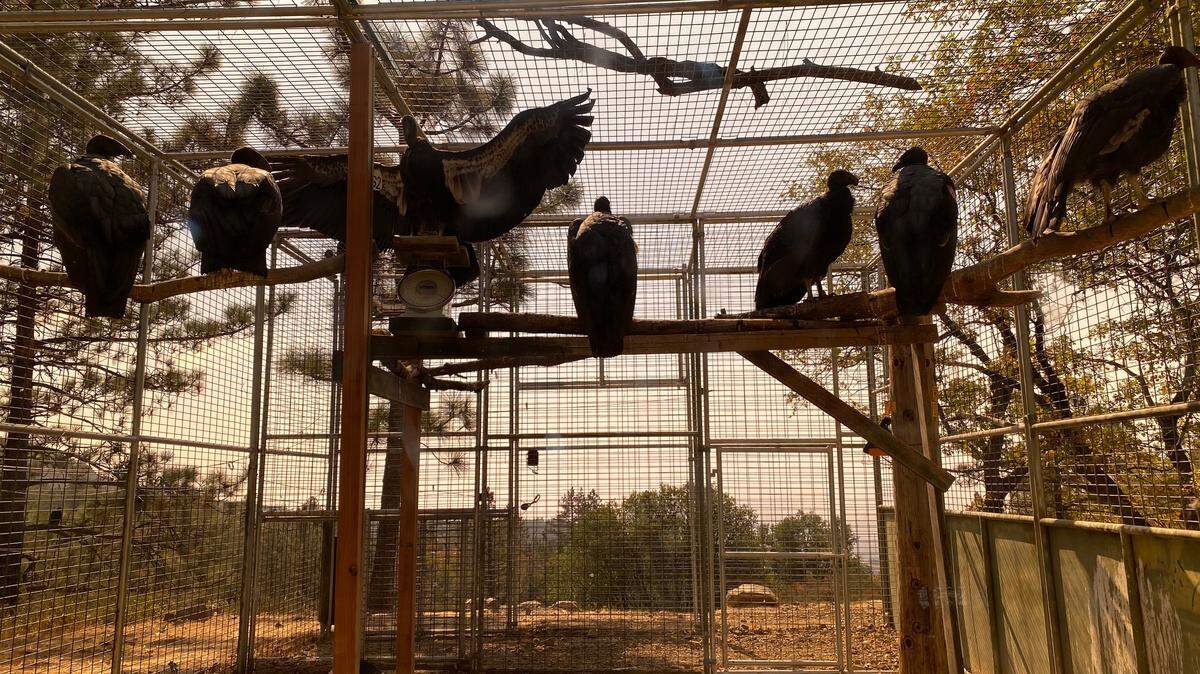
A cohort of seven juvenile California condors have taken temporary residence in the rugged mountains high above San Simeon in preparation for their release next month.
The young birds were moved to a large holding pen on the North Coast on Oct. 7, ahead of a planned release by mid-November, according to Kelly Sorenson, executive director of Ventana Wildlife Society in Big Sur.
It is particularly fortuitous that these giant and endangered birds — raised in captivity at San Diego Zoo Global — are about to join the wild flock at this moment.
On Aug. 20 and 21, the ferocious Dolan Fire destroyed the condors’ Big Sur sanctuary. Two chicks died in the fire and nine other free-flying condors went missing, Sorenson said in a news release.
The seven juveniles — three years from maturity and mating yet fully grown with 9-1/2 foot wingspans — are in the same holding pen that has been the release site for 28 juveniles since 2016.
Of those, 24 remain alive. Two died of lead poisoning (the biggest threat to condors), one is missing following the Dolan Fire, and a fourth died from unknown sources.
The cohort of seven condors have been given names that honor descendants of Central California’s indigenous peoples — the Salinan, Esselen and Rumsen tribal communities, Sorenson said.
Linda Yamane, a member of the Rumsen Ohlone Tribal community, interviewed by VWS, said: “We are honored these condors will carry a reminder of our people with them. … Their massive wings will carry them over our traditional homelands.
“Like condor, our languages were once near extinction, but we have worked hard to breathe new life into our ancient languages and are keeping them safe for the future.”
Condor “Pixchi” is named for the Pico Blanco Mountains in Big Sur; in the Esselen language, Pixchi is pronounced “Pee-chee.”
“Tich” is the word for “condor” in the Antoniano dialect of the Salinan language; pronounced “Teech.”
“Wassak” is the word for “condor” in the Rumsen language; pronounced “WAHS-aek.”
“Muursh” means “to be dark” in Rumsen; pronounced “MOORSH.”
“Xakkin” means “to eat ravenously” in Rumsen; the pronunciation is “HAWK-een.”
“Sottow” means “black” in Rumsen; pronounced “SO-toe.”
And “Xuchen” means “to get to be first” in Rumsen language; pronounced “HOO-chen.”
Meanwhile, the campaign to rebuild the ravaged Big Sur Sanctuary has raised over $465,000, Sorenson said. Launched by VWS, a key collaborator with the California Condor Recovery Program, the fundraiser received substantial contributions from Margaret and William R. Hearst III, the Hind Foundation, U.S. Fish and Wildlife Service, among many others.
Currently there are 90 condors flying free in Central California – between the Big Sur flock and birds in Pinnacles National Park — and 507 are in the air in the Western United States.
“2020 has just been a terrible year for condors, and as a result, we need to re-double our efforts to restore condors to the wild,” Sorenson concluded.
Ventana Wildlife Society has announced that both live-streaming cameras in Big Sur’s Sanctuary are operational. For more information on condors and to access the cameras, visit www.ventanaws.org.