Plan could send 70 oil trucks a day along SLO County’s border – if SB County approves
After years of planning, ExxonMobil’s proposed revival of its offshore oil production off the Santa Barbara County coastline is coming up for key hearings next month that, if approved, would use trucks to transport oil along San Luis Obispo County’s southern border.
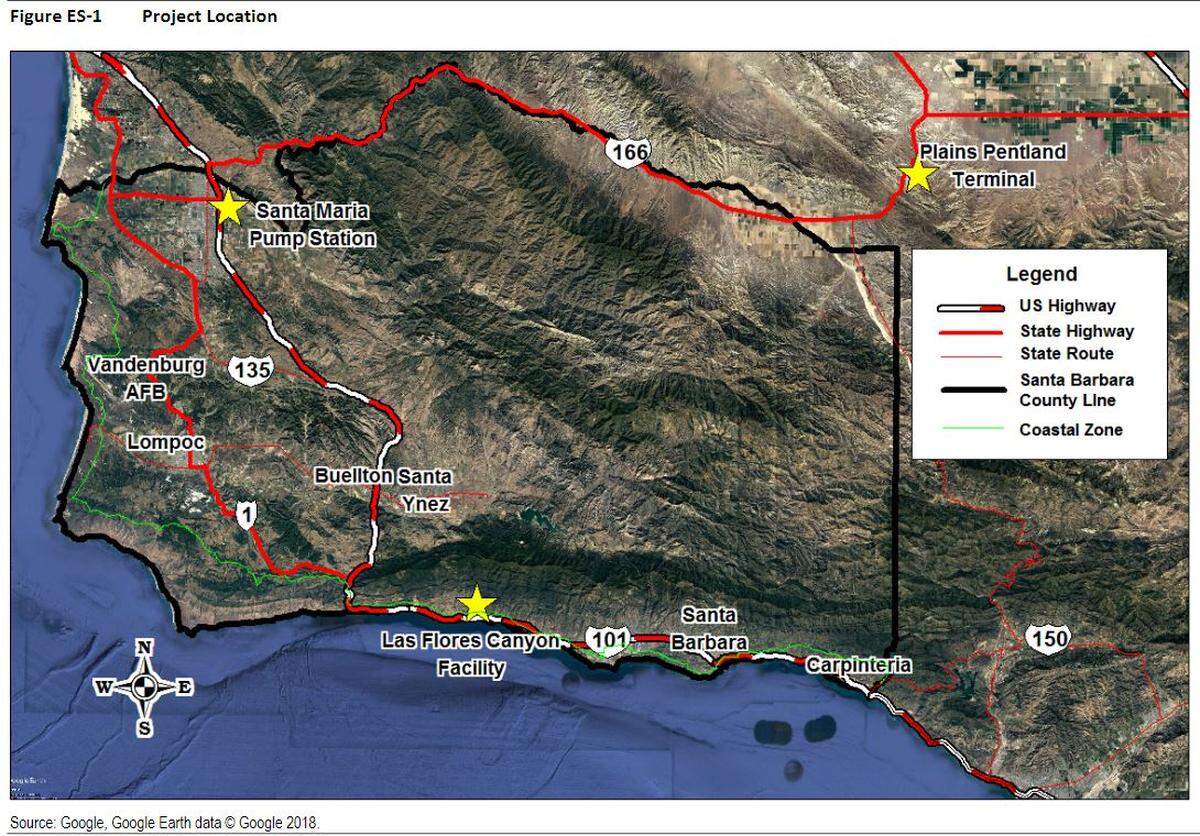
The oil company hopes to begin a “phased restart” of its Santa Ynez Unit by using trucks to move about 470,400 gallons of oil a day from its Las Flores Canyon facility on the Gaviota Coast to either the Phillips 66 Santa Maria Pump Station in Santa Maria, or the Plains Pentland Terminal in Kern County.
Up to 70 oil trucks per day would carry about 6,720 gallons of oil each along Highway 101 to the Santa Maria pump station, and then along Highway 166 on the border of Santa Barbara and San Luis Obispo counties to the Pentland Terminal.
After reviewing the newly released final environmental impact report, The Santa Barbara County Planning Commission is scheduled to hold hearings on the project in early September before voting on it. Already, Santa Maria and Buellton city councils have passed resolutions in favor of the proposal, while Santa Barbara, Goleta and San Luis Obispo city councils passed resolutions in opposition.
Environmental groups strongly oppose the plan, citing the environmental and safety risks.
Why the need for a phased restart?
In May 2015, a pipeline managed and operated by Plains All American Pipeline, a Texas-based company, corroded and leaked thousands of gallons of crude oil onto the shore and into the Pacific Ocean near Refugio State Beach.
The company subsequently shut down the pipeline, shuttering ExxonMobil-associated offshore oil rigs. Multiple investigations into the incident led to criminal charges and a new law requiring safety updates to pipelines.
Plains All American in March settled subsequent lawsuits for $60 million, which will largely go to restorative projects and for paying back previous oil spill cleanup costs.
Now, the company has proposals filed to rebuild a 124-mile long pipeline running through Santa Barbara, San Luis Obispo and Kern counties, mostly along the route of the existing pipeline.
The pipeline would transport oil from the Las Flores Pump Station to an existing delivery point at Pentland in Kern County. Some of the oil would be diverted through an existing pipeline to the Phillips 66 refinery in Nipomo.
From there, it would travel to Bay Area refineries, where it would be further refined into gasoline, jet fuel and diesel.
In a bid to restart operations while Plains All American continues to develop its pipeline rebuild proposal, ExxonMobil has created a plan to use trucks to transport oil to to either the Phillips 66 Santa Maria Pump Station or Pentland in Kern County.
What environmentalists, community members are saying about the plan
Environmental groups and community organizations such as the Center for Biological Diversity, the Wishtoyo Chumash Foundation, the Environmental Defense Center, Food and Water Action, GOO!, the Sierra Club’s Los Padres Chapter and more have released statements opposing ExxonMobil’s trucking plan.
“This is a disaster waiting to happen,” said Stephanie Prufer, who works on protecting oceans from offshore drilling and plastic pollution for the Center for Biological Diversity.
Data compiled from the California Highway Patrol and obtained by Curt Bradley from the Center for Biological Diversity shows that there were 216 oil-truck accidents from 2015 through March 2020 along the proposed trucking route.
“This disturbing data shows that ExxonMobil will endanger California’s motorists and communities to get its offshore oil flowing again. Santa Barbara County officials can’t let that happen,” Prufer said. “Route 166 is just too treacherous for these tanker trucks. A crash along coastal Highway 1 could cause yet another oil spill in the Pacific Ocean.”
One oil truck crashed as recently as March 21, spilling about 4,200 gallons of crude oil into the Cuyama River above the Twitchell Reservoir, Santa Maria’s main source of water, according to Santa Barbara County Fire Department Public Information Officer Daniel Bertucelli. Luckily, cleanup crews were able to prevent the oil from leaking into the drinking water source.
According to a 2019 poll by Public Policy Polling, most Santa Barbara residents are concerned that offshore drilling is dangerous and oppose ExxonMobil’s plan.
Environmentalists and community members alike worry that the risk to the ecosystems that surround the trucking route is too high and have called upon Santa Barbara County officials to reject ExxonMobil’s proposal.
“Not only do the Chumash people originate from our local lands and waters, but Chumash culture itself is created from the relationship we have maintained with all beings in these ecosystems since time immemorial,” said Alicia Cordero, First Nations program officer with the Wishtoyo Chumash Foundation. “It is our sacred duty to protect and care for this natural abundance that all beings depend upon.”
ExxonMobil defends plan, citing economic benefits and stringent safety measures
If approved, ExxonMobil spokeswoman Julie King said the operation would bring in more than $4.5 million a year for schools in Santa Barbara, and $2 million a year in additional tax revenues.
“Santa Maria LULAC (League of United Latin American Citizens) supports restarting SYU (Santa Ynez Unit) because the restart would add millions of dollars into local schools that have large Latino populations,” said Mary Solorio Jackson, president of the Santa Maria LULAC Council in a statement to Santa Barbara for Safe & Local Transport, a coalition of residents, local businesses and ExxonMobil employees who support the trucking plan.
“Schools like Allan Hancock College, where nearly 60% of the students are Latino, and Santa Maria Joint Union High School District, a district where more than 18% of students are English-language learners, would receive significant funding when the county moves forward with the restart,” Solorio Jackson said in the statement.
Right now, 60 employees maintain the offshore drilling facilities and onshore operations in the area, King said. But if the plan is approved, King said that number could jump to 330 people, which is how many people worked to maintain the facilities before the oil spill in 2015.
Santa Barbara for Safe & Local Transport has created a website outlining the plan’s projected economic impacts.
Additionally, King said they have worked with the county to develop an extensive transportation safety plan to prevent truck accidents. The safety plan includes rigorous training, video cameras installed inside the trucks, and speed monitoring and limiting systems.
What’s next?
The Santa Barbara County Planning Commission is scheduled to hold hearings on the project on Sept. 2 and Sept. 9 before voting on it and sending it to the Santa Barbara County Board of Supervisors for a final vote.
If approved, ExxonMobil would begin construction of the truck loading facilities at the Las Flores Canyon facility and trucks would be on the road shortly thereafter.