
From Cal Poly to the moon: Artemis pilot Victor Glover reflects on historic mission
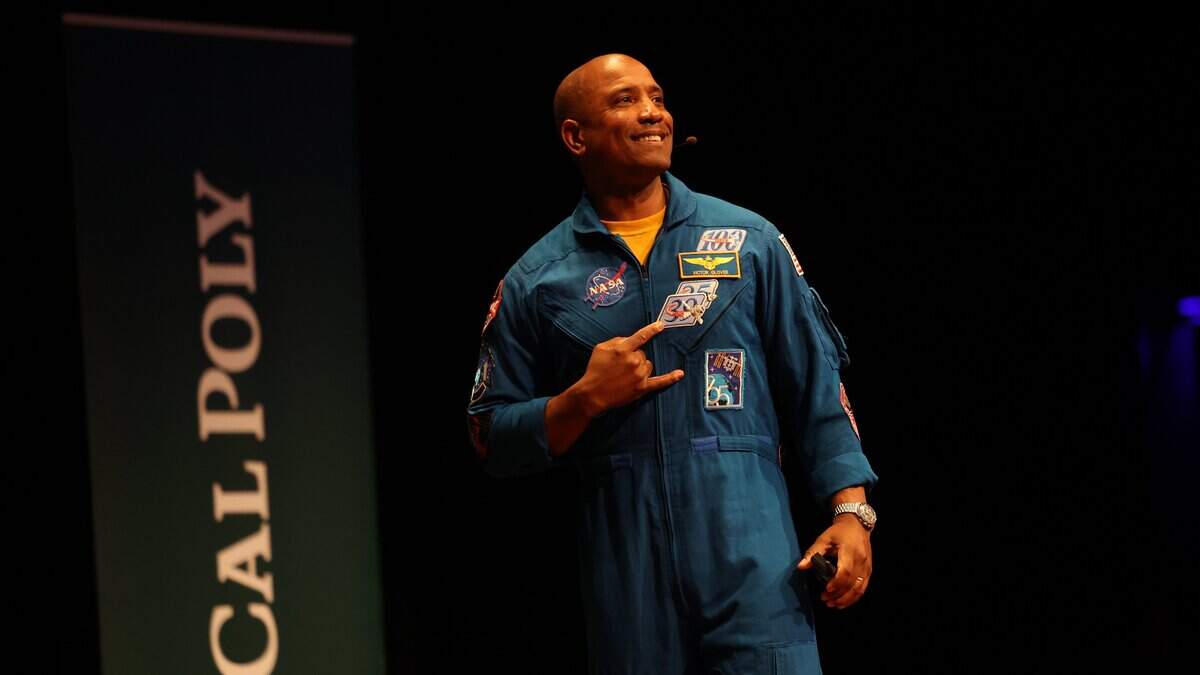
After successfully going farther into space than humans had ever gone before, Cal Poly alumnus and NASA astronaut Victor Glover isn’t touting the glory of his record-breaking off-world adventure or chasing the next historic mission — he’s more focused on the wonder and inspiration he derives from his own planet.
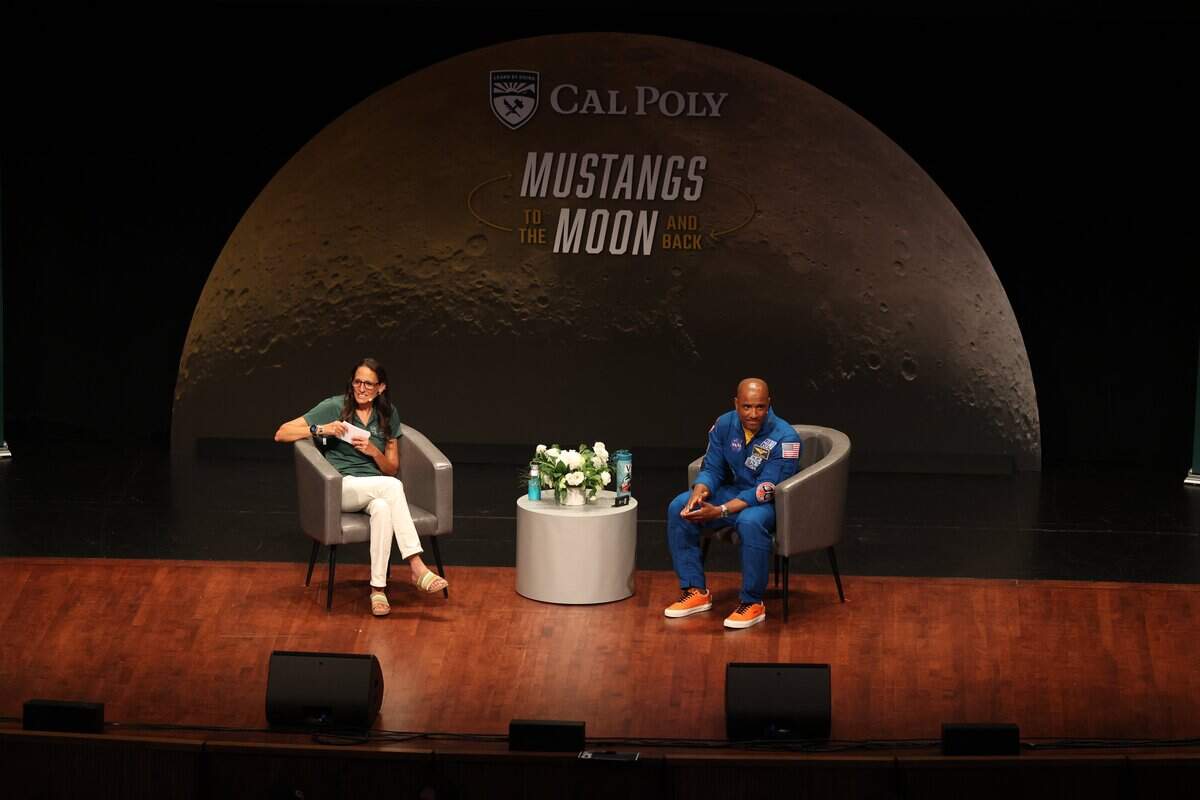
Glover visited his alma mater on Monday night, sporting his cobalt NASA jumpsuit as he addressed a packed crowd at the San Luis Obispo university’s Performing Arts Center. People of all ages littered the crowd, from faculty and alumni who knew Glover as a student to current Mustangs and recent graduates hoping to follow in his footsteps and young children craning their necks to catch a glimpse of what their future could look like.
The visit came a little over two months after Glover splashed down off the coast of San Diego after a historic lunar fly-by mission alongside fellow NASA astronauts Reid Wiseman and Christina Koch and Canadian Space Agency astronaut Jeremy Hansen. The four made up the crew of the 10-day Artemis II mission.
Glover’s appearance was also a uniquely local timing — he was already in town to help his daughters move out of Cal Poly housing for the summer.
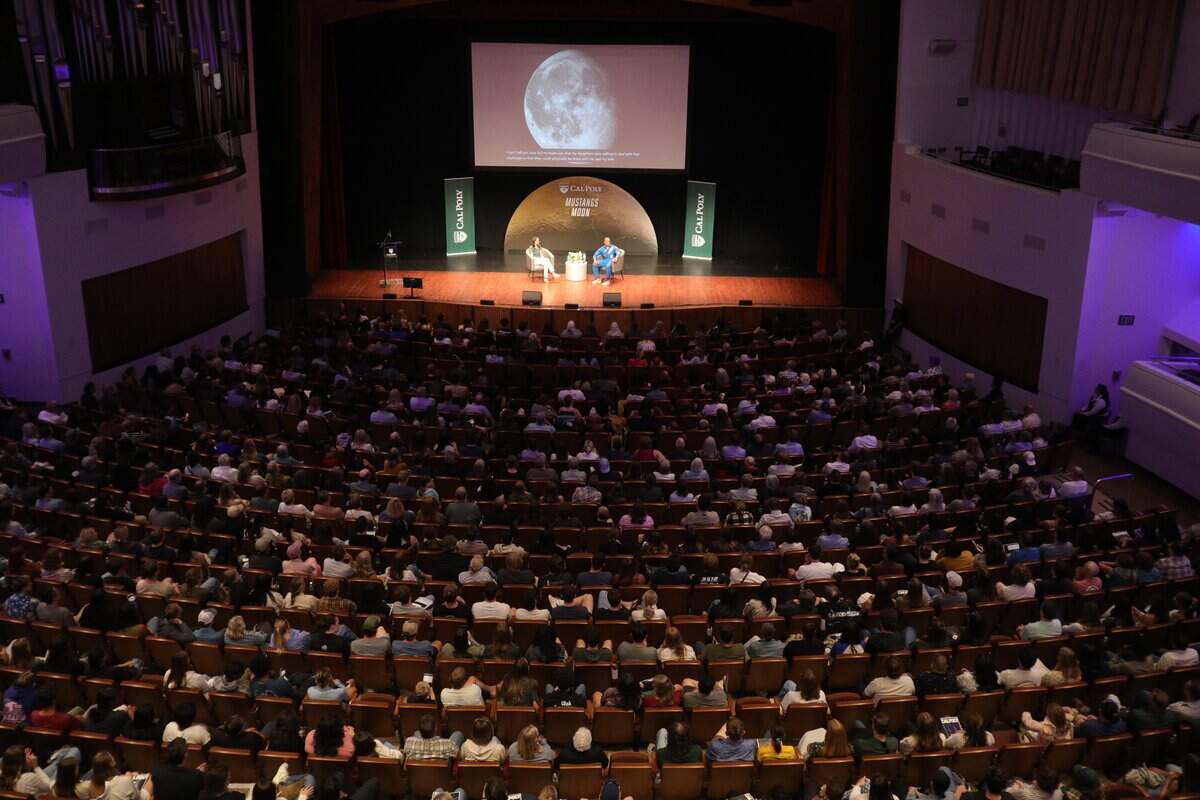
“That is the whole reason all of this is happening,” Glover told a group of reporters during a news conference ahead of Monday’s presentation. “I was here this weekend for Mustang move-out and, you know, when I told Cal Poly I was going to be here anyway, all of this happened.”
Glover’s daughters and wife Dionna were in the crowd Monday night, watching proudly from their balcony seats as Glover recounted his journey from Cal Poly to the Navy to NASA — but they weren’t the only ones with a personal reason for attending the event.
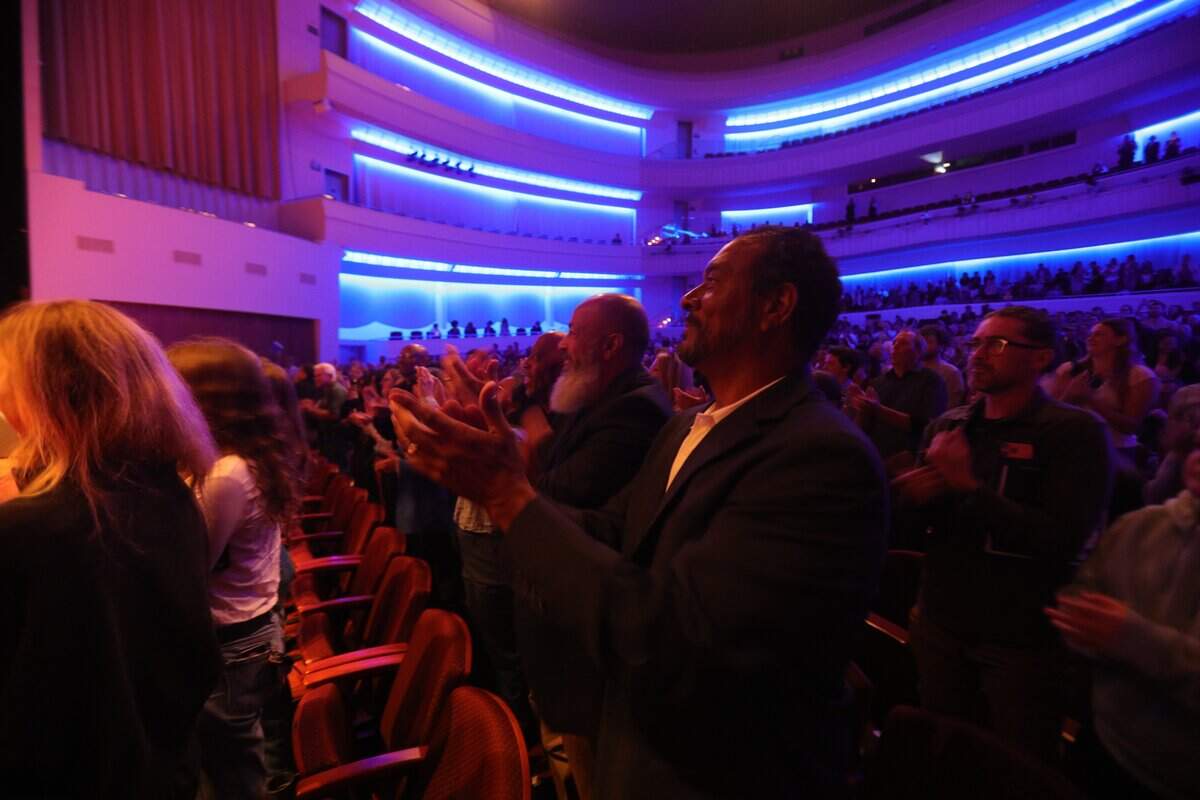
A handful of Glover’s Phi Beta Sigma fraternity brothers were sat in the first few rows in the auditorium — some of whom traveled from around the state to see their friend and former classmate. The event just happened to be scheduled on the eve of the historically Black fraternity’s 42nd anniversary at Cal Poly, international fraternal archivist Phil Eugenio told The Tribune.
“We’re just here to support Victor,” Eugenio said. “It’s been a while since some of us have seen him.”
Phi Beta Sigma alum Robert Megna was proud to be in the audience supporting his friend.
“I know this guy, you know?” he told The Tribune ahead of the event. “So, it’s very special for all of us.”
From Cal Poly to the Navy to NASA
Glover is a 1999 engineering graduate of Cal Poly. During his time at the San Luis Obispo campus, he was a wrestler, a football player, a resident adviser and a fraternity member.
Cal Poly is also where Glover met his wife, Dionna.
“You have no idea how much I love this place,” he told the sold-out auditorium Monday night.
A key moment in his time at Cal Poly occurred during a fluid mechanics course — which he initially failed. During his second go, Glover recalled attending office hours with Dr. Jim LoCascio, when he received a piece of advice that altered his trajectory.
“He said, ‘You know, you’re not here at Cal Poly to get training to get a job, you’re here to learn to think,’” Glover recalled Monday night.
He described that moment as a “rudder steer” in his path toward becoming a critical thinker and lifelong learner.
While still at Cal Poly, Glover enlisted in the Navy, where he eventually learned to pilot aircraft and earned his wings.
Glover said he originally intended on becoming a Navy SEAL, but a moment he shared with his father once again helped shape his future into what it is today.
As a retired police officer, Glover recalled that his father believed the Navy SEAL training wasn’t the right fit for his son.
“I think with an engineering degree from Cal Poly, and wings, you go fly — you might mess around and become an astronaut,” Glover recalled his father telling him in 1997, segueing into a humorous piece of advice for the children in the crowd: “Kids, message, listen to your parents.”
After a graduate degree and an international career in the Navy, Glover returned stateside to serve as a legislative fellow for late U.S. Sen. John McCain, who helped Glover set up a meeting with one of his personal heroes: the late U.S. Rep. John Lewis.
“Both of them passed away before I launched on my first mission,” Glover said during his appearance Monday. “I invited them both, and they both would have been there, and they both passed away prior. So, this — I will, I will never take this slide out of my talk.”
It was while he was working in McCain’s office that Glover first received the offer from NASA to train to become an astronaut, which he started in 2013 and completed in 2015.
“When we graduated, we became ambassadors of NASA’s mission,” Glover said. “What do we do? We explore the unknown in air and space. We innovate for the benefit of humanity. And we inspire the world through discovery.”
To this day, Glover maintains that wrestling at Cal Poly was one of the hardest things he has ever intentionally done — second only to an hours-long space walk he conducted at the International Space Station.
Space exploration isn’t just about space: ‘You instantly love Earth’
The theme of humanity was a tether for Glover throughout Monday’s speech as he focused on how his off-Earth trips have helped forge a contagious appreciation for Earth and its occupants.
“That’s probably why all of us are fascinated by space,” he told the crowd Monday. “Because you look up into the nothing, and you instantly love Earth, and you love Earthlings.”
During the mission, Glover and other members of the Artemis crew were heralded for their profoundness and teamwork as they experienced a series of firsts for humanity, traveling 252,756 miles away from Earth for the very first time, witnessing an in-space solar eclipse and capturing rarely seen angles of the moon.
Glover reflected on the work the team did with counselors and psychologists before embarking on the trip to ensure they could work in tandem in an inevitably inescapable environment. He encouraged any student hoping to pursue science or engineering fields to zero in on their communication skills.
“Getting a team to perform at their optimum — that is something that the humans had to decide, and our crew, we did that,” he said.
Space travel is not only about exploring what lies beyond the Earth’s atmosphere, Glover said, but is also about finding new ways to support the home planet. He highlighted scientific breakthroughs that have originated within NASA or other space-related organizations, with implications ranging from helping health conditions like osteoporosis to the miniaturization of technology.
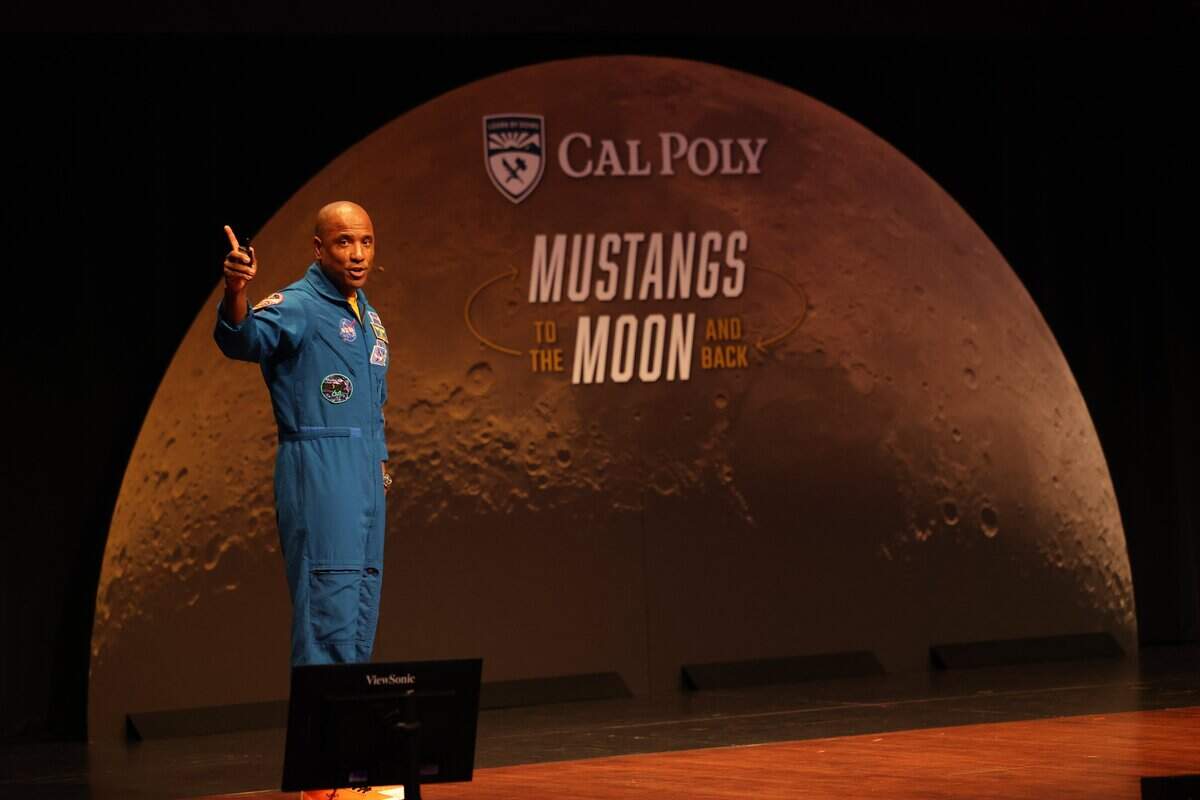
Science aside, Glover added that the inspiration people can derive from watching or participating in space travel can be a powerful tool for change.
“Inspiration drives decision-making,” he said. “When you’re inspired, you will do something differently.”
He highlighted the first Earthrise photo taken by the crew of Apollo 8 — saying that the first Earth Day occurred just 14 months after that photo was taken. Now, with modern technologies, Glover hopes the future will take the inspiration even further to induce positive change here on Earth.
“We’re just scratching the surface,” he said. “We can do a whole lot more. I hope Artemis II started that discussion, and we just now got to keep it going.”
What’s next for Victor Glover?
During Monday’s news conference, The Tribune asked Glover what the future of space travel looks like for him, and whether he plans to step foot on the moon or venture further into space.
The timing of missions and NASA’s readiness for space flight is always changing — and Glover said he isn’t currently assignable, and plans to use this time to take vacations with his family.
Regardless, he believes the future is bright, highlighting the recently announced crew for Artemis III, which is slated to conduct test flights in Earth’s orbit in 2027.
“If you’re asking me like what I want to do, I don’t know yet,” he said. “We’ll have to all wait and see.”
.JPG)