Cal Poly professor faces suspension for participation in Pro-Palestine protests
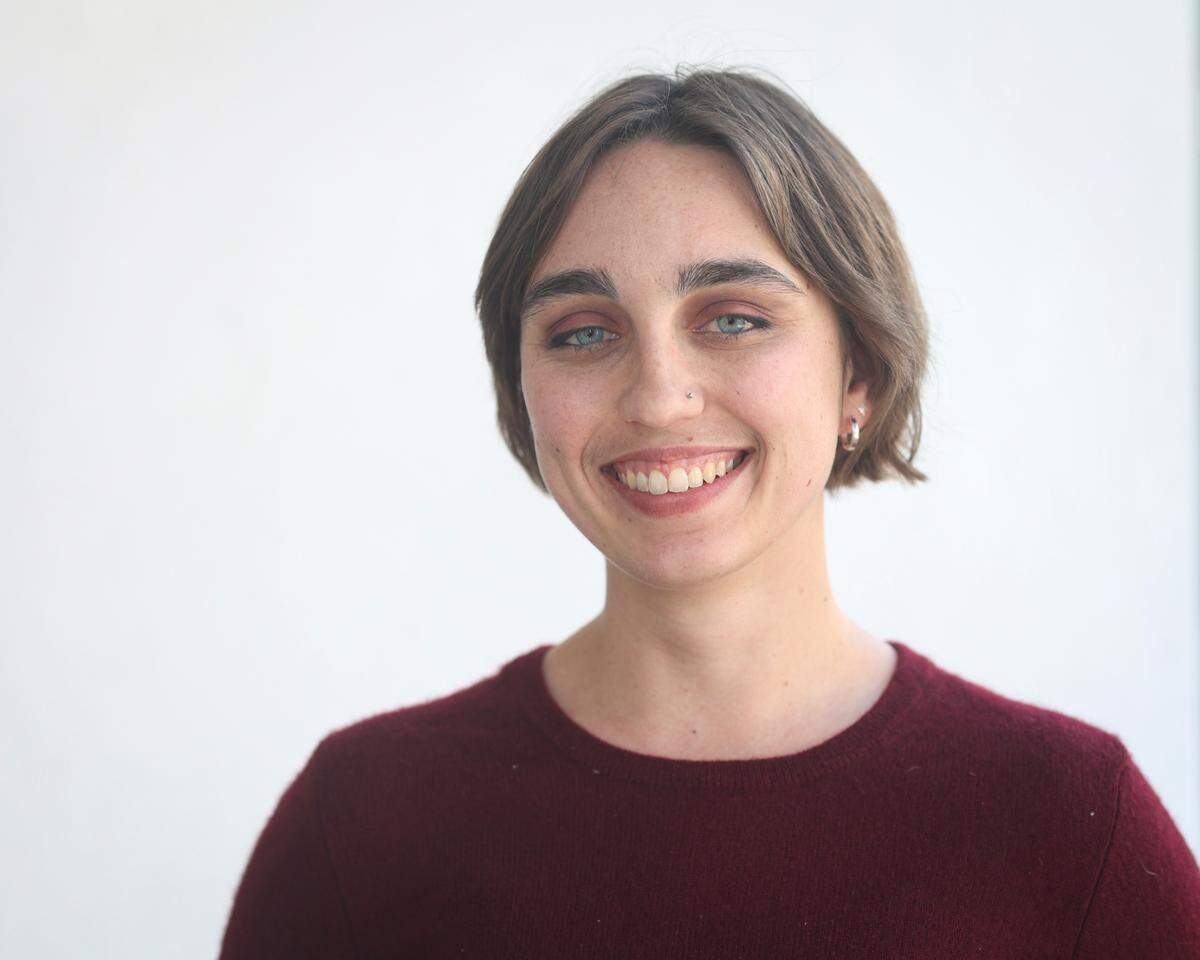
A Cal Poly English professor faces a two-quarter suspension without pay for their involvement in two Pro-Palestine protests last year — and said the university violated their due process rights while handling the disciplinary process.
Shanae Aurora Martinez, who uses they/them pronouns, joined a January 2024 protest outside the Cal Poly Recreation Center that ended in a violent clash between police and demonstrators. Then, in May 2024, Martinez was present at another Pro-Palestine protest at the California Boulevard entrance to campus, where they communicated with police officers and protesters during the demonstration and resulting arrests.
The university alleged that Martinez’s behavior at the protests violated the California Education Code of Conduct for “unprofessional conduct,” according to a Feb. 14 notice of pending disciplinary action mailed and emailed to Martinez.
Martinez chose to have their case heard by a Faculty Hearing Committee, who will recommend to Cal Poly President Jeffrey Armstrong whether the university should impose a two-quarter suspension without pay, choose a different sanction or abandon the charges.
The public hearing was originally set for May 2, which was within 14 days of the selection of the Faculty Hearing Committee — the timeline required by the California Faculty Association’s Collective Bargaining Agreement.
On April 30, however, the university postponed the hearing without setting a new date because some of the appointed committee members were unavailable.
This violated the 14-day time frame required by the Collective Bargaining Agreement, according to Martinez’s faculty representative, San Jose State University professor Sang Hea Kil.
Cal Poly, however, said it could restart the timeline.
The university told Martinez that new members were appointed to the Faculty Hearing Committee on Wednesday, which means the hearing must occur by May 20, Martinez said.
The delay could have larger impacts than just a longer wait, Martinez said.
Martinez was concerned Armstrong’s testimony before Congress on Wednesday about antisemitism will direct national attention to Cal Poly — leaving the professor more vulnerable to harassment related to the hearing. That hearing, which begins at 7:15 a.m. PT, can be viewed here.
Kil, who uses she/they pronouns, suspected the university intentionally postponed the hearing to redirect anger about antisemitism onto Martinez instead of Armstrong.
“If I were to think innocently of it, it’s unprofessional at least,” Kil said of the postponement. “If I want to be suspicious, it’s intentional degrading of the process at most.”
Kil was also concerned the university would use the disciplinary action to deny the tenure promotion Martinez has been working toward.
“This is about not just this letter being in their file. This is about their whole entire career here at SLO,” Kil said. “There’s more at stake for their life.”
The university declined to comment further on the case because it is an “ongoing personnel matter,” Cal Poly spokesperson Matt Lazier said in an email to The Tribune.
What happened at the January protest?
On Jan. 23, 2024, about 25 people gathered outside the Recreation Center to protest Cal Poly’s Winter Career Fair, where defense companies like Raytheon and Lockheed Martin were recruiting.
The protesters called for the university to cut ties with weapons manufacturers and contractors and take a stance against Israel’s military tactics in Gaza, which they called genocide.
Partway through the demonstration, seven more people joined, wearing black clothing, goggles and masks while holding “plywood ‘shields’ measuring approximately 5 feet in height by 2 feet in width,” the letter containing the notice of pending disciplinary action said.
Martinez was not part of the group of protesters who held the shields.
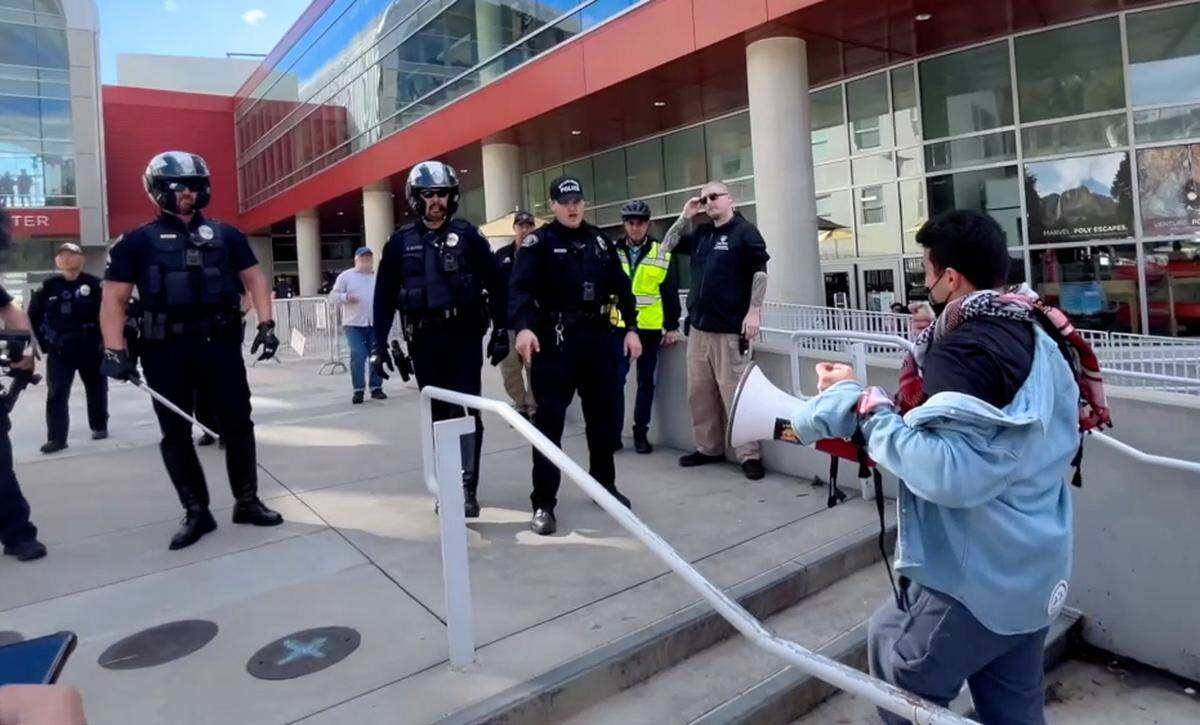
At the same time, police officers stood behind metal barricades and guarded the entrance to the Career Fair.
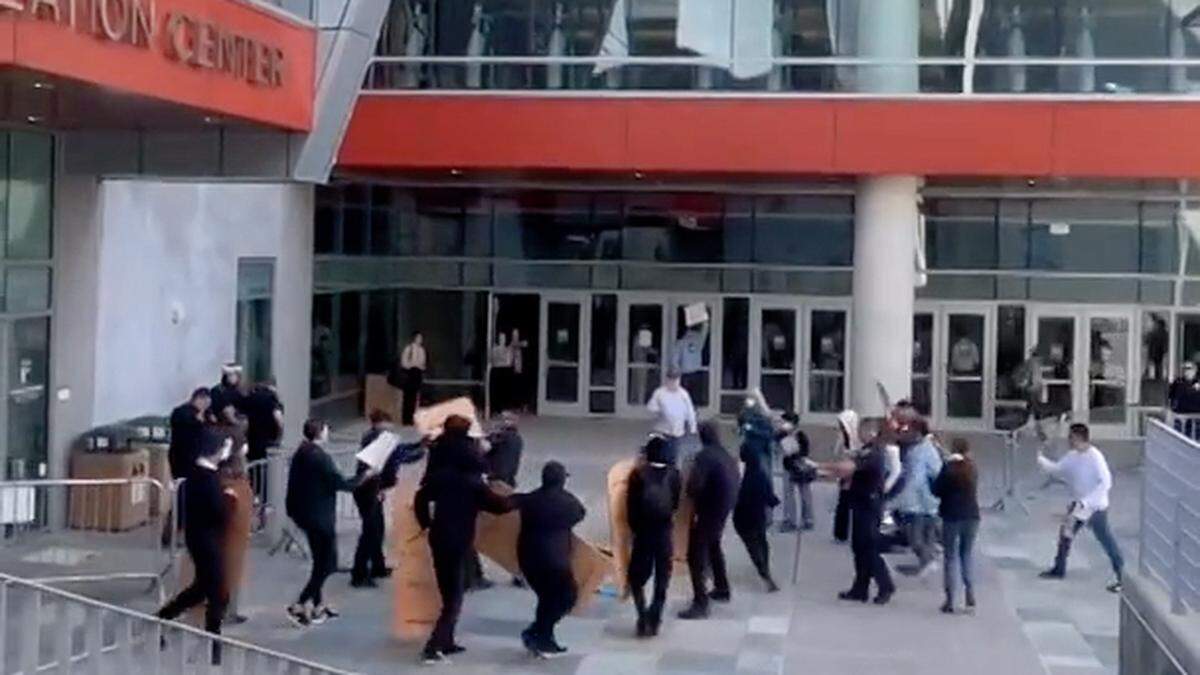
Police said seven people “placed the shields against the barricades and pushed the barricades into the officers,” lifting the barricades off the ground and “pushing the officers against a permanent handrail,” the letter said.
The shield bearers then backed away. About a minute later, they pushed their shields into the barricades again while officers held them, the letter said.
Martinez, however, said the police officers were the first to pick up the barricades. The officers marched the barricades into the crowd in an apparent attempt to push the demonstrators back, Martinez said.
Martinez and other protesters then pushed back on the barricades. Video footage provided to The Tribune by Martinez shows an officer smiling and laughing as he attempted to hold the barricades in place.
Martinez’s goal was to protect the group and defend the space they were protesting in, they told The Tribune.
“From my perspective, they were trying to push people out with the barrier, but we had a right to protest,” they said. “I felt like my role was to maintain that kind of free speech area.”
When Martinez stepped away from the barricade, another police officer saw them speak to an individual and point to a location where the shield bearers then gathered, the letter said.
“Your gestures to demonstrators showed that you likely instructed demonstrators to locate to an area where their activities violated applicable law and university policies,” the letter said.
Martinez, however, said they did not know the demonstrators or direct them at any point during the protest.
Martinez viewed the university’s accusation as part of the administration’s search for the leader of the protest. At one point, the administration claimed the student with the bullhorn was the leader. The court, however, did not press charges against that student, Martinez said.
According to Martinez, there was no one leader of the protest — multiple groups collaborated to organize it.
“This idea that they’re saying I was somehow, like, leading it is so absurd,” Martinez said.
Once police and the demonstrators dropped the barriers, officers started arresting people.
While a protester was being arrested, the letter said Martinez “pushed against the officers and yelled, ‘Students have the right to protest.’” Martinez then tried to follow the officers into the Rec Center, where the person who was arrested was taken into custody. Officers ordered the professor back, and when Martinez didn’t comply, an officer pushed them away.
“When I saw students getting arrested, I wanted to make sure they weren’t abused, basically, by the police,” Martinez said.
Martinez was not arrested at the protest, but on March 4, the San Luis Obispo County District Attorney’s Office charged them with battery of a police officer.
Instead of going to jail or paying a fine, Martinez is set to receive diversion for the battery charge — meaning they will be placed on probation, perform community service and the charge could eventually be dismissed, they said.
“The court has seen all the same evidence and decided that I was acting in good faith,” Martinez said. “The university has the exact same evidence because they have the police report and have decided that I’m a violent protester.”
Cal Poly professor accused of violating campus policies
The university said Martinez’s behavior at the January protest violated the campus Civility Statement, Cal Poly’s Statement on Commitment to Community and the Faculty Code of Ethics, arguing that Martinez “showed a lack of civility, respect or concern for the well-being of others” and created an “unhealthy environment,” the letter said.
Kil, however, said Martinez wished to protect the protesters and maintain a safe environment.
“I see their actions in those videos as a protective one of their students and of their community that they have a moral obligation to protect,” Kil said.
The university also said Martinez’s “conduct showed a lack of civility and respect for the efforts and directives of peace officers striving to maintain order and safety.”
Martinez, however, said police presence does not necessarily inspire order and safety at a protest. In fact, armed police can make demonstrators feel unsafe and escalate tension, they said.
When police lined up and formed a human shield in front of the Recreation Center, many protesters felt threatened, Martinez said.
“Not everyone sees police and thinks of safety,” Martinez said. “They have a record for escalating violence, for especially having some implicit bias that can lend them to target people who actually need the most protection.”
That especially applies to political protests, which Martinez said are often treated more aggressively than other types of large gatherings on campus.
For example, protesters in the January 2024 incident were arrested after pushing on police barricades. But when St. Fratty’s Day partiers at Cal Poly’s March 15 concert rushed the barricades and broke into the event, the university opened the fences to allow students through.
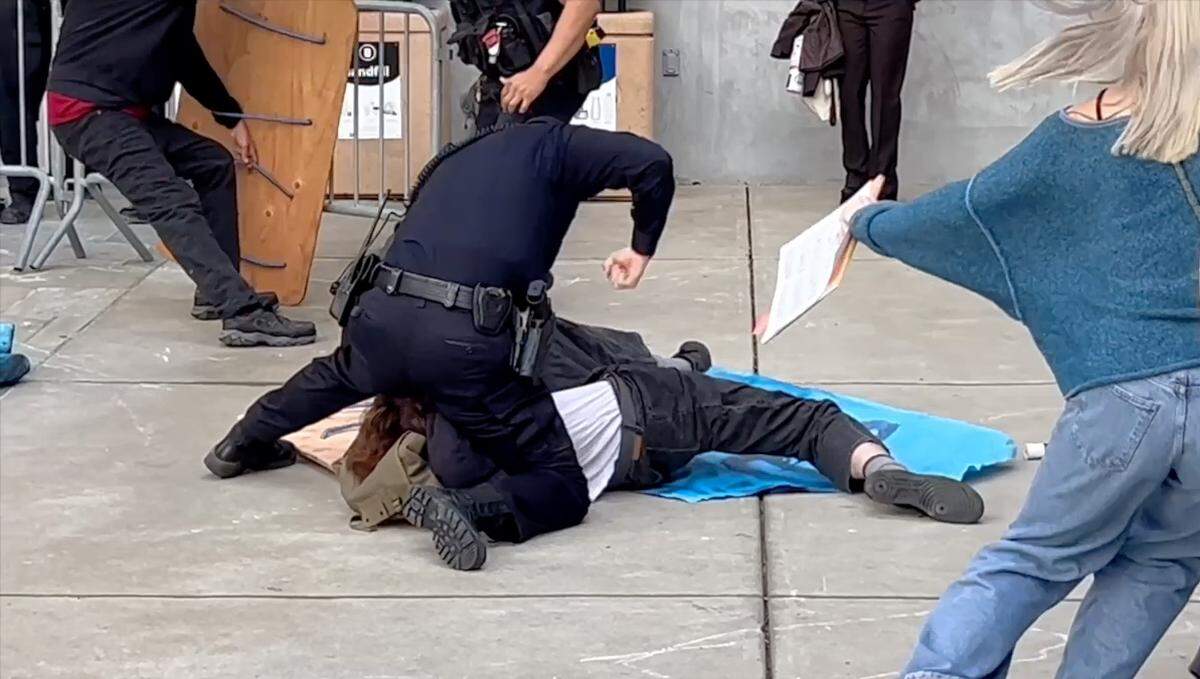
Other videos from the January 2024 protest show an officer throwing one protester to the ground, tackling them and hitting them three times in the stomach.
That same officer shoved another protester down the stairs as the group retreated, video showed.
That officer’s use of force did not violate the San Luis Obispo Police Department’s policy and he did not face disciplinary action, San Luis Obispo Police Chief Rick Scott told The Tribune soon after the protest.
With these concerns in mind, Martinez’s impulse was to protect the protesters from the police, they said.
Cal Poly, however, defended the actions of the police and said Martinez violated campus policies.
“The university believes in and fully supports lawful protests and demonstrations,” Lazier wrote in an email to The Tribune. “At the same time, one of the most important responsibilities of the university is to ensure the safety and well-being of all members of the campus community.”
Lazier said Cal Poly “will fully enforce the laws and rules governing our campus to protect our community.”
“Anyone who jeopardizes or undermines the safety of campus through unlawful activity or violations of university policy is subject to the consequences of their actions,” he said. “These are not the university’s rules, but the basic rules of society by which we all live.”
Meanwhile, the university alleged that Martinez disregarded their appointed role as an “intellectual guide or counselor” for students, the letter said.
Martinez, however, said their work as a professor is intertwined with their activism. They were hired in 2019 as part of the College of Liberal Art’s diversity, equity and inclusion cluster hire.
Their research focuses on community-engaged scholarship.
“It’s very clear that my dossier (in) being hired was about my community engagement,” Martinez said. “But there isn’t a lot of, like, infrastructure for me to do that at Cal Poly, especially when protests are repeatedly met with criminalization.”
Martinez’s curriculum also uses Indigenous literature to analyze how state-sanctioned violence is used to maintain settler colonialism.
“They’re saying I’m not doing my job, and my job is clearly wrapped into this political moment — or my research is, at least,” Martinez said.
What happened at the May protest?
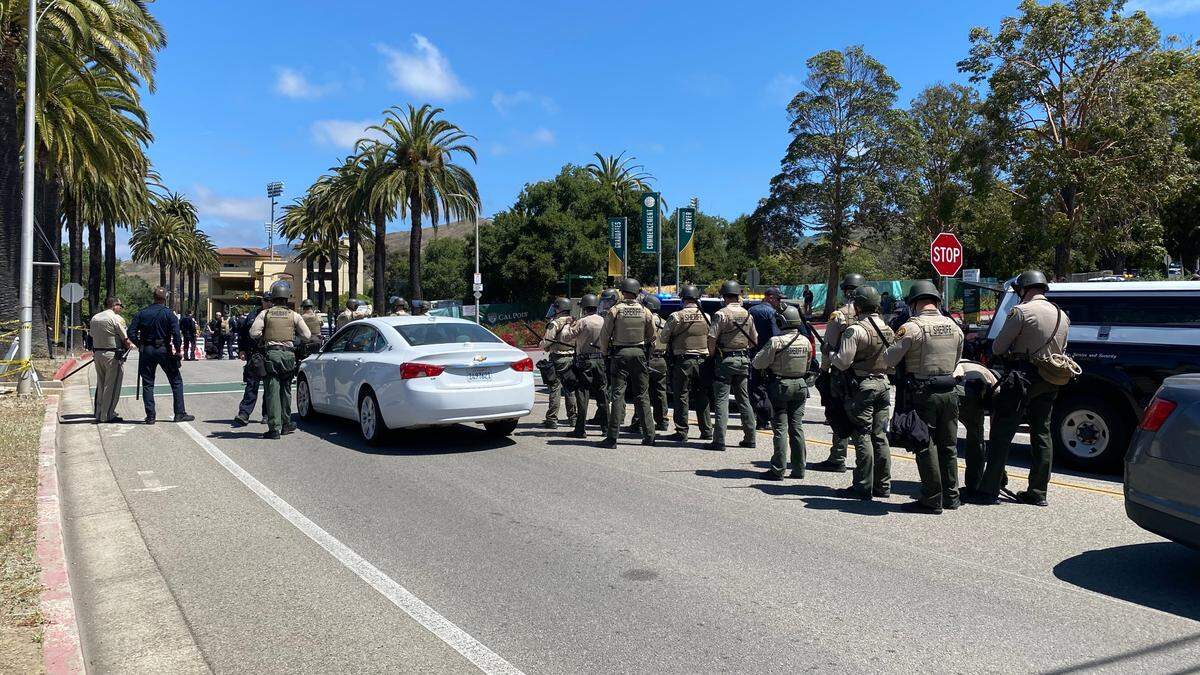
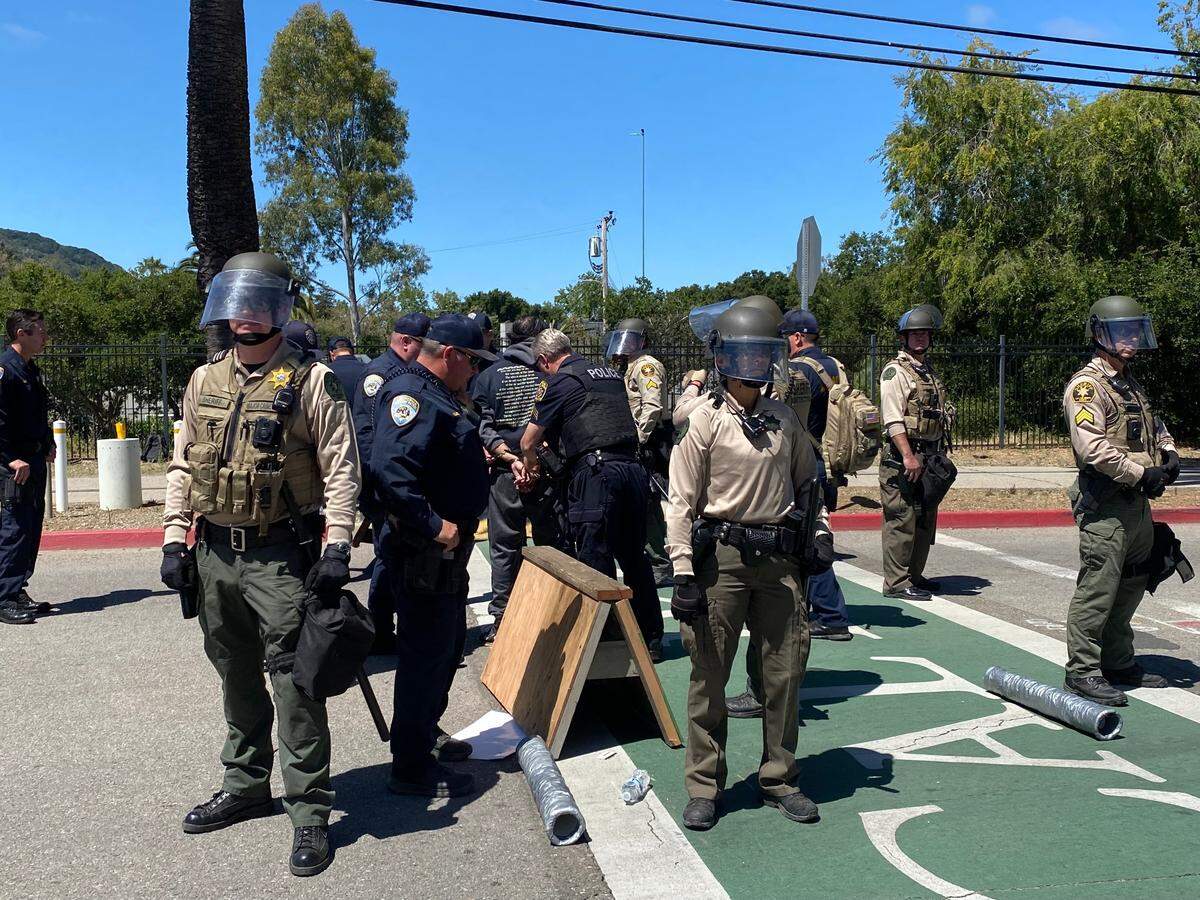
During the Pro-Palestine protest on May, 23, 2024, demonstrators chained themselves to wooden barricades set up in the crosswalk of California Boulevard and Campus Way.
Eventually, police arrested eight protesters without incident.
During that protest, the university alleged Martinez interfered with an arrest, “did not comply with verbal orders by peace officers to step away,” entered a roadway and “used words and gestures to communicate to and to encourage demonstrators to enter the roadway and to disrupt the safe flow of traffic,” the letter said.
Martinez said they observed the protest from the sidewalk until a behavioral health nurse with the San Luis Obispo County Sheriff’s Office asked them to accompany him to talk to the demonstrators.
Other faculty members also talked to the behavioral health nurse, then-Cal Poly Assistant Vice President and Dean of Students Joy Pedersen and even the police during the demonstration, Martinez said.
Pedersen is currently serving as the Interim Dean of Student Affairs at Cal Maritime.
Later, Martinez witnessed Pedersen tell the protesters they would not be arrested if they unchained themselves and walked out of the street.
When one of those protesters later unchained herself before police issued the official dispersal order, she was arrested. Martinez then hurried to talk to the officers and defend the student, they said.
Martinez did mistakenly tell other protesters that they could legally walk back and fourth across the crosswalk after police told them to disperse.
“Part of my role in that situation was to communicate their rights to them, and at that time, I did believe that to be true,” Martinez said.
During the May demonstration, Martinez said their goal was to advocate for their students’ right to protest.
Martinez was not arrested at the protest.
On July 15, the San Luis Obispo County District Attorney’s Office charged Martinez with misdemeanor unlawful assembly and obstructing the free movement of any person in a public place.
A misdemeanor diversion consideration hearing is scheduled for May 21, according to court records.
Cal Poly postponed the hearing. Did it violate policy?
The committee must include three randomly selected faculty members and one alternate. After hearing the case, the committee will recommend whether the case should be dismissed or if Martinez should be sanctioned. Armstrong will then make the final decision.
The procedures for scheduling, staffing and performing the hearing are outlined by the Collective Bargaining Agreement between the California Faculty Association and the Trustees of California State University.
The agreement requires that the hearing occur “within 14 days from the date of notification to all parties of the selection of the Faculty Hearing Committee at a mutually acceptable time at the campus where the affected faculty unit employee is employed.”
The university first notified Martinez about the selection of the Faculty Hearing Committee on April 18 and scheduled the hearing for May 2, the final day in the 14-day timeline, according to emails shared with The Tribune.
Then, on April 30, the university told Martinez the hearing would be delayed because some of the panel members were unavailable. The university did not offer a new date for the proceedings, according to an email shared with The Tribune.
Kil said delaying the hearing past Friday would violate the 14-day timeline required by the Collective Bargaining Agreement.
She also thought it was “highly suspect” that appointed faculty members were not available so close to the scheduled hearing date.
“They had 14 days with those four names,” Kil said. “They should have checked their schedules on that day one, and confirm that the date that they set for the hearing, May 2, worked for everybody.”
Cal Poly spokesperson Matt Lazier, however, said the university believed it could re-start the 14-day time frame because the originally appointed panel was unavailable on Friday.
The new hearing date will occur within 14 days of the notice of the newly formed panel, he said.
“The CBA does not have a specific provision that addresses what happens if a panel member drops off — but since the CBA requires 3+1, replacements must be selected and the hearing date must not conflict with their existing obligations, including their class schedules. Since the original panel was incomplete, the notice to them is effectively rescinded and replaced by the new notice to the current panel members,” Lazier wrote in an email to The Tribune.
But given Armstrong’s expected testimony on campus antisemitism Wednesday, Martinez said they were concerned they would be vulnerable to harassment if their hearing occurs after the congressional hearing.
Kil said they think the university may be making a political example of Martinez.
“Maybe this is the administration trying to protect the president after his congressional hearing, his testimony, in order to deflect any kind of ire that might happen from the president onto Shanae,” Kil said. They later added: “This is me being rather suspicious.”
Martinez also alleged other violations of their due process.
For example, the university sent them a notice of disciplinary action on Feb. 12, 2024 — before withdrawing it and issuing a pending notice, which allowed Martinez to fight the charges.
Additionally, Martinez’s former landlord originally oversaw the randomized selection of the Faculty Hearing Committee. Martinez said CFA-SLO President Lisa Kawamura threatened to evict Martinez when they lived on her property.
Martinez said this should be a conflict of interest, and that Kawamura should have recused herself from the process. Kawamura declined to comment due to the matter being an ongoing personnel issue.
After Martinez brought this to the university’s attention, Cal Poly professor Silvia Marijuan replaced Kawamura as a co-chair of the hearing.
Considering the combination of violations of the Collective Bargaining Agreement, which culminated in the postponement of the hearing, Kil said she thinks the process put Martinez at a disadvantage.
“This is a very unprofessional and degraded process that they are putting Dr. Martinez through,” Kil wrote in a text message to The Tribune.
This story was originally published May 6, 2025 at 2:03 PM.