Cal Poly releases first look at incoming 4,200-unit modular dorm layout. See the design
Cal Poly’s plan to bring around 4,200 new beds to campus to house more of its student population is taking shape.
First approved by the California State University Board of Trustees as part of Cal Poly’s billion-dollar Future Housing Plan, the 4,200-unit buildout will use a modular construction model from FullStack Modular to fabricate and install nine new eight- and nine-story buildings within the next five years — the first development of its kind not only for Cal Poly but the California State University system.
Buildings are expected to go up quickly, with off-site manufacturing reducing cost, construction time and local environmental and air quality burdens.
Unlike existing modular projects in San Luis Obispo County — such as the planned Welcome Home Village transitional housing project — these buildings were designed by architect Steinberg Hart with longevity and efficiency in mind from the start, while replicating the structure of more conventional multi-story dorms, Cal Poly vice president of facilities management and development Mike McCormick told The Tribune.
McCormick said the modular approach allows for more efficiency in the building process, allowing for more expansion than expected when the university started laying the project out.
“I think a good way to think about this is when we started this program, our goal was to build 3,000 beds, and because of the efficiencies we were able to find, we’re well up over 4,000 now,” McCormick said.
Now, with building designs finalized, Cal Poly and manufacturer FullStack Modular are giving students and San Luis Obispo residents a first look at what the finished product will look like.
Modular high-rise dorms touted for efficiency
With a full price tag of over $1 billion, the 4,200-unit expansion may end up being one of the more efficient builds in San Luis Obispo County on a per-unit basis.
FullStack Modular founder and president Roger Krulak said all manufacturing will occur offsite, limiting truck trips and construction impacts on the nearby neighborhoods once foundations and site preparations are complete.
The factory environment allows for the units to be rigorously controlled and vetted before they reach the job site, and allows FullStack to manufacture the units without relying on a local construction workforce, which may not be large enough to support a project of that scale, McCormick said.
“There’s two choices: one is we could just import all of the workers, but that puts more pressure on the housing market in SLO, which is exactly what we’re trying to address, so it’s kind of counterproductive to our goals, or we can take advantage of places where the workforce exists already, as opposed to trying to import the workforce,” McCormick said.
Krulak said unlike the more common wood frame modular units that tend to dominate the market, the all-steel construction of the units allows the modular design to reach as high as nine stories while lowering fire risk and making it easier to incorporate Leadership in Energy and Environmental Design-certified energy efficiency features.
Dorms will be structured around three-bedroom double-occupancy suites that include two bedrooms and a shared living space, while the buildings will also include a large community space, study lounges and kitchens, according to Cal Poly’s website on the expansion.
“Our system is specifically focused on, ‘How do we do as much as we can in the factory?’” Krulak said. “What we do is fully finish the units to the extent possible and put the facade on the entire superstructure as part of our system, so we’re literally stacking the building as you see it.”
Dorms to become available in waves in coming years
Manufacturing will start in late winter 2025, with the first phase of buildings ready to lease in the fall of 2026. FullStack will continue to build and assemble the new buildings on-site until all nine have been installed by 2030, bringing each building online as it goes.
Each new wave of completed units will become available to students each fall semester, McCormick said.
Early construction work got underway in the summer of 2024, permanently closing campus parking lots K1, K2 and R1 and nearby roads including Deer Road, Klamath Road and Mountain Lane through the summer of 2030.
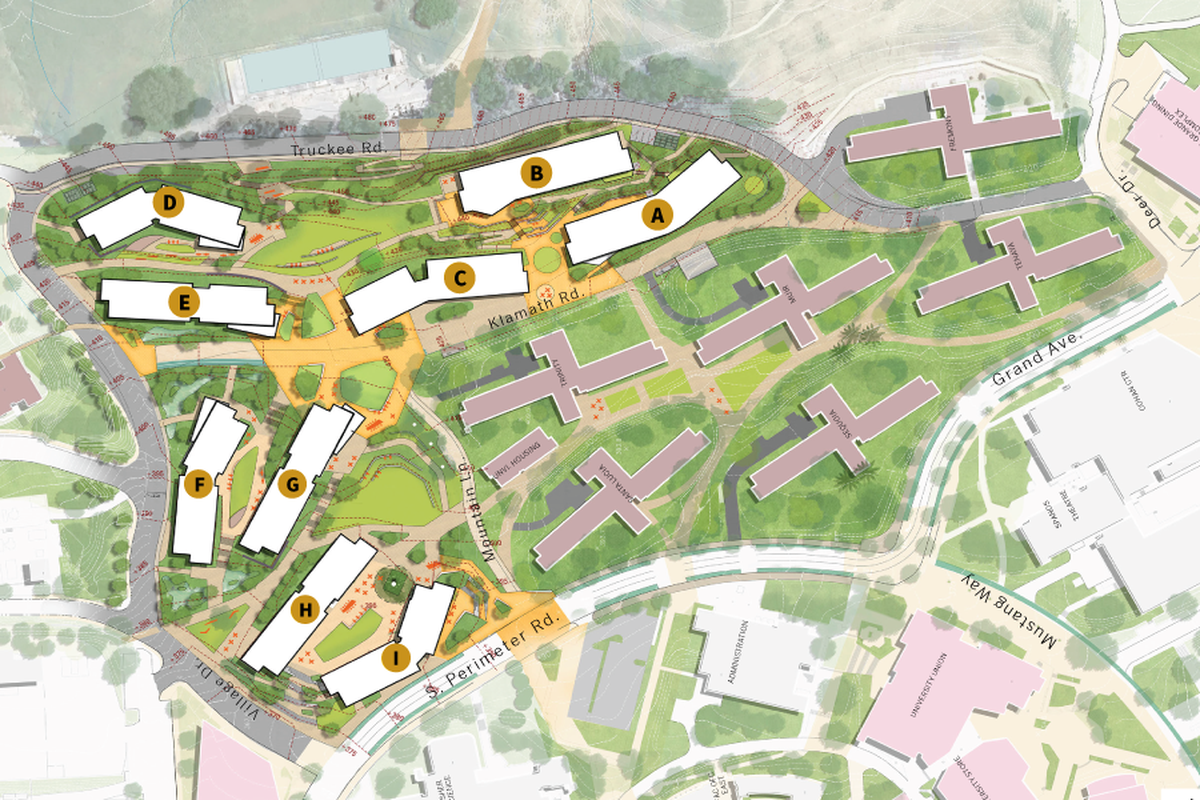
Meanwhile, renovation of the six existing 60-year-old red brick residence halls — which border the modular installations to the east — will pick up after the first phases of new dorms are available, for an estimated additional cost of $200 million, McCormick said.
By the completion of the university’s Future Housing Plan, Cal Poly promises to be able to offer housing to all freshman and sophomore students.
“Our absolute hope is that this is something that gets applied across the CSU, no question about it,” McCormick said. “The hope is that this is something that we can apply across the system because ... student housing is the issue right now for for higher ed institutions across the country, but especially here in California.”