
National protests called for universities to cut ties with defense companies. Would Cal Poly?
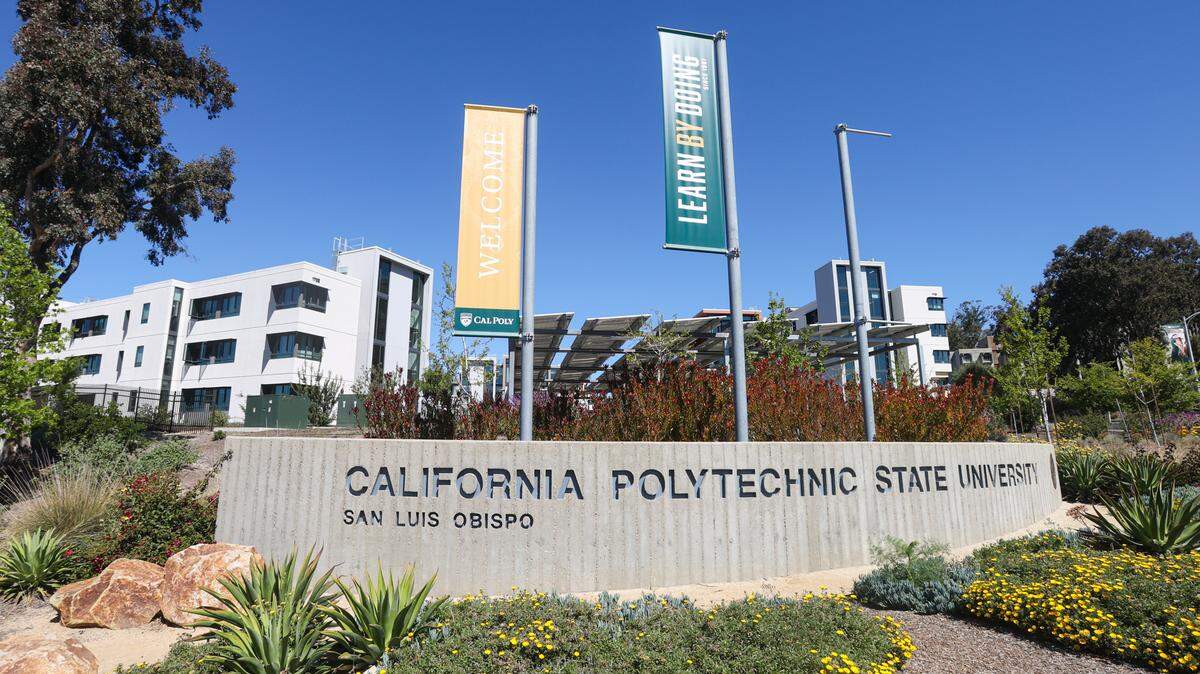
Financial and academic ties between the U.S. military and universities across the country are almost a century old.
Most famously, they date back to the advent of the atomic bomb, but the mutually beneficial associations persist to this day and have come into focus recently as American weapons are used by Israel in the war in Gaza.
This spring, protests broke out on college campuses across the United States — even modestly at Cal Poly in San Luis Obispo — as student activists marched, sang and set up encampments to push their universities to divest from defense companies as the death toll from the Mideast war mounted.
The demands put forward by student organizations raise the question: At an engineering school like Cal Poly, is divestment from the defense industry reasonable or even possible?
As part of its Reality Check series, The Tribune asked an expert, the university and students whether they felt divestment was a possibility.
What are Cal Poly’s connections to defense industry?
Cal Poly has a number of connections with the defense industry, though it is difficult to map exactly how far those connections stretch.
University spokesperson Keegan Koberl told The Tribune that Cal Poly is currently involved in a “small number of projects” that “have received awards from agencies and offices that are considered under the purview of the U.S. Department of Defense.”
Koberl described these projects as “research in science, technology, engineering and mathematics,” but did not provide specifics on what is being studied, who the projects are funded by or how much the university has received.
Cal Poly is one of many universities that receive this kind of funding.
According to Defense Department contract database, in 2024 the department allocated over $4 billion in contracts for university-led research.
Outside of projects connected to the Department of Defense, a few private defense technology companies, including Lockheed Martin and Raytheon, also finance scholarships at Cal Poly.
According to the university’s website, the companies fund four scholarships available to students in the College of Engineering for students studying a variety of STEM subjects, including computer science and engineering.
The scholarships from Raytheon are available to students studying engineering, mathematics or chemistry, while financial assistance from Lockheed Martin is only available for students studying electrical engineering.
The companies also regularly recruit on campus.
At one such event in January, eight pro-Palestinian protesters were arrested when they tried to break into a career fair at the Rec Center on campus.
Student activists say Cal Poly career fairs need more options
In a list of demands submitted to the university this spring, the Cal Poly SLO branch of the Young Socialist Democrats of America named 22 companies involved in defense technology that it said were connected to the university through scholarships or ties with university officials.
The Tribune was not able to verify the claim made by the group on their list of demands.
In a conversation with The Tribune, several student activists from the club expressed their concerns about the university’s connections to defense companies.
All of the students requested to remain anonymous due to concerns about retaliation related to their participation in anti-war protests.
Several told The Tribune they wanted their university to break ties with companies involved in weapons manufacturing or defense technology, even if that means ending scholarships that are financed by these companies.
They also said they would push for Cal Poly to provide a greater diversity of companies at engineering career fairs, where they said there was a strong showing for defense companies and a lack of diversity for students in STEM careers looking to pursue a wider variety of careers.
“A lot of students come into these STEM careers thinking, ‘I am going to work with NASA to create these rockets,’ ‘I am going to do electrical engineering and help the power grid and do amazing things.’ And then they get their degree, they spend four years and insane amounts of money to do this, and then they get to a career fair and their options are: bomb builder, weapon maker or contractor and cybersecurity,” one student said. “Their only options are to build bombs.”
Koberl, though, told The Tribune that out of the 160 to 180 companies that attended the university’s fall career fair, only about 20 were in “defense or defense-adjacent industries.”
According to Koberl, divestment or boycotting any particular industry would be an “inherently political” move and is “not the university’s role.”
He added that by detaching itself from any industries or companies, the university would hinder its ability to be a space for “a free exchange of ideas,” saying “the university must maintain neutrality.”
Why do universities often have ties with defense industry?
According to Cal Poly technology ethics professor Patrick Lin, the question of universities’ connections to weapons technology is more complicated than just demands for divestment.
To Lin, the question of college involvement in military defense pulls at the foundation of how universities are funded in the United States and what kinds of opportunities they seek to create for their students.
Lin told The Tribune universities are having a harder time funding for various programs and scholarships. In light of that, he said many institutions turned to private companies that are more than willing to pitch thousands of very needed dollars.
In exchange, these companies make connections with students and may be able to get a leg up in securing highly trained employees for their companies.
He said that this need for funding could pose the largest barrier for universities — including Cal Poly — to divest from the defense industry. However, Lin did not speak on whether he thought Cal Poly could or would divest from arms companies.
“On one hand, it’s good to make war less terrible — which includes being more precise in killing only the right people and not innocent ones — but on the other hand, it might make war too easy an option for politicians to choose,” Lin said.
Lin advised that with defense technology playing a larger role in higher education, students should be able to take advantage of their time as young adults to decide what kind of role they want to play in the workforce.
“Higher education is a rare opportunity where fully grown adults have the privilege of being challenged by new ideas and reflecting about the direction of their lives — not just accepting a path because they don’t know any better or hadn’t thought critically about it. You might not get another chance until it’s too late, and you find yourself stuck in a life you don’t want,” Lin said.
However, he acknowledged that a competitive job market and the rising cost of living can put pressures on new graduates entering the workforce.
Lin said by welcoming in defense company funding, some colleges may feel they are choosing between giving their students the best financial opportunities and the best moral paths.
However, he said, this is a false paradigm.
“I’d suggest that the ’best’ financial opportunities are the ones that strike a balance between a reasonable amount of money and being able to sleep at night and a good person for your kids to follow,” Lin said.
The greatest challenge to this, he said, is a lack of time available to look for those opportunities.
“Money isn’t the most important thing — it comes and goes. But the problem is that most people are too busy just trying to survive and can’t dedicate time for soul-searching about what’s important to their lives and the kind of person they would like to be,” he said. “So, they sleepwalk into their own futures.”
He said there are options out there for students looking for jobs in the technology field that are not related to defense and that universities should do their part to make those opportunities more accessible to students.