
SLO County 4-year-olds are going to school. Take a look inside a TK classroom
In a portable building at the back of Hawthorne Elementary School sits a small classroom filled with books, building blocks, finger paints and games.
Instead of desks, a colorful, alphabet-emblazoned rug occupies the center of the room, surrounded by play sets where students can imagine they’re a chef, a doctor or a teacher.
On one wall, there’s a tank that houses two snakes — affectionately named Hot Chocolate and Ice Cream.
This is San Luis Obispo teacher Fiona Lloyd-Moffett’s transitional kindergarten classroom, where about a dozen 4-year-olds show up each weekday morning ready to learn, sing, imagine, create and explore.
Often referred to as the first of a two-year-kindergarten program, transitional kindergarten is California’s newest grade level. It helps prepare youngsters for kindergarten through play-based learning.

In Lloyd-Moffett’s classroom, students learn everything from how to count to how to recognize and regulate their emotions— and they do this in a screen-free environment. The San Luis Obispo program has received praise from parents and teachers for setting kids on a positive path in the school system and essentially, teaching them how to learn.
But the program has had a rocky past year in the San Luis Coastal school district — one of a few California districts required to fund the state-mandated program out of its own pocket.
The SLO-based district threatened to cut transitional kindergarten last winter as it attempted to right a multimillion-dollar budget deficit. The school board ultimately saved it after widespread outcry from parents and staff.
But with the future of funding for the program still uncertain, The Tribune set out to discover what exactly happens in transitional kindergarten and whether it’s at risk again this year. This story is part of The Tribune’s Parents Central series.
The Tribune visited a TK classroom. What did we see?
Tribune reporters paid a visit to Lloyd-Moffett’s morning transitional kindergarten classroom on Sept. 18.
Just after 8 a.m., about a dozen 4-year-olds entered the room and busied themselves. Some walked in sleepily, still waking up from the previous night’s rest, while others burst in full of energy.
Two youngsters made a beeline for the reptile tank, pressing their faces in close to catch a glimpse of the snakes slithering inside.
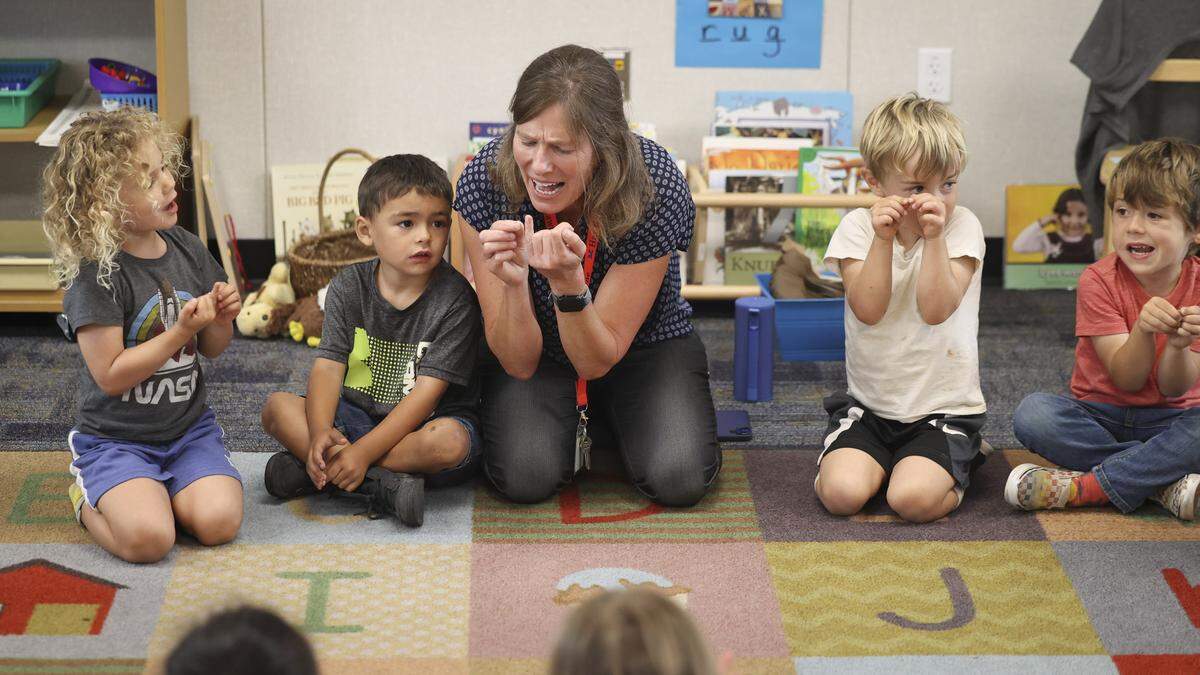
At the start of class, Lloyd-Moffett circled the students up at the center of the room. In a warm and clear voice, she led students in different versions of “The Itsy Bitsy Spider.” Loud and quiet renditions of the song helped students gauge their voice volume, and allowed the youngsters to get out their morning wiggles and settle in for class.
Lloyd-Moffett worked diligently to ensure each child received eye contact and encouragement. She met the students where they were at — allowing them to be fidgety, spirited 4-year-olds, while gently reeling them in to show them what a learning environment should look like.
The students were in the middle of a unit on threes, Lloyd-Moffett told The Tribune.
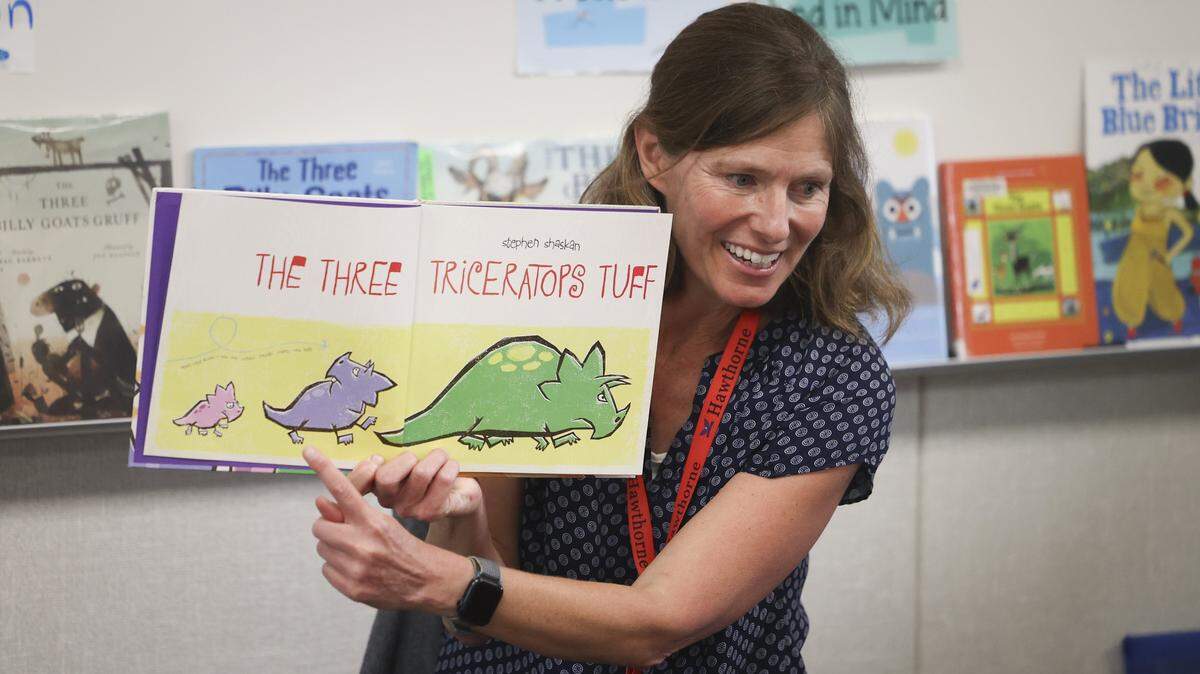
As a class, they previously read books like “Three Billy Goats Gruff” and on that Thursday — to the great excitement of the dinosaur enthusiasts in the room — they moved to a different rendition: “The Three Triceratops Tuff.”
The students sat on the floor, eyes glued on Lloyd-Moffett as she acted out the story in front of them, cylinders firing as they exclaimed their own predictions and reactions to the book.
After story time, some students went to a table in the corner of the room to finger paint, while the rest of the class played dice games while they waited for their turn with the paints.
Lloyd-Moffett explained to The Tribune that the educational goal of the games was to help students practice interval counting — essentially, counting the distance between one dot to another on a die and then moving a piece the same number of intervals on a game board.
Some students had no trouble counting intervals, The Tribune observed, while others struggled.
Lloyd-Moffett explained that those differences are usually a result of age — while all students must be 4 years old to enroll in transitional kindergarten, some turn 4 just before starting while others may have been 4 for nearly a year by the time they start.
Even an eight-month difference in age can result in vast learning differences for students so young, Lloyd-Moffett said.
After each student had rotated through both activities, the class moseyed outside to eat. As they gathered at small tables on the concrete patio, one boy asked for help opening the pack of apples he brought for snack.
To this, Lloyd-Moffett didn’t open the package for him — she knelt down and talked him through the process.
She explained to the student the clues she usually looks for when she opens packages, pointing to the incision on jagged edge of the plastic bag, helping him tear it open.
As she stood up, Lloyd-Moffett explained to The Tribune that every moment — even during the leisure of snack time — can be a learning opportunity for transitional kindergarteners.
After finishing their snacks, students had time to play outside — something Lloyd-Moffett said is becoming increasingly important.
In an area with a high cost of living like San Luis Obispo, more and more families are living in apartments or homes with small yards, she said. That means that kids now have fewer opportunities to run and play in the open air.
Transitional kindergarten provides a chance for rough-and-tumble play in a controlled environment. During The Tribune’s visit, some students wrestled and laughed with each other, while others played with toys or took turns shooting a miniature basketball into a short plastic hoop.
By the time the students went back into the classroom, they had spent some of their pent-up energy and were ready to dive into their final unit: how to build a bridge.

Lloyd-Moffett demonstrated for the class how to build different types of bridges using blocks and paper. The students then got the chance to build their own, working out for themselves how different variables affected the effectiveness of their constructions.
As some students piled blocks in high towers upon their bridges — giggling at their success — Lloyd-Moffett wandered around the room to look at each child’s project and help those struggling problem-solve.
She also snapped pictures of the bridges, which she told The Tribune she does regularly for class projects.
She sends the photos to parents to keep them in the know and help encourage families to continue learning at home.
How transitional kindergarten prepares students for school
San Luis Obispo kindergarten teacher Robin Minkel told The Tribune that students who attended transitional kindergarten usually have a leg up when they enter her classroom.
“When they come to kindergarten, regardless of their background, they’ve at least had a year to kind of acclimate to that, and they’re more prepared to do true learning tasks because they already know how to be a student and how to be in a classroom,” she said.
That preparation is growing increasingly important as the standards and rigor of kindergarten continue to increase, said Minkel, who has taught for over 13 years.
“The expectations of kindergarten don’t hold as much space for just learning how to be at school as they used to,” she said. “Because of that, children who do not have previous school experience before kindergarten are just at a like, a much greater disadvantage than they used to be, because the pacing of kindergarten is so much more accelerated.”
Those skills — learning how to exist in a classroom and learning how to learn — are what Lloyd-Moffett focuses on in her classroom.
She told The Tribune she and other transitional kindergarten teachers focus on the “whole child” — a term referring to education that involves social-emotional needs as well as cognitive and physical development.
In terms of social-emotional development, transitional kindergarten students learn to name their emotions, regulate their feelings, cooperate with their peers and solve conflicts, Lloyd-Moffett said.
Academically, the students focus on sound processing, numbers, letters, the foundations of reading comprehension and analysis and other learning fundamentals.
Movement is also a part of the students’ physical development.
“We don’t think of it as recess,” Lloyd-Moffett said of the students’ outdoor playtime. “We are teaching them all the movement foundational skills. And then with their fine motor, they’re learning how to hold writing tools, they’re strengthening their grip, all of those things which will later help them in their own writing as they get older.”

She said transitional kindergarten also provides more equity for students whose families might not be able to afford private preschool. Transitional kindergarten in San Luis Coastal is free and available for any 4-year-old who wants to enroll.
This year, the program was cut into two half-day blocks.
For the portion of the day a student is not in class, the district partnered with the city to offer childcare through its program, Sun ‘N Fun, Lloyd-Moffett said. That allows every enrolled student to get a full, free day of childcare.
And because transitional kindergarten is tied to the school district, Lloyd-Moffett is able to collaborate with local kindergarten teachers to learn what they’re seeing in their classrooms and what they need help with — another factor that differentiates it from a private preschool or daycare experience.
According to Lloyd-Moffett, transitional kindergarten teachers are often able to identify learning disabilities, physical disabilities like poor eyesight or hearing loss and behavioral challenges in students at a very young age, helping families create learning plans and access resources as soon as possible.
“TK really gives us that opportunity to invest in our youngest ones early, and that’s when it’s the most powerful in terms of supporting them for their future,” she said.
Lloyd-Moffett echoed the stance that transitional kindergarten sets students up for a lifetime of learning.
“We’re building this really, really strong foundation that all of their schooling can be based upon,” she said. “They have their foundations of literacy, of numeracy, of how to be a student, how to be part of a community, how to feel confident, to believe in themselves.”
What’s next for transitional kindergarten in San Luis Obispo?
Nine months ago, Lloyd-Moffett was on the brink of losing her job.
That’s because the San Luis Coastal school district was considering cutting its transitional kindergarten program entirely to help solve its multimillion-dollar budget deficit. The district argued it could cut the state-mandated program because, as a basic aid district, it doesn’t receive any state funding for the program.
“I was absolutely shocked,” Lloyd-Moffett told The Tribune. “I was devastated, I was heartbroken, and I really couldn’t believe that it was going to happen.”
The announcement drew parents, district staff and concerned community members to public meetings in droves to advocate for the beloved program and urge administrators to find another way. Parents cited the positive outcomes their students got from transitional kindergarten, the high cost of childcare in the local area and their concerns about families not being able to access early childhood education in other forms.
“People were saying, ‘This program is preparing our children to succeed. They love school. They love learning. They are flourishing and showing that this is making such a difference, and our families need it,’” Lloyd-Moffett said.
The school board ultimately decided not to cut transitional kindergarten in response to the community pleas.
The district signaled its intent to work with PG&E to renew funding from Diablo Canyon nuclear power plant — which depreciated and was on its way to closing, but ultimately was authorized to continue operating — and to work with state legislators to potentially secure transitional kindergarten funding for basic aid districts.
Assemblymember Dawn Addis proposed a bill that would accomplish the latter goal, but the bill ultimately died in committee.
Lloyd-Moffett told The Tribune she was grateful the district decided to save the program for another year, but she wasn’t sure what the future would look like.
When The Tribune asked if she had heard any rumblings about what would happen, she responded: “No, that’s, of course, that’s what we’re all worried about.”
The Tribune reached out to district superintendent Eric Prater to ask the same question.
He confirmed transitional kindergarten won’t be on the chopping block this year, despite the fact that the district’s budget outlook is still dire.
“As we enter another year of budget deliberations, our district continues to face financial challenges due to several factors,” Prater wrote in an email to The Tribune.
He listed the loss of funding from Diablo Canyon, the expiration of COVID relief funds that left several local school districts reeling and the SLO district’s lack of funding for transitional kindergarten.
The district expects to make another $5 million in cuts next budget cycle, piling atop the $5 million in cuts that were already made earlier this year, Prater said.
“That said, we continue to place a very high value on transitional kindergarten,” he wrote. “It’s an amazing program, led by a dedicated and talented staff who provide a critical early learning experience for our youngest students.”
Prater added that the district received a letter from California’s state Superintendent of Education Tony Thurmond, informing the district that cutting transitional kindergarten would violate state law, even though the district does not receive state funding.
Prater praised district staff who worked to keep the program afloat amid cuts.
“I’m extremely proud of our TK teachers, who worked collaboratively to create efficiencies in their programming last year, ensuring that we could maintain this essential service for our community,” he wrote. “Their commitment has allowed us to continue providing a strong foundation for our youngest learners despite ongoing fiscal pressures.”
“In short,” he continued, “we do not anticipate cutting TK in our district moving forward.”
This story was originally published October 26, 2025 at 5:00 AM.
.JPG)