SLO County lawmaker’s bill aims to fight antisemitism. Teachers call it censorship
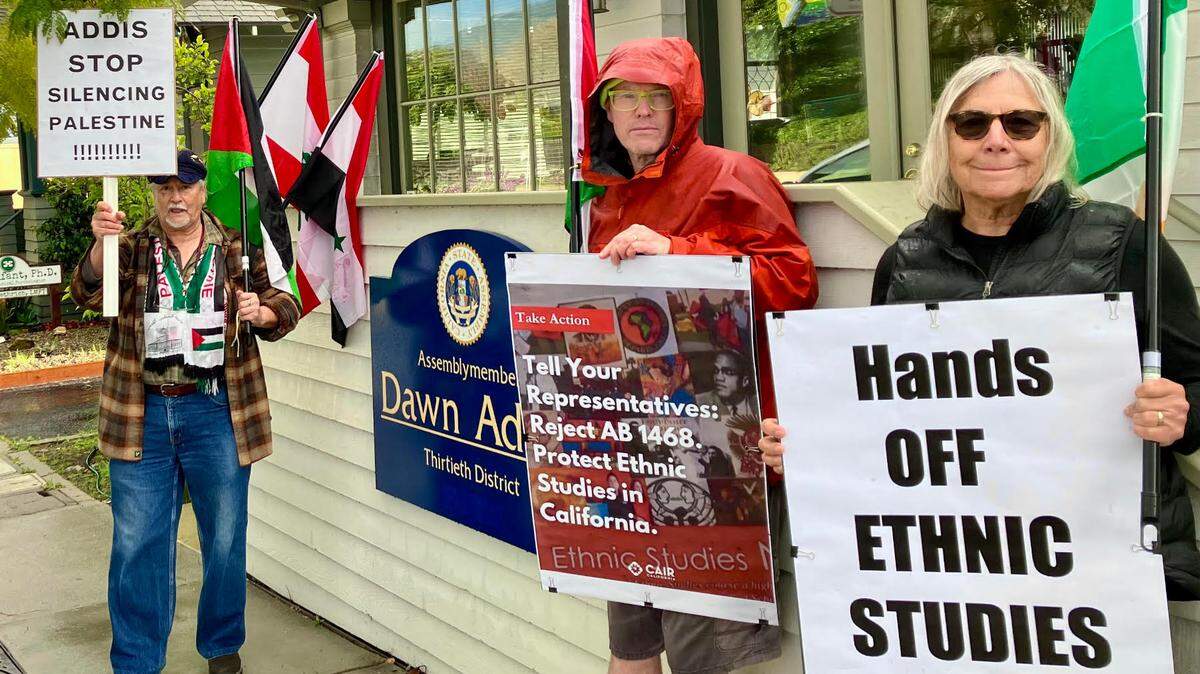
A San Luis Obispo County lawmaker recently introduced a bill in the California Legislature to fight antisemitism in the classroom — but educators who oppose the legislation say its real effect will be silencing the Palestinian narrative.
Assembly Bill 1468 — introduced in the current legislative cycle by Assemblymember Dawn Addis, D-Morro Bay, alongside Assemblymember Rick Chavez Zbur, D-Los Angeles, and Sen. Josh Becker, D-San Mateo — would require California’s Department of Education to create curriculum standards and monitor the instruction of ethnic studies courses in K-12 classrooms.
The goal of the bill, according to Addis, is to prevent political views, bias or discrimination from entering the newly introduced courses across the state.
But critics say it will do just the opposite.
“It’s really a war on ethnic studies,” Marcy Winograd, a former Los Angeles teacher who’s now an anti-war activist and organizer in SLO County, told The Tribune.
Though the bill mentions neither Israel nor Palestine, AB 1468 has become a focal point of the debate among state educators over how to teach about the conflict in the Middle East.
Addis and the bills’ other co-authors have spoken publicly on how AB 1468 will combat rising antisemitism as it relates to Israel’s war in Gaza.
In a recent op-ed in The Tribune, Addis wrote that the lack of statewide curriculum standards has “allowed some ethnic studies courses to be manipulated into pushing political agendas that glorify Hamas, perpetuate antisemitic tropes and denigrate Jewish people,” since the Oct. 7, 2023, Hamas-led attack on Israel.
Addis sees this bill as an effort to protect not only Jewish students taking ethnic studies classes, but the classes themselves, which are being targeted in antisemitism lawsuits across the state.
“The real intent of the bill is to help California fulfill its promise in delivering an ethnic studies curriculum,” Addis told The Tribune in a recent interview. “We have to be able to talk about challenging topics, and we have to do it in a way that doesn’t discriminate against any one group of students or make them feel unsafe in the classroom.”
She said there is “nothing in the bill that would silence Palestinian voices.”
Still, teachers and pro-Palestine activists say the bill is nothing more than a thinly veiled attempt to censor any criticism of Israel or discussion of the Palestinian experience.
“What these lawmakers ... are attempting to do is to say that Jews across California must be protected from those who would criticize Israel’s policies,” Winograd said.
“Why aren’t teachers talking about this?” Winograd asked in reference to the Israel-Palestine conflict. “They’re not talking about this because they are under so much pressure to silence the debate.”
The bill is set be heard by the Assembly Education Committee on April 30.
What are ethnic studies classes?
Passed into law in 2021, Assembly Bill 101 added ethnic studies as a graduation requirement for all California high school students, requiring schools to create and implement curriculum by the 2025-26 school year beginning in the fall.
But developing a statewide curriculum for the classes has been a battle in and of itself, one fueled by scholars’, parents’ and educators’ conflicting views on how to teach about the Israel-Palestine conflict.
The state released the first draft of its ethnic studies model curriculum in 2019. The New York Times said it “reflected the discipline’s investment in the Palestinian cause” and “rarely mentioned Jewish history and antisemitism, but touched repeatedly on the Boycott, Divestment and Sanctions movement to pressure Israel.”
Facing strong opposition from Pro-Israel Jewish groups, the state went back to the drawing board and adopted the current and revised model curriculum in 2021. It “added the stories of other ethnic groups, including Jewish Americans, while eliminating discussions of the Israeli-Palestinian conflict,” and “said lessons should include ‘multiple perspectives’ on political issues,’” The Times wrote.
In reaction, ethnic studies scholars and educators who supported the original model curriculum are now promoting a new structure known as “liberated ethnic studies,” which excludes the history of Jews — seeing them as a “white” ethnic group — and includes Arab American studies, the Times said.
Opposition to Israel is also a central focus of the model curriculum, which has been adopted by multiple school districts statewide, but a 2022 lawsuit filed by Jewish parents and teachers alleging the curriculum was antisemitic was dismissed by a federal judge, EdSource reported.
SLO County school districts are in the process of creating and refining their ethnic studies courses for next school year, if they haven’t launched already.
Atascadero High School is currently writing a curriculum plan for the course using the state’s 2021 model curriculum, Atascadero High History Department chair and teacher David Donati told The Tribune.
The school currently offer a dual enrollment ethnic studies course with Cuesta College, with plans to offer the course at the high school starting in the 2026-27 school year, he said.
“If the Addis bill passes, we will make the necessary adjustments to the course at that time,” Donati said.
In the Lucia Mar school district, special education teacher Loni Carbonella said the creation of ethnic studies classes has been a multi-year process of proposal after proposal. It’s “been definitely a rocky rollout,” she said, and the classes have received backlash from parents in the school district.
A class was piloted last year, which is currently offered at all Lucia Mar high schools, but the curriculum is still under development and subject to change, she said.
Addis’ says ethnic studies bill will fight antisemitism
Addis’ bill is a direct response to antisemitism lawsuits across the state — not only to protect Jewish and other students from discrimination, but to protect ethnic studies classes themselves from being disbanded, she said.
“I believe in the promise of ethnic studies to tell the stories of California’s children,” Addis told The Tribune in an interview. “What has happened in California, unfortunately, is some folks have started to use ethnic studies to push their own political opinions and antisemitism has entered many of these discussions within ethnic studies.”
The Santa Ana Unified School District recently canceled three ethnic studies courses in a legal settlement that alleged antisemitism in how the classes were rolled out, including public meetings being held secretly on Jewish holidays in order to avoid participation or protest by Jewish people, the Los Angeles Times reported.
In the Bay Area, accusations of antisemitism — including swastikas drawn on campus and reports of antisemitic slurs — led to a lawsuit against the Sequoia Unified High School District by students from two different high schools in the district, ABC7 News reported.
At one of the schools, an ethnic studies teacher reportedly gave a presentation depicting a puppeteer in cartoon imagery to explain Jews as controlling of the dominant narrative, a “blatantly antisemitic” trope, a Jewish parent told the Menlo-Atherton Chronicle. According to one parent who spoke to ABC7, teachers advised Jewish students to hide outward signs of their faith, like Star of David necklaces, to avoid being targeted.
Earlier this month, two other Bay Area school districts — Campbell Union High School District and Santa Clara Unified — were ordered to provide anti-discrimination teacher trainings after a California Department of Education investigation found two teachers taught biased lessons about Israel-Palestine that “discriminated against Jewish students,” the state’s report found.
Colleges are experiencing similar accusations, though the ethnic studies bill would only pertain to K-12 institutions. Cal Poly President Jeffrey Armstrong will appear before the House Committee on Education and the Workforce on May 7 for a hearing to address the university’s “failures to address antisemitism on campus,” The Tribune previously reported on April 11.
Addis said there have been even more instances across the state that have not yet resulted in lawsuits.
However, critics argue the bill pushes too far in the opposite direction and into the territory of educational censorship.
“I don’t think I know of any teachers who believe that there’s any room for antisemitism in schools, in our curriculum. I don’t think that’s controversial among any teachers that I know, at least, and absolutely there are instances of it, but I think, unfortunately, the political climate now is to use that as a term to suppress Muslim and Arab American voices or people who are allies with them,” Carbonella said.
AB 1468 is backed by the entire California Legislative Jewish Caucus — with Addis, Becker and Zbur all members of the caucus — and pro-Israel groups like the Jewish Public Affairs Committee of California, but other pro-Israel Jewish advocacy groups like the Israeli-American Civic Action Network say the bill doesn’t do enough to fight antisemitism.
“Their definition of antisemitism equates antisemitism with anti-Zionism, or any criticism of Israel,” Caryolyn Krueger, a former arts teacher in the Los Angeles Unified School District, told The Tribune. “There’s definitely a need to fight antisemitism — real antisemitism — but I don’t feel that that these groups are doing that. In fact, I think they’re weaponizing the whole idea of antisemitism.”
Others, like the San Diego chapter of pro-Palestinian Jewish group Jewish Voice for Peace, oppose the bill.
As a matter of fact, Jewish students are not the only ones facing discrimination in classrooms as a result of the turmoil in the Middle East, Krueger said.
The Berkeley Unified School District faced two federal civil rights complaints alleging widespread antisemitism and anti-Palestinian and Arab hate, including a student’s hijab being ripped off during class and other Arab and Muslim students being called “terrorists,” Berkleyside and the San Francisco Chronicle reported.
“I know there is ... an increase in antisemitism. There’s also an increase in Islamophobia,” Krueger said. “It’s just a one-sided approach to a subject that should benefit all students.”
What would Addis’ ethnic studies bill do?
Instead of resolving the issue of how to teach ethnic studies courses in a responsible way, AB 1468 seems to be further fueling the fight.
AB 101 did not provide much curriculum framework or many teaching standards beyond requiring that classes “be appropriate for use with pupils of all races, religions, nationalities, genders, sexual orientations, and diverse ethnic and cultural backgrounds, pupils with disabilities and English learners,” “not teach or promote religious doctrine” and follow California Education Code guidelines outlawing discrimination in the classroom.
Introduced in the Legislature on Feb. 21, AB 1468 would set up “content standards” and “curriculum frameworks” for teaching ethnic studies classes.
Addis’ ethnic studies bill adds to AB 101’s existing framework that classes should “foster multicultural respect and understanding and focus on the domestic experience and stories of historically marginalized peoples in American society, along with understanding the histories, origins, cultures, struggles and contributions to American society of these peoples.”
Classes should also “provide a fair, balanced and humanizing academic presentation of various points of view regarding controversial issues, consistent with accepted standards of professional responsibility, rather than advocacy, personal opinion, bias or partisanship.”
The framework also requires curriculum and instruction to be consistent with other state and federal laws in addition to the education code.
“The goal should not be to understand abstract ideological theories, causes or pedagogies which then filter or limit the breadth of an ethnic group’s experience,” the bill states.
However, Winograd, the activist and organizer of the SLO County chapter of anti-war group CODEPINK, is one voice of many California teachers who believe the bill is unnecessary. Krueger, who is also involved in CODEPINK, said the group held vigils for Palestine outside Dawn Addis’ office in SLO every Thursday from October to March.

The state of California already has guardrails in Section 220 of the state Education Code to protect against bias and discrimination in the classroom, Mary Winograd said.
“No person shall be subjected to discrimination on the basis of disability, gender, gender identity, gender expression, nationality, race or ethnicity, religion, sexual orientation or any other characteristic that is contained in the definition of hate crimes ... including immigration status,” in any state public education institution, the law reads.
The United Teachers of Los Angeles and the California Teachers Association both oppose the bill, Winograd said — though the state union co-sponsored AB 101.
According to her, AB 1468 is not just unnecessary, but harmful.
She is specifically opposed to the bill’s language restricting curriculum to the “domestic experience” of marginalized people.
“They don’t want students of color, many of them in our public schools, to understand the roots of attempts to marginalize them,” Winograd said. “The bill specifically says don’t talk about anything but domestic issues.”
She said the language of the bill limits the topics that teachers can discuss in other ways, too.
Critics on both ends claim the bill explicitly cites four “priority” ethnicity groups — African Americans, LatinX, Asian American and Pacific Islanders, and Native Americans — in an effort to limit ethnic studies curriculum to exclusively teach about these four minority groups.
The only mention of the ethnic groups in the bill is as recommended groups of academics who would make up “an advisory committee with a majority of the advisory committee’s members being experts in African American studies, Asian American and Pacific Islander studies, Native American studies and Latino and Chicanx studies to provide input to the state board on content standards.”
For Jill Stegman, a former English teacher and school librarian at Atascadero High School who wrote a recent op-ed for The Tribune about AB 1468, this constitutes an exclusion of other groups from the conversation.
“It’s very vague, and it sounds like, well, the idea that they don’t want to include Arab Americans as marginalized people,” Stegman told The Tribune.
Notably, Jews are not included in the four minority groups, either.
“There are a lot of voices being left out,” Carbonella, the Lucia Mar teacher, said. “And it is interesting that then there is a focus on addressing antisemitism without actual Jewish voices.”
The bill never explicitly mentions these four groups as “priority” groups, but Addis told The Tribune “the four core disciplines plus local communities are the focus of California high school ethnic studies.”
A spokesperson from Addis’ office said the focus on the domestic experience of the four discipline groups was not a new addition to ethnic studies curriculum, and started with AB 101. Even though it is not explicitly mentioned in the earlier bill, it is outlined in the model curriculum.
“The bill is focused on uplifting California’s multicultural students and multicultural schools and societies, while making sure that all students feel welcomed and affirmed. That is the same for children of Palestinian backgrounds as children from Israeli backgrounds, children from Muslim backgrounds, as well as children from Jewish backgrounds, children from African American, LatinX, AAPI, Native American, Sikh — all kinds of different backgrounds,” Addis said. “Children from every background should be welcomed and affirmed in California classrooms.”
On that, Addis’ critics can agree with her.
“Bringing all voices to the table is important, because, I mean, I think that’s the point of ethnic studies,” Carbonella said. “It’s not to hyper focus on one group over another.”
This story was originally published April 25, 2025 at 11:22 AM.