Cal Poly president OK’s big fee increase to fund more scholarships. Here’s how it works
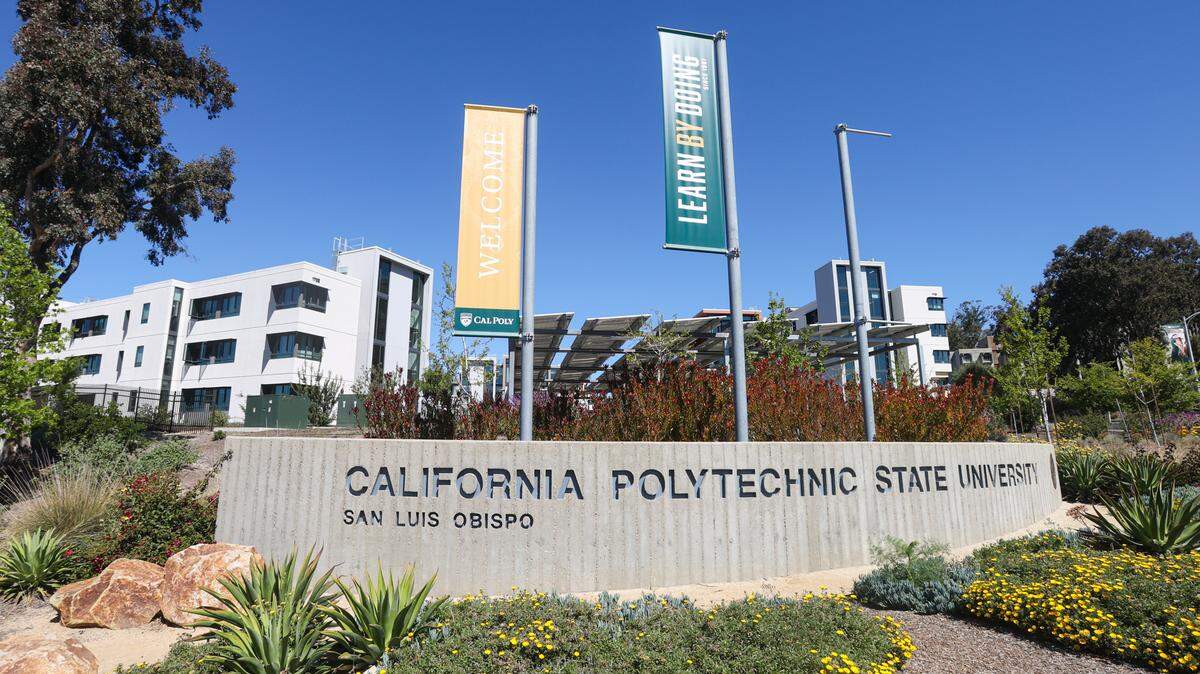
Cal Poly’s president has approved a major increase in student fees in an effort to provide more scholarships for low- and middle-income students and fund its “Learn by Doing” programs.
By 2026, the new fees will tack on as much as $3,500 a year, but Cal Poly President Jeffrey Armstrong said the increase will “level the playing field” for students and ensure low- and middle-income students receive scholarships to offset their fees, ultimately lowering the cost of a Cal Poly education for those students.
“This is one of the most transformational things we can do for Cal Poly, for all students,” he told The Tribune in an interview.
Armstrong noted that the fee increase will hopefully make Cal Poly more competitive against the other public California universities it competes against. Oftentimes, he said, students will be accepted into Cal Poly but choose a University of California school with similar programs instead due to its better financial aid packages and overall lower cost.
The fee increase may also make Cal Poly a more attractive employer as the university should be able to increase faculty salaries with the revenue generated from the fee, Armstrong said.
Students currently enrolled in Cal Poly will not be affected by the fee changes. The fee increase will roll out over the next five years starting this fall and vary by college.
Students also will not see their college-based fee increase year over year. Instead, each new class will have a higher fee than the class before it.
Fee increase will decrease cost of attendance for some students
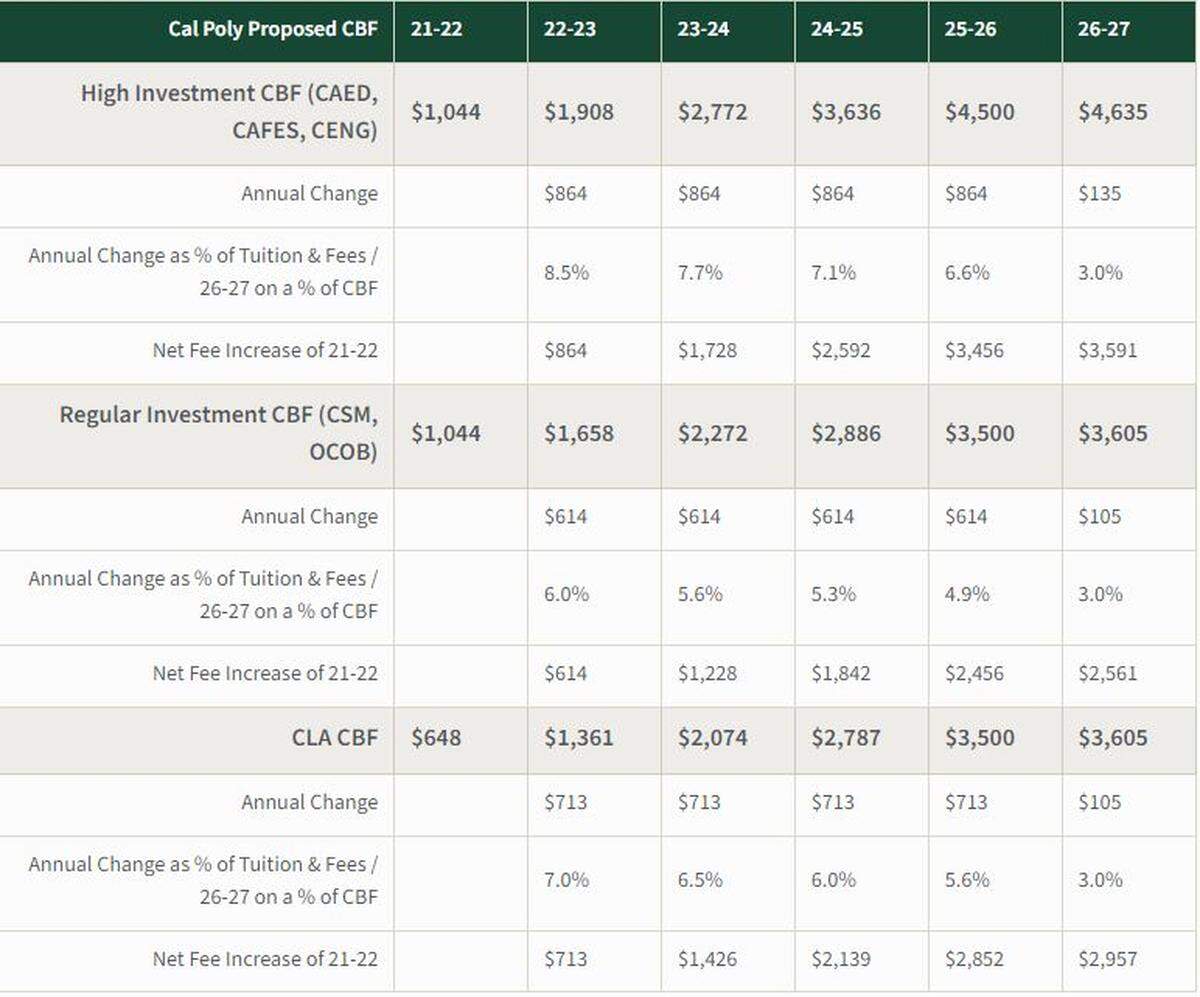
By 2026, new students will pay fees that are between $2,561 and $3,591 higher than the fees current students pay.
For example, students enrolled in the architecture, agriculture and engineering schools currently pay $1,044 in college-based fees. This fall, that will increase to $1,908, and by 2026, newly enrolled students will have to pay $4,635 per year on top of tuition.
Those enrolled in the science and mathematics and business schools also now pay $1,044 in college-based fees. Come fall, new students will pay $1,658, and by 2026 the fee will be $3,605.
Finally, students enrolled in the College of Liberal Arts currently pay $648 in college-based fees. That will increase to $1,361 in the fall and $3,605 in 2026 for newly enrolled students.
These fee increases are expected to generate about $4.3 million iin the 2022-23 academic year, and about $52.5 million by the 2026-27 academic year.
Approximately 60% of that revenue will fund student aid, while the remaining 40% will go to the university’s faculty salaries and its “academic mission” of “Learn by Doing.”
Essentially, incoming Cal Poly students with families who make less than $90,000 should have their college-based fees completely offset by scholarships generated from the fee increase.
“It is a hallmark of almost any public university in the country: that those who are given more, who have more income, pay; and those who do not, pay, but have it offset,” Armstrong said.
For example, freshman students with a parent income between $20,001 to $60,000 annually would, without the college-based fee increase, likely pay about $15,323 to attend Cal Poly this fall, including room and board, books and travel. With the financial aid generated by the fee increase, that cost should decrease to $14,978, according to university calculations.
University calculations show that the projected net cost of attendance would only increase for those with a parent income specified as greater than $150,001.
Without the college-based fee increase, freshmen in that higher income bracket will likely have to pay about $29,363 in total to attend Cal Poly this fall. With the increase in the fee, that cost should rise to $30,139, according to university calculations.
That increase in the net cost of attendance is because those students would not see the college-based fee offset — they would be paying the full amount to fund the scholarships for the low- and middle-income students and the university’s academic mission.
Although it appears as though the fee increase would attract more low-income students to the university who would not be paying the higher fees, Armstrong was not worried about the sustainability of the fee increase’s promise.
“We have a higher percentage of wealthy parents and students than any public university in California,” Armstrong said. “So sustainability is really not an issue in our modeling.”
Faculty union, student government opposed college-based fee increase
Although the fee increase has already been approved, it did face some opposition as it was being proposed.
The university’s student body government, Associated Students Inc. (ASI), passed a resolution in late February that noted it was concerned by the “lack of strategy for outreach, the lack of clarity among students about potential impacts and the lack of regard for potential negative impacts on nonresident students.”
The university held a consultation period for the proposed fee increase between Jan. 5 and Feb. 9 and conducted dozens of university presentations about the proposal, according to Armstrong.
“The ASI Board of Directors do not support the proposed CBF (college-based fee) increase as the proposed CBF increase places responsibility for sustainable financial aid and the academic mission primarily upon the student body,” the resolution said.
The ASI resolution noted that should the fee increase be adopted, the university should annually review its implementation to ensure it is carrying out its mission of supporting student aid.
The California Faculty Association’s Cal Poly chapter also opposed the college-based fee increase.
“CFA SLO opposes any proposal that would make Cal Poly less accessible for low-income students or students of color,” the union’s chapter president, Lewis Call, wrote in an email to The Tribune. “Although 60% of the new CBF revenue will go to financial aid, we are concerned about the impact that the fee increase will have on undocumented students, who are not eligible for financial aid.”
More information on the fee increase can be found at afd.calpoly.edu/cbf.