
Cal Poly is getting more diverse, but will the whitest CSU ever look like California?
Andru O’Hara did his research before choosing to attend Cal Poly.
He knew that if he picked the San Luis Obispo university — instead of UC Davis, his other option — he’d be headed to a predominantly white campus where he might feel isolated as a student of color.
As prepared as he felt, the culture shock still hit him head on.
“It is really intimidating, the first day of school when you walk onto campus and you don’t see anyone that looks like you,” O’Hara said.
O’Hara, now a fourth-year animal science major, helps run one of the student-led, multicultural clubs that works hard to welcome underrepresented minority students to Cal Poly — the whitest public university in California, a state with a predominantly Latino population.
It’s pretty much a full-time job, he said.
“We just want our community to grow and just show that we have open arms, even though we may be hidden sometimes,” O’Hara said.
While the university has been making steady gains as it works to diversify its student body, Cal Poly’s campus demographics remain far off from those of the state.
For example, two out of every five California residents are Hispanic or Latino. At Cal Poly, they are represented at less than half that rate.
Just over 5% of Californians are Black; at Cal Poly, they make up less than 1% of the student body.
Meanwhile, white students are hugely overrepresented, making up more than half of the student body.
Beyond those numbers is a vexing problem: Non-white students are less likely to apply and be accepted into the university as first-time freshmen than their white peers, according to Cal Poly admissions data.
Cal Poly officials, including President Jeffrey Armstrong, regularly say the university is working to improve student diversity, and the numbers do bear that out.
But the university still has a long way to go to truly reflect California.
“When I was interviewed for president back in 2010, diversity, this very point, was well known,” Armstrong told The Tribune in an interview. “This is a long-standing issue and one that I have embraced and our leadership team have embraced.”
.jpg "20210913-FallConvocation-JoeJ0185 (1).jpg")
To better understand the challenge, The Tribune spent six months investigating why Cal Poly continues to be the whitest CSU campus.
We spent hours analyzing data, speaking with experts from around the nation and listening to the stories of students, faculty and staff at the university.
In this series from The Tribune, we will break down the data, stories and resources to show clearly why diversity is important to a thriving university and what Cal Poly can do to achieve it.
This first story focuses on the university’s demographics.
Next, we’ll bring you a story about the experiences of students of color at Cal Poly.
Then, we’ll dive into what we know about Cal Poly’s current methods to recruit, retain and support diverse students.
And finally, we’ll bring in all the experts to explain how Cal Poly can improve its practices to grow student diversity.
How Cal Poly’s student population compares to California
If nothing else, ethnic and racial diversity is about fiscal responsibility, said José Navarro, a Cal Poly associate professor of ethnic studies and research fellow for the university’s Office of Diversity & Inclusion.
“As a public university, we take tax dollars to fund and run our university from all the people of the state of California,” he said. “And so if you’re taking their money, but not serving the entire population of California, you raise ethical questions; you raise fiduciary questions.”
Take another look at the data, and it’s quite clear that Cal Poly — one of 23 campuses in a CSU system that bills itself as “the People’s University” — is disproportionately serving the white subset of California.
California’s population is 39.4% Latino, 34.7% white, 15.1% Asian, 5.4% Black and 1.6% Native American, according to the latest data from the U.S. Census Bureau.
Cal Poly’s student population, however, is currently 53% white, 19.4% Latino or Hispanic, 13.5% Asian, 0.7% Black and 0.12% Native American.
Looking at the raw numbers, out of the 22,022 students enrolled at Cal Poly in fall 2021, 11,716 were reported as white, according to university data.
A little more than 4,271 students were reported as Hispanic or Latino, 2,960 as Asian American, 159 as Black and 27 as Native American.
If Cal Poly truly represented the demographics of the state, it would need to at least double its number of Latino and Hispanic students to 8,542 and boost the number of Black students eightfold to 1,272, while increasing the number of Asian Americans 13% to 3,365. Its Native American student population would need to increase 13 times to 351.
Meanwhile, the number of white students would need to drop to 7,733, a decline of 35%.
Comparing Cal Poly’s diversity to the San Luis Obispo County demographics is a little different. University officials often say one barrier to increasing student diversity is the lack of it in the surrounding community.
“What we are challenged to do is reach students who go beyond this small county of San Luis Obispo,” said Terrance Harris, the university’s interim vice president for strategic enrollment management.
Overall, Cal Poly is actually more diverse than the community it resides in — in some regards, at least.
The most recent U.S. Census data show San Luis Obispo County is 65% white, 24% Hispanic or Latino, 3.7% Asian, 1.6% Black and 1.4% Native American.
Cal Poly president has made headway in improving student diversity
Cal Poly President Armstrong has been at the helm of the university for a decade. When his tenure started in 2011, he made clear that improving the school’s student body diversity was at the forefront of his priorities.
Back then, 64.4% of the students were reported as white, while 12% were Hispanic or Latino, 10.3% were Asian American, 0.8% were Black and 0.5% were Native American, according to university data from 2010.
So, in his 10-year tenure as president of Cal Poly, Armstrong has initiated a notable shift, moving the demographics of the university to be less white by about 10 percentage points, the data show.
In that time, the share of Hispanic and Latinos students has grown by a full 60% and Asian Americans by 31%.
But the percentage of Black and Native American students has not improved.
“By no means have we reached the university’s goal of reflecting the state’s demographics, but the data shows that we are making steady progress in the direction of a more diverse student body,” said Cal Poly spokesman Matt Lazier.
Armstrong is confident the university’s efforts are working and that they improve the county’s diversity as well.
“I am excited and optimistic that we can attract more diverse students and they end up staying in good jobs around the community and we end up impacting the community over time,” Armstrong said of the improvements to Cal Poly’s diversity over the years.
History of racist incidents harms university’s reputation
Despite those gains, the shortcomings in diversity at Cal Poly are brought into sharp focus every time a racist incident happens on campus — which is an average of about once or twice a year over the past decade.
Students of color told The Tribune they considered dropping out of Cal Poly because of the microaggressions or blatant racism they faced. They said it was hard to find a sense of belonging at the university with cultural clubs struggling to gain support and recognition from the administration.
“I’m really thankful that I did have the support that I did because if I didn’t, I would have been even more unhappy, I wouldn’t have felt safe; I probably would have had a mental breakdown,” said Selina, an undocumented student at the university who preferred to go by only her first name. “I would have been happier in Long Beach, where it’s more diverse.”
Most non-white students interviewed by The Tribune said they’d experienced some form of racism while attending Cal Poly.
Some said it seemed as though the aggressor was misguided or ignorant, while others said there were moments of flagrant hatred directed toward them because of the color of their skin, the way their hair looks or their culture.
Reported racist incidents over the last decade include a 2013 party where men attendees wore Colonial-era costumes and women wore sexually explicit Native American-themed attire, and a recurring “Free Speech Wall” erected by the Cal Poly College Republicans — dubbed a “Hate Speech Wall” by critics — that hosted racist messages in 2015 and 2016.
Also in 2016, two students were suspended for vandalizing another student’s bedroom door with swastikas and racial and homophobic slurs, according to a Mustang News article that details Cal Poly’s history of racism and hateful incidents.
In April 2018, photos surfaced of members of the Lambda Chi Alpha and Sigma Nu fraternities posing for racist photos, with one in blackface and others dressed like Mexican gang members, sparking protests.
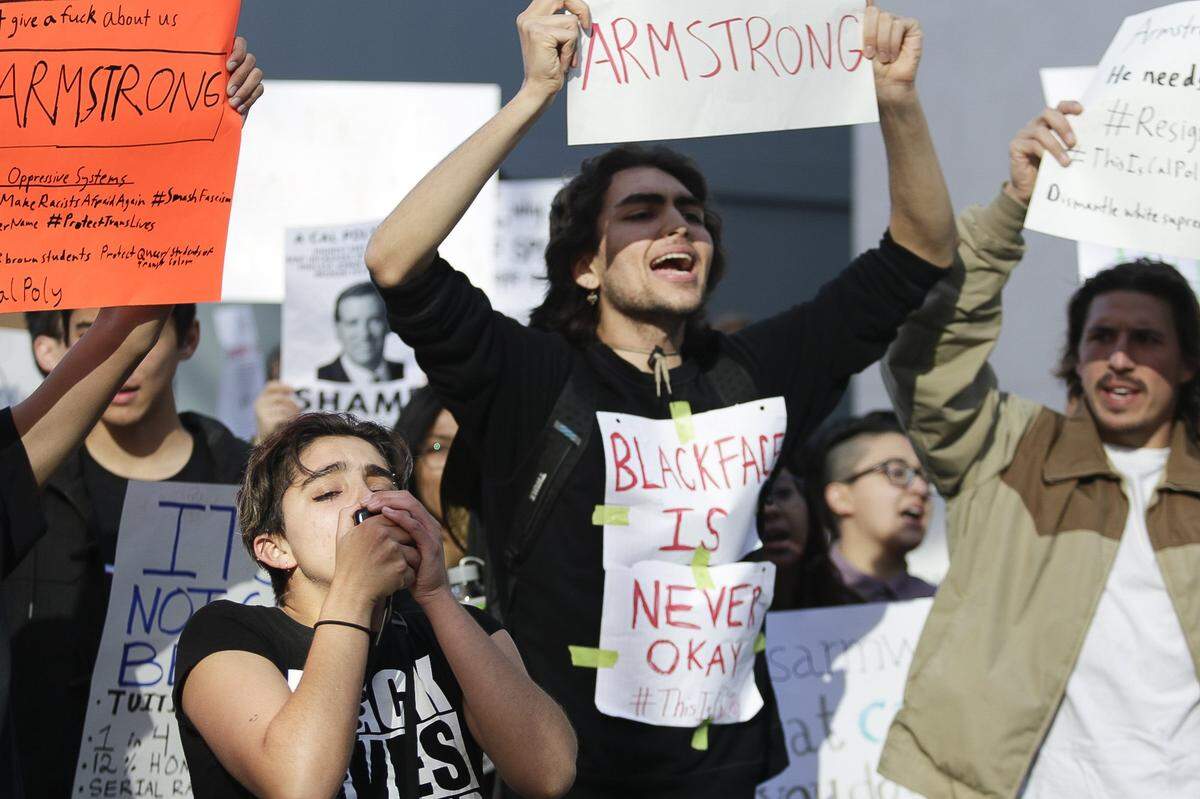
All non-cultural fraternities and sororities at the university were temporarily suspended after the incidents.
And in November 2018, a belt allegedly tied like a noose was found in a Cal Poly residence hall.
More recently, in February, someone vandalized the Alpha Epsilon Pi house — a Jewish fraternity at Cal Poly — with anti-Semitic graffiti.
And in late October, students told Mustang News that two supposedly white women kicked in window screens and yelled the N-word around campus apartments.
University officials and diversity experts say there’s a way to help stop these racist incidents from happening: Increasing student body diversity will help shift the culture of the university to one that’s more inclusive.
“Culture and climate, that’s absolutely an issue (at Cal Poly),” said Navarro, the ethnic studies professor. “Now, how do we respond to that? One of the ways we respond, of course, is you get people in the room, you get people on campus.”
Coming tomorrow: What is it like being a student of color at Cal Poly? Part 2 takes a look at their experiences on the predominantly white campus.
Tribune reporter Stephanie Zappelli contributed to this report.
BEHIND THE STORY
MOREBehind our reporting
Tribune reporter Mackenzie Shuman spent about six months investigating why Cal Poly in San Luis Obispo remains the whitest, least ethnically or racially diverse public university in California. She was aided by Tribune reporting intern Stephanie Zappelli.
Click the arrow to see what went into our reporting.
How the series started
Mackenzie received a document from a now-retired Cal Poly admissions official that showed the university’s application, acceptance and enrollment data broken down by ethnicity, race and various other factors. She was initially interested in the simple fact that the data showed clearly that white applicants were more likely to be accepted into Cal Poly than minority students.
Mackenzie then asked a question: Why was that?
That led her down a much deeper path of reporting.
Who was interviewed for this series
Once it was realized that the reporting project would focus on solutions for improving the diversity of Cal Poly’s student body, Mackenzie enlisted the help of intern Stephanie.
The pair then reached out to diversity experts from around the country. They presented Cal Poly’s diversity data to each of the experts and asked what they would suggest the university do to change it.
The experts, from national nonprofit leader Maureen Hoyler to Cal Poly Pomona’s Director of Admissions Brandon Tuck, each had different ideas for the university.
Mackenzie and Stephanie also interviewed several Cal Poly faculty and staff, although many did not feel comfortable being named in the stories for fear of retribution.
Bringing the data to life
This series was largely guided by the data Mackenzie received from the beginning.
But stories filled only with data would not accurately portray the issues a lack of student diversity has caused at Cal Poly.
So, Mackenzie and Stephanie interviewed dozens of students of color attending the university and asked about their experiences. They attended several Cal Poly club meetings, spoke to students on campus and reached out to campus leaders.
Many students of color said they’d grown used to being the victim of racist microaggressions from other students on campus. Not all students were comfortable sharing their stories, but several did so in hopes that their voice would push the university’s administration to make changes so future Cal Poly Mustangs would have a better, more comfortable experience on campus than they did.
Student anecdotes are the heart of “The People’s University” series.
This story was originally published February 22, 2022 at 5:00 AM.
CORRECTION: This story was updated to include the number and percentage of total population of Native Americans in California, San Luis Obispo County and Cal Poly.