Paso Robles school board bans aspects of critical race theory in classrooms
The Paso Robles Joint Unified School District Board of Trustees passed a resolution Tuesday that bans several “doctrines” it says are included in critical race theory teachings from being taught in district classrooms.
The adopted resolution, drafted by Board President Chris Arend, allows the theory to be taught in Paso Robles schools, if “such instruction focusses (sic) on the flaws in Critical Race Theory.”
The resolution directly contradicts school district policy, which allows controversial issues to be taught so long as “all sides of the issue are given a proper hearing.”
Arend said during the board meeting that the district is not teaching critical race theory in any of its classrooms.
However, “we have had incidents where teachings of CRT (critical race theory) have found their way into our classroom,” he added.
Therefore, Arend’s resolution effectively bans several “specific elements of critical race theory” from being taught in Paso Robles classrooms.
Arend had previously proposed the same resolution at a school board meeting on June 22. But at that meeting, the board did not take action on the resolution and tabled the matter to a later meeting.
The school board voted 4-3 to approve Arend’s resolution — with trustees Nathan Williams, Tim Gearhart and Chris Bausch dissenting.
Bausch had suggested approving one of the other proposed resolutions that banned teaching critical race theory outright.
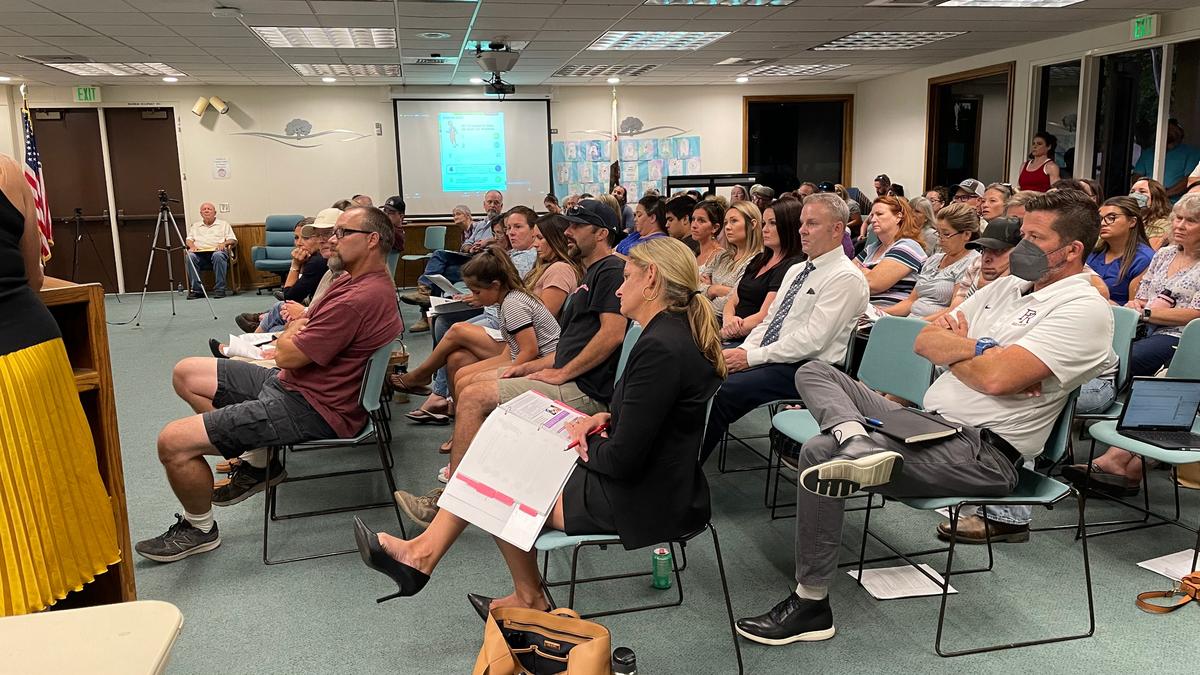
Public comment split on issue of critical race theory in classrooms
The resolution drew comments from the public both in favor of or against banning teaching critical race theory. The board limited public comments on the subject to 20 minutes total as allowed by its bylaws, so only seven people spoke during Tuesday’s meeting, though others had asked to comment.
School officials noted the board had received 82 emails about the critical race theory resolutions.
Those who spoke in favor of the resolutions wanted the school board to ban teaching critical race theory overall.
Michael Rivera said the board needs to “draw a line in the sand” and take a stand against the theory because it teaches kids to disparage others on account of race.
“We’re not going to have our kids pointing the finger of the blame and calling one group oppressors and calling another group victims,” Rivera said during Tuesday’s board meeting. “You’ve got to draw the line and say, ‘Not one step further, we will not turn our kids against each other.’ “
His comments were largely reflected by other speakers at the meeting.
Joddy Moore, a parent in the district, said “I don’t believe any of us would be foolish enough to state that under no uncertain terms here (critical race theory) is not being taught in our classrooms in one form or another.”
Moore added that banning critical race theory from Paso Robles classrooms “sends a clear message that we will not stand for racist or extreme ideology.”
Those against the resolutions made clear their assertions that critical race theory is not being taught in Paso Robles schools, nor any kindergarten through 12th grade schools because it is a highly complex academic theory typically taught in law school or graduate school.
Some said that the resolution that Arend authored misinterprets critical race theory and does not reflect the teachings.
Commenters against the resolutions also said the discussion taking place during Tuesday’s board meeting was unnecessary.
“This is wasting time and resources that you should be spending on issues that are actually happening now,” said Shannon Gonzalez at the board meeting. “We need to be focused on transportation; you’re considering closing a school. Why are we wasting time?”
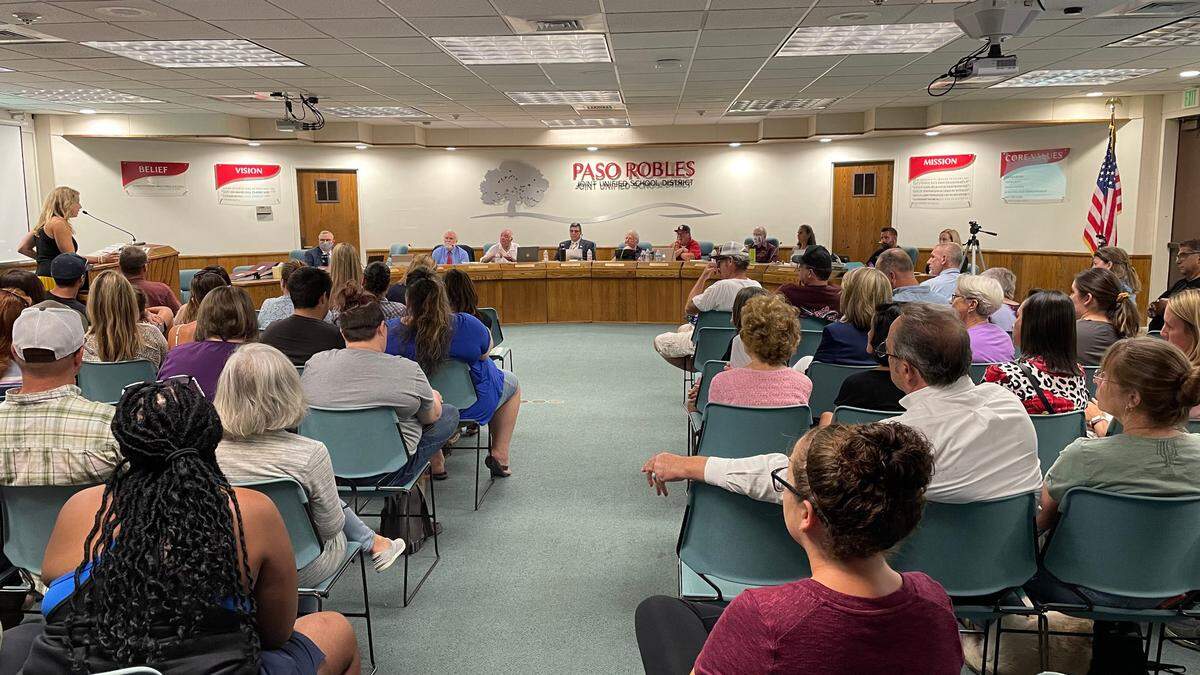
What does the resolution do?
Arend’s resolution approved by the board lists several reasons why the board is banning critical race theory.
Among other things, it asserts that critical race theory “is an ideology based on false assumptions about the United States of America and its population,” “is a divisive ideology that assigns moral fault to individuals solely on the basis of an individual’s race,” “assigns generational guilt and racial guilt for conduct and policies that are long in the past,” and “violates the fundamental principle of equal protection under the law.”
It then outlines several specific elements of and doctrines derived from critical race theory that cannot be taught in Paso Robles classrooms.
In essence, the resolution says that any notion that racism is normal, the color of someone’s skin can be used to discredit them or make them feel bad about past actions of people from the same race, and that only white people are racist cannot be taught.
It also prohibits teaching that “the advent of slavery in the territory that is now the United States constituted the true founding of the United States, or the preservation of slavery was a material motive for independence from England.”
That teaching is not found in critical race theory, but rather in The New York Times’ “1619 Project.”
The resolution stops short of completely banning critical race theory from being taught.
Instead, it says “social science courses can include instruction about critical race theory, provided that such instruction plays only a subordinate role in the overall course and provided further that such instruction focusses (sic) on the flaws in critical race theory.”
Board members against critical race theory, not all supported resolution
All of the Paso Robles school board members said they were against the teaching of critical race theory in classrooms.
Trustee Jim Reed said “if you actually look at all whites, we are not oppressive” after he spoke about several actions taken by what he called the “Democrats.”
“The truth is, not all Americans have been racists and oppressors. Only some have been,” he said. “From the early 1800s, the southern plantation owners were already making more arguments for slavery ... they were Democrats.”
“President Andrew Jackson, in the name of Indian justice, took Indian land by violence and put them on reservations, he just happened to be a Democratic president,” Reed continued. “Democrats imposed the injustice of oppression — from Indian massacres, broken treaties, Trail of Tears and slavery — from the beginning.”
Reed was briefly interrupted by Trustee Gearhart, who argued his comments were partisan and should not be allowed on a nonpartisan school board. However, Board President Arend allowed Reed to continue.
Reed went on to say that history should be properly taught with all the facts and that “it’s imperative that we teach truth in our classrooms, there is no place for inaccurate theories such as” critical race theory.
Trustee Bausch mentioned during his comments that the board already adopted a “broad resolution” declaring the board’s firm stance against racism in the Paso Robles school district, and wondered why banning critical race theory from schools was necessary.
He said he trusts teachers to facilitate robust discussions, teach kids to be critical thinkers and to “not indoctrinate students.”
Trustee Williams said he did not support the resolution because the school district already has policies in place that dictate how “controversial subjects” are taught in classrooms.
“The resolution does not ban CRT. It only controls the way that it’s taught,” Williams said. “It explicitly allows it to be included, but only how one side wants it to be. It goes against the very nature of education.”
This story was originally published August 11, 2021 at 10:03 AM.