How you elect SLO County school board members could change. Here’s what you need to know
Some San Luis Obispo County school district boards of trustees are changing how board members get elected.
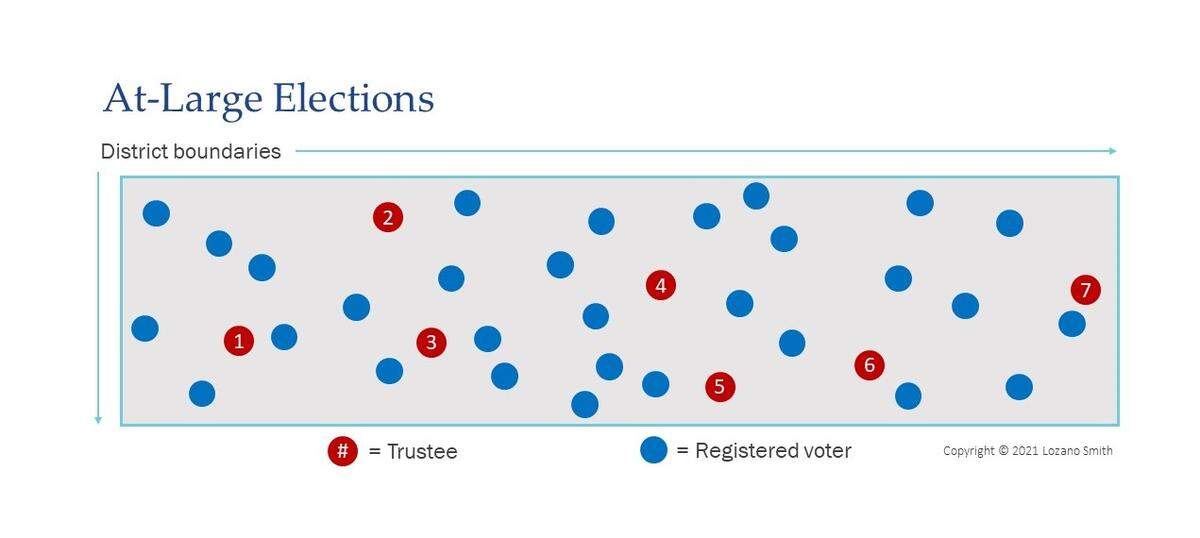
The school boards are transitioning from an at-large voting system to a by-trustee area voting system.
In other words, instead of voters choosing from a list of all eligible candidates within their school district, they’ll only see a list of candidates who live in their area, known as a trustee area, on their ballot.
Lucia Mar Unified, San Luis Coastal Unified and Paso Robles Joint Unified school districts are among the districts that have begun the process of changing their election systems. Shandon Joint Unified, Cayucos Elementary and Coast Unified are also making the move.
“This is one of the most important issues the district will be facing,” said Chris Ungar, board president for San Luis Coastal Unified School District. “And I think it’s really important that the public pay attention to this.”
Most of the local school districts have already held public hearings to receive input on how trustees should draw maps — but public participation has been scant.
School districts are changing their trustee election systems because they could face lawsuits should they keep their current election systems.
Under the California Voting Rights Act, if a school district’s at-large board election system results in “racially polarized voting,” then the school district may be found in violation of the California Voting Rights Act, according to Chelsea Olson Murphy, an attorney with Lozano Smith, a law firm that is representing Lucia Mar, Paso Robles and San Luis Coastal school districts.
To avoid any potential liability, school districts are switching to the by-trustee area system.
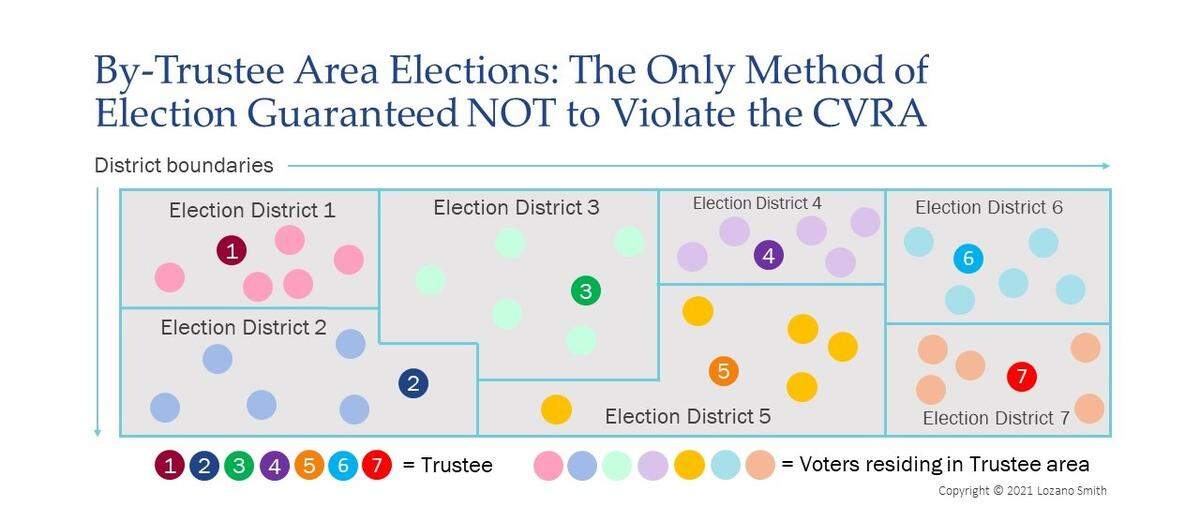
In that system, school board members are elected by people living in their trustee area. Those areas are determined by trustees drawing lines on a map to decide which residents can vote for a certain trustee.
How do SLO County trustee areas work?
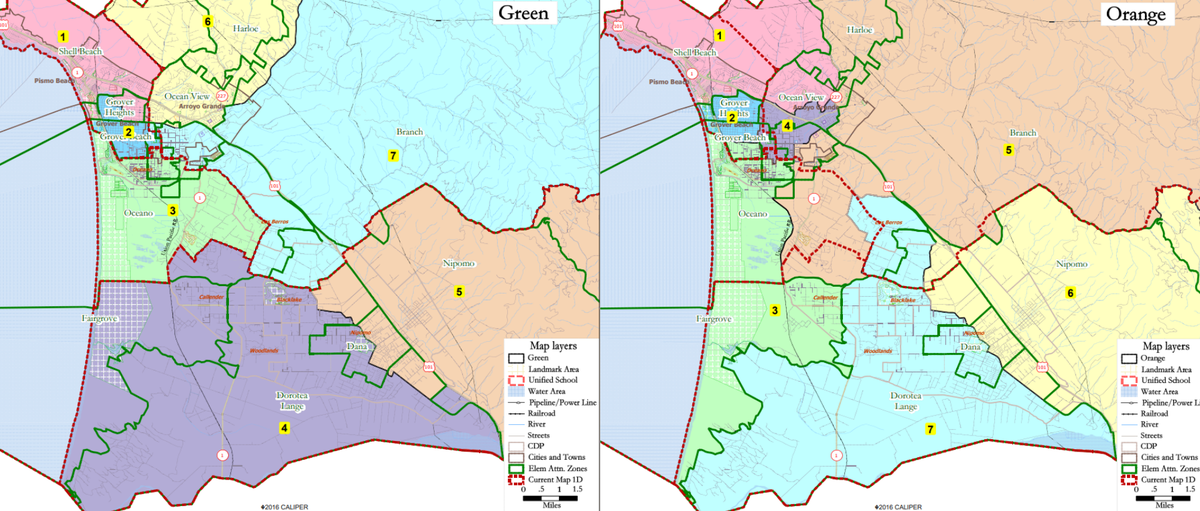
Lucia Mar Unified School District is the first to release its proposed maps of trustee areas. Those maps show two proposed options for a total of seven different trustee areas; in each trustee area, residents will elect one school board member.
Should one of the maps be approved by members of the Lucia Mar school board, someone living in Grover Beach will have a different ballot than someone living in Arroyo Grande, Pismo Beach, Nipomo, Oceano or Shell Beach.
This is significantly different from the 2020 election, where all residents living within the Lucia Mar school district’s boundaries received the same ballot.
However, some districts, such as Lucia Mar and San Luis Coastal, are currently operating in a hybrid voting method. For example, Lucia Mar has four trustee areas: Arroyo Grande, Nipomo, Oceano and the Pismo Beach and Grover Beach area.
In past elections, Lucia Mar school board candidates were required to represent each of those areas. Two trustees were required to be elected from the Arroyo Grande area, two trustees from Nipomo, one trustee from Oceano and two trustees from the Pismo Beach and Grover Beach area; but all voters within the district received the same ballots regardless of which trustee area they lived in.
Lucia Mar’s two new maps for trustee areas feature subtle differences that result in very different representations of the local population.
For example, in the green map, trustee area five would be comprised of 45% Hispanic voters and 49% white voters. Hispanic people make up about 26% of Lucia Mar’s total population, while white people make up about 68% of the district’s population.
But in the orange map, trustee area five would hold 11% Hispanic voters, and 83% white voters.
How do school boards decide who votes for trustees?
When figuring out where to draw the lines for each trustee area, school districts have factors they are required by law to consider.
The most important factor is ensuring there is an equal, or near equal, resident population in each district, according to Doug Johnson from the National Demographics Corporation, a company contracted by some local school districts to help them draw the new trustee area maps.
Districts have to do this while also avoiding “racial gerrymandering,” Johnson said. That’s when a trustee area map is drawn to lessen the voting power of certain races or ethnic groups, such as Hispanic or Black people, he said.
To dilute a certain ethnic group’s voting power, a line could be drawn down the middle of where a large population of the ethnic group lives.
If trustees were to draw a line that split a neighborhood where many Hispanic people live, that would split the population of Hispanic voters in half between two different trustee areas. That would cause Hispanic voters to become an even greater minority within each trustee area, as opposed to if the neighborhood was kept together in one trustee area.
Racial gerrymandering is more of an issue in the Lucia Mar and Paso Robles school districts — as opposed to San Luis Coastal — because those districts have some concentrated areas with large minority populations.
Additionally, Johnson said that school districts can consider several other factors such as school attendance zones, physical landmarks, cities, communities or the locations of the homes of current board members.
“If we follow attendance zones, some school districts like that because then a trustee can have a focus on a particular school,” Johnson said. “But at the same time, a majority of districts don’t like attendance zone-driven election areas because then the board members start to feel like ‘This is my school.’ “
Most schools “go to fairly extreme lengths to avoid that kind of balkanization,” Johnson said because board members “want to feel like they’re responsible for the whole school district, not just the schools in their area.”
Drawing the new trustee areas around where current board members live is also a popular way to create the new maps, Johnson added.
“If a small adjustment can make it so that each board member gets to run again, we actually look at that as truly empowering the voters,” he said. “Then, voters decide which board members have earned reelection. If we end up with two board members in the same trustee area, hopefully they’re on the same year, so they get to run against each other.”
School districts may also consider where other city councils or special district trustee lines are drawn to ensure some alignment in districts, county elections officer Tommy Gong said.
This will help simplify ballots and create coterminous districts, Gong said.
School districts have started the process of creating the maps even though the latest U.S. Census Bureau data has not been released due to COVID-19-related delays.
School districts that draw their maps using 2010 Census data will need to make adjustments to reflect large population growth or declines revealed in the 2020 Census data, which is expected to be released in late September.
However, school districts are aiming to have their maps finalized before the next election in November 2022.
Public input important as trustees consider new maps
School districts are required to hold at least five public hearings for community members to express their opinions on where the lines should be drawn.
So far, at most of those public hearings, only a few people have shown up to speak.
“How these lines are drawn is going to shape the board for the next 10 years, so everyone who is concerned with school district issues and the results of school district elections, hopefully will follow this process and weigh in with their thoughts,” Johnson said. “It’s very common to have only a few comments early on before the draft maps appear because the issue is kind of complicated and weird. But once the draft maps come out and people are seeing the very clear choices that each map represents, hopefully that’s when they really start to weigh in.”
Johnson said the most productive comments people can give are solutions. For example, if a line is drawn somewhere where you don’t think it should be, Johnson said you can propose the line to be drawn somewhere else during the public hearings and board members can consider that.
Ungar, San Luis Obispo Coastal board president, the public input that trustees receive may shape the board for the next several elections.
“However we draw the maps, that’s going to be your voting district,” he said. “That’s going to be your representative.”
This story was originally published May 13, 2021 at 11:35 AM.