Video shows police stop of Cal Poly lecturer. Now he’s fighting to get his job back
A former Cal Poly lecturer who accused the university and its police department of racial profiling over a 2019 traffic stop says he is now at risk of deportation after his teaching contract wasn’t renewed.
Sarder Sadique, an instructor in the Materials Engineering Department until his employment ended in July, says the fateful police stop on Village Drive over an alleged unsafe driving maneuver set off a chain of events that now threaten his U.S. work visa.
No charges were ever filed or a citation issued over his traffic stop, but upon learning of Sadique’s allegations, the local chapter of the California Faculty Association took up his case and publicly accused the university of violating an anti-discrimination clause in the educator’s contract.
The allegation came as Cal Poly was trying to move past a series of racially charged incidents that drew international attention and a growing public perception that the university is not a friendly place for people of color.
In response, the university turned the incident over to the California Attorney General’s Office, one of several agencies that represent the California State University system, and assigned a deputy attorney general to conduct an investigation.
That investigator concluded in July that racial profiling played no role in the traffic stop and found no wrongdoing on the part of the university police officers, according to a redacted copy of the investigator’s report obtained by The Tribune.
But the agency also found that miscommunication played a key role in officers’ actions during the stop, in which they handcuffed Sadique and sat him on a curb for more than a half-hour.
The agency’s investigator also found that Sadique’s confusion during the encounter was reasonable.
Now Sadique, a Canadian citizen born in Bangladesh who speaks English with a thick accent, says he and his family have had to move back to New York state after the university declined to renew his contract.
The faculty union has filed complaints with Cal Poly’s Office of Equal Opportunity and the state Department of Fair Employment and Housing, as well as formal grievances with the university over Sadique’s loss of employment, which the union says was discriminatory.
Unable to find work amid the COVID-19 pandemic, he’s asking the university to allow him to continue teaching a minimum of one or two classes so that he can maintain employment, a requirement of his work visa.
“Whether I stay in the U.S. or not depends on (resolving) this situation,” Sadique told The Tribune via Zoom.
Lecturer said officers ‘didn’t respect me at all’
At the time of his traffic stop, Sadique — a Canadian citizen who received his Ph.D. from the University of Singapore — had only been teaching at Cal Poly for a little over a month.
Due to a lack of affordable housing in the area, he and his family were granted residence in an on-campus apartment in the Poly Canyon Villas while he taught.
At about 8:27 p.m. on Oct. 5, 2019, he dropped his family off with their groceries at the loading zone in front of the Aliso Building, and pulled out onto Canyon Circle Drive to retrieve a work item from his campus office, he said.
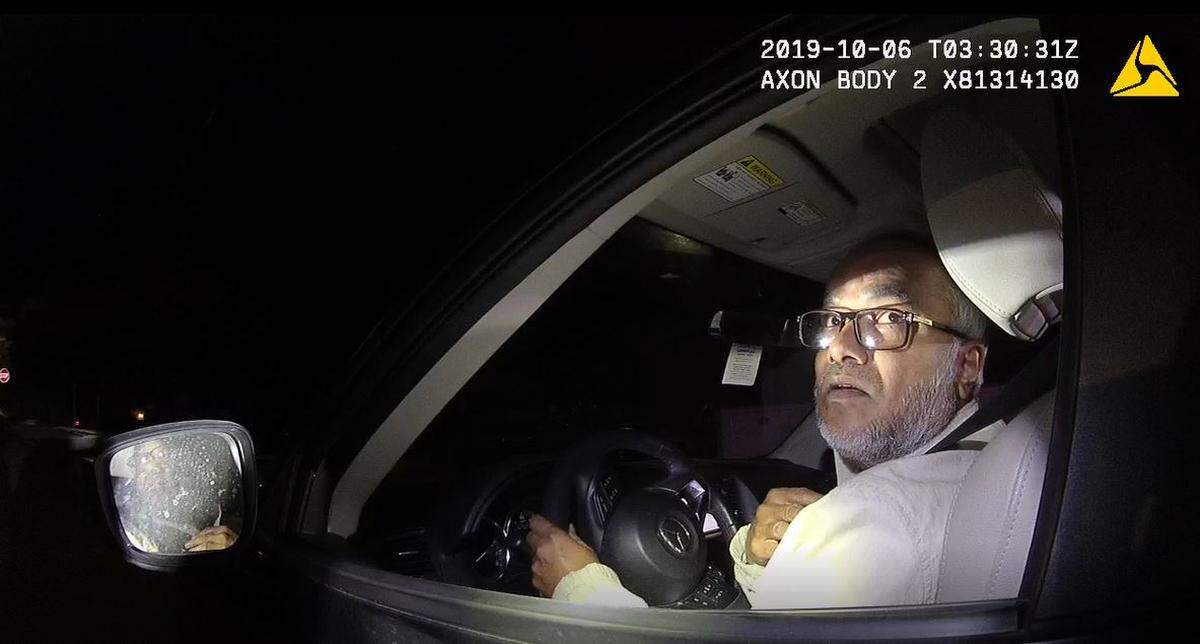
According to Sadique, he was driving alone when he was stopped by a university police officer for pulling out in front of the officer’s patrol vehicle, which he doesn’t believe he did and a video of the incident doesn’t show.
Sadique said he believes the officer pulled him over because of the color of his skin.
He said that the officer, who was white, did not say why he pulled him over but told him to exit the vehicle, and searched him without his consent. After that, Sadique said he was handcuffed and made to sit on the sidewalk for about 30 minutes.
Sadique said that he was confused and in his “panic” provided the officer with his New York state driver’s license, which, unbeknownst to him, had been suspended before he moved to San Luis Obispo.
“I had no idea,” Sadique said. “I told them I had my Canadian driver’s license but they didn’t care at all.”
In officer body camera footage of the incident obtained by The Tribune, Sadique is seen telling the officer he has a Canadian driver’s license, and the officer appears to misunderstand him as saying “driving lessons.”
“I had no idea at all what was happening to me. I was so afraid I was going to be arrested or something bad was going to happen to me that night,” Sadique said. “They did not ask me anything, who I am, what I’m doing there. … They didn’t respect me at all.”
‘There’s no reason for you to go to jail tonight,’ officer says
But the officers’ body camera footage contradicts some of Sadique’s details about the incident.
The copy of the video viewed by The Tribune does not show what led up to the traffic stop, making Sadique’s key allegation of racial profiling impossible to verify from the video alone.
The video does show that university police Officer Thomas McNutt, who pulled Sadique over, did almost immediately explain the reason for the stop.
The video also shows that the officer asked the instructor to exit the vehicle after the New York driver’s license came back as suspended.
In the video, McNutt repeatedly tells Sadique to stop pulling his arms away as the officer searches him for weapons.
“Your driver’s license is suspended. Your driver’s license is no good,” he says.
The officer is seen patting Sadique down while holding his hands behind his back.
“Stop pulling away from me, or you’re going to be in handcuffs,” McNutt says suddenly, though the video does not appear to show Sadique moving. “This doesn’t have to go any certain way — if you cooperate you’re just going to get a citation.”
After a few more seconds, McNutt again orders Sadique: “Sir, do you understand what I’m saying or no? Then stop pulling away from me. I’m not going to tell you again.”
A few seconds later, McNutt handcuffs him.
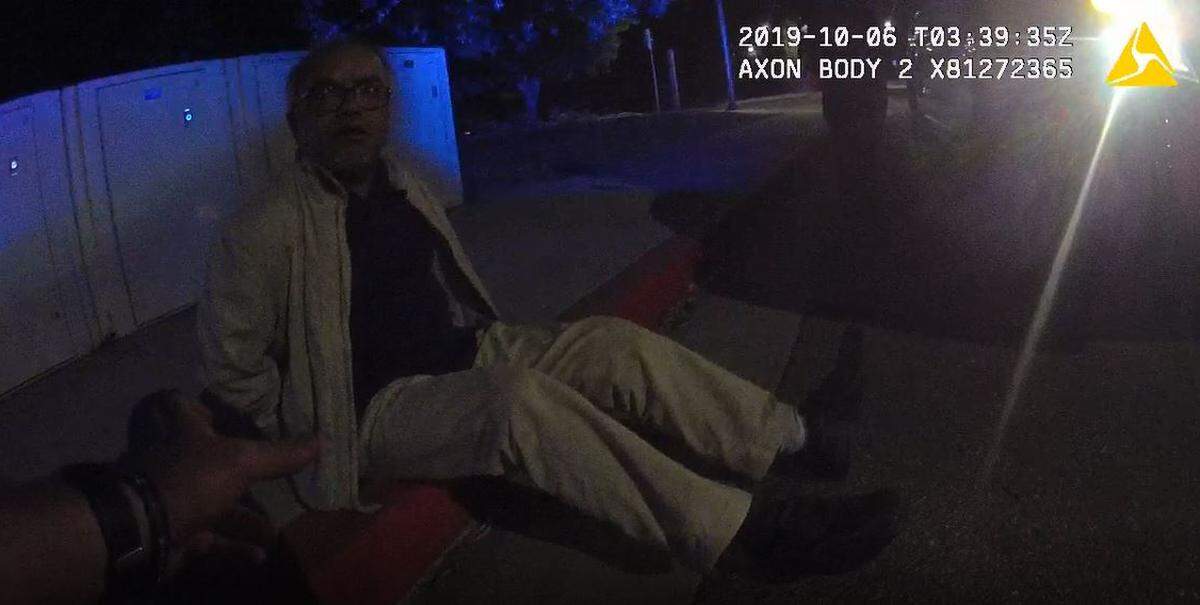
“You understand driving in California with a suspended license is a misdemeanor, sir, OK? So that’s where we’re at right now, that’s why this is happening,” McNutt says. “So just relax, and everything will be fine. There’s no reason for you to go to jail tonight.”
Another officer, Chad Reiley, then tells the handcuffed Sadique that he’s not under arrest.
“We need to figure out what’s going on with your license,” McNutt said.
Once the officers learn of the Canadian license — which they were unable to verify was current — they un-cuff Sadique and release him with an order to acquire a California driver’s license within 10 days.
“And we’re going to follow up and make sure that you do,” McNutt said. “We know where you live, we know where you work, (so) we’re going to make sure you follow it up.”
At the conclusion of the encounter, McNutt asks if Sadique understands why he was put in handcuffs, to which Sadique says yes.
“We’re not here to hurt you or anything like that, OK? I’m just patting you down for weapons because you’re outside the car, you’re amongst us (and) we don’t know what you have or don’t have, OK?”
“But you asked me to come out from the car,” Sadique tells him.
“Right, but I have to make sure you don’t have any weapons,” McNutt says.
“This is the first time in my life,” Sadique says. “I am a professor. I am a professional.”
“Well, that’s understandable. I hope you feel we treated you with respect and we were professional, OK? We just have to do our job. That’s why I’m also not going to write you citations or anything like that.”
As Sadique walks away, Reiley says, “Good luck, sir. Good luck on your classes.”
The entire encounter lasted 39 minutes.
AG: ‘A confluence of events’ escalated traffic stop
A redacted copy of the Attorney General’s Office’s June 29, 2020, report says Cal Poly retained the agency on Nov. 18, 2019, to conduct “an independent fact-finding investigation” into the incident.
The deputy attorney general wrote that the scope of the investigation was to find whether the police officers’ contact with Sadique was motivated by bias and whether he was treated in an inappropriate way.
It found that the preponderance of evidence did not sustain Sadique’s allegations, and that no evidence “connects the stop to his nationality, race or ethnicity.”
As evidence, the report states that conditions were too dark for McNutt to have seen Sadique’s physical features before the stop, and that McNutt’s deceleration of this patrol vehicle supported that Sadique pulled in front of the officer.
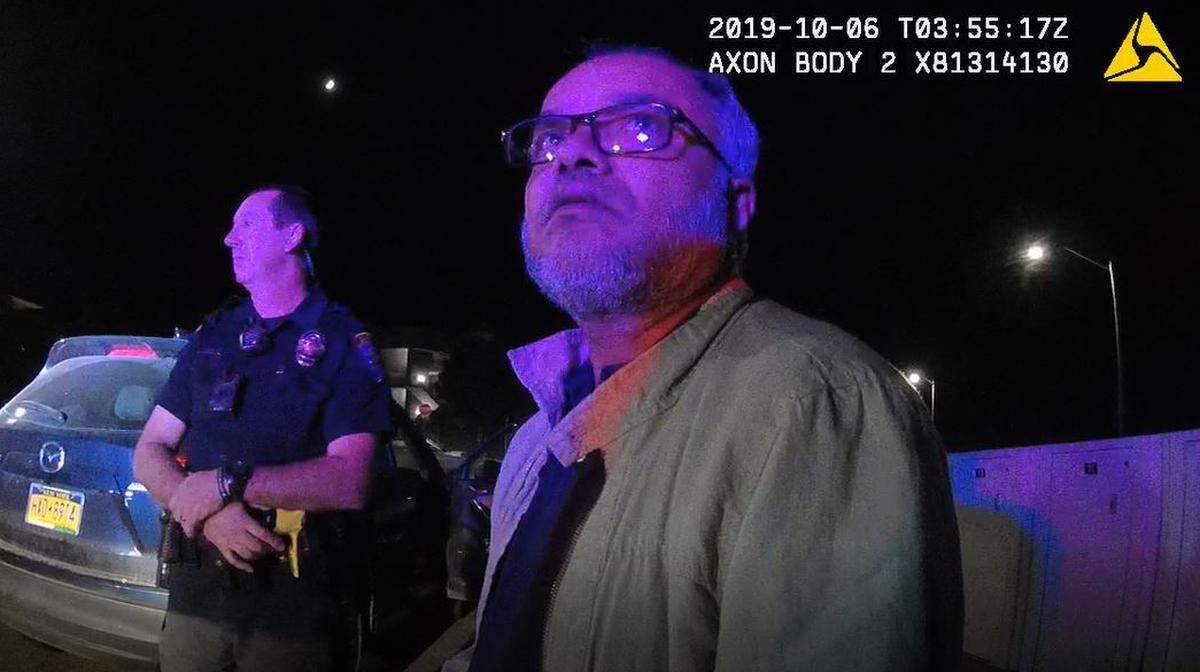
The investigator also said the video showed that officers had reason to handcuff Sadique because “he appeared to be resisting the officer’s weapons search by pulling his hands away.”
“The video and audio recordings also do not show any animus or motivation by the officers that show racial bias,” the report says. “While both officers asked — repeatedly — if Dr. Sadique understood English, their questioning his English comprehension seems justified given Dr. Sadique’s failure to respond to questions at key moments and his occasional unresponsive statements.”
But the report also shows that Sadique was reasonably in a “panic condition” and that he was justifiably confused when he was told driving with a suspended license was a misdemeanor offense, and while he wasn’t under arrest, he was placed in handcuffs and clearly not free to leave.
“The evidence shows that Dr. Sadique’s complaints against the officers were based on a confluence of events ranging from the officers’ inability to hear and understand Dr. Sadique, Dr. Sadique’s understandable anxiety, and the officers’ reasonable efforts to investigate and resolve the situation.”
Union calls police stop ‘disturbing and humiliating’
In November 2019, Cal Poly’s chapter of the California Faculty Association sent a mass email to university staff reporting that earlier in the quarter, a “faculty member of color” was pulled over by campus police and handcuffed.
The union said that its board believed the then-unnamed staff member was racially profiled and noted that the faculty member’s person and vehicle were searched for weapons before he was released “with no citation or an apology.”
“The treatment that this faculty member was subjected to was disturbing and humiliating, and the faculty member’s dignity was severely compromised,” the email says. “The faculty member continues to fear being randomly stopped again by campus police.”
The union asked that all staff report any suspected incidents of discrimination and called on staff and students to “watch out for each other.”
Cal Poly President Jeffrey Armstrong responded to the union’s email by pledging to investigate the allegations despite what he described as the union’s refusal to cooperate.
“(The union’s) suggestion that the university does not care about incidents of racism on Cal Poly’s campus is inaccurate, inflammatory, and destructive at a sensitive time on our campus,” Armstrong wrote Nov. 15, 2019.
Lecturer seeks job to stay in the country
Sadique says that the incident has left him traumatized and afraid he would be pulled over again. The stress affected his teaching, he said.
In July 2020, he was informed by his department chair that his one-year appointment would not be renewed.
“I have not gotten any support from my department. The chair told me there’s no legal issue at all, there’s nothing to discuss,” Sadique said.
In response, the faculty union said it has filed a pair of grievances with the university over the traffic stop as well as Sadique’s employment.
Sadique says he is asking the university to allow him to continue teaching, either online or in person, with at least two units so that he can maintain minimum employment for his visa, while he seeks a stable job.
“If I can do online classes, I will,” he said. “I would come back to Cal Poly, no problem.”
Craig Flanery, field representative for the California Faculty Association at Cal Poly, told The Tribune that every faculty member has a right to “careful consideration” when up for a reassessment.
“Mainly, we’re claiming that the university did not consider the effects and trauma of this police (stop) just a few weeks after he relocated to campus,” Flanery said, adding that Sadique was clearly confused and scared during the incident. “A police officer should be trained to recognize this.”
Flanery said that the university’s Office of Equal Opportunity investigation of the union’s grievances remain ongoing.
Asked whether it’s likely the university will assist Sadique with his employment and visa issues, Flanery said: “It’s definitely something they can do.”
In response to questions about Sadique’s employment, Cal Poly spokesman Matt Lazier wrote in an email that privacy protections prevent the university from discussing individual employees’ personnel matters.
“Speaking generally, the university does not tolerate discrimination or harassment of any kind and responds to reports of such activity within the campus community promptly and thoroughly,” Lazier wrote. “Cal Poly firmly believes in providing a just and equitable campus community for all students, employees and visitors.”
Lazier wrote that, in addition to state-mandated training required for all law enforcement officers, the university’s police force receives additional training on topics such as racial and cultural diversity and racial profiling; bias in policing; hate crimes; community-oriented policing; and ethics.
Lazier would not say whether the traffic stop in Sadique’s case led to any additional training.
This story was originally published January 26, 2021 at 5:10 AM.