
Murder suspect's right to remain silent was violated by police, judge rules
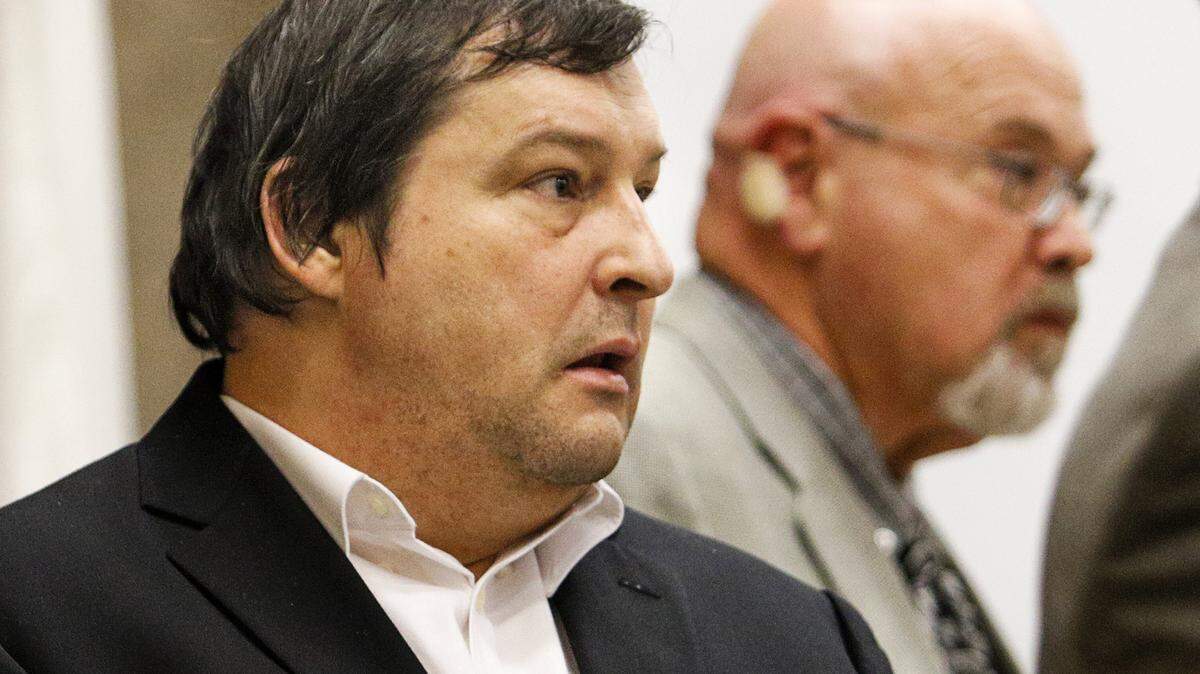
Jurors in an Atascadero murder trial will not see the defendant’s videotaped confession, a judge ruled Monday in San Luis Obispo Superior Court, saying detectives who interviewed him violated his right to remain silent.
Mark Andrews, 51, is charged with murder in the shooting death of his neighbor, Colleen Barga-Milbury, 52.
According to court documents, during a roughly three-hour interview with detectives at the Atascadero Police Department in May 2013, Andrews admitted that he “shot her (Barga-Milbury) in the gut.” But defense attorney Ilan Funke-Bilu argued that the confession should be tossed out because the detectives violated his client’s so-called Miranda right.
Under the landmark Supreme Court ruling in Miranda v. Arizona, suspects are allowed to invoke their right to silence during interrogations by law enforcement.
Andrews, who once told police he has schizophrenia, has pleaded not guilty by reason of insanity.
During his interview with detectives, Andrews initially denied involvement in Barga-Milbury’s murder. At one point — as noted on page 83 of the 171-page transcript — he told detectives he didn’t want to talk anymore.
“I want to go home,” Andrews told them. “I’m finished talking. I want to go home. That’s my right.”
The detectives continued to question him, and eventually Andrews confessed.
Deputy District Attorney Matt Kraut argued that the Miranda ruling did not apply in Andrews’ case because Andrews hadn’t been arrested nor identified as a suspect until the end of the interview.
Acting on a tip, police had stopped Andrews earlier that day, May 24, at a Circle K convenience store in Atascadero. They briefly questioned him in the Circle K parking lot about his whereabouts the day of the killing and asked whether he could help them.
They asked Andrews about his mental health history and whether he had weapons in the home he shared with his mother. When Andrews said he did have weapons, investigators said, they asked to search his home.
Both Andrews and his mother consented to a search of his room, and detectives found a rifle, expended shell casings that matched those found at the crime scene and a nutcracker figurine, an investigator with the county District Attorney’s Office, Casey Neall, testified in a motion hearing Monday.
Barga-Milbury’s house, he added, had several nutcrackers.
“She was a collector of them,” Neall testified.
After the search, Nicholas Coughlin, a detective with the Atascadero Police Department, asked Andrews whether he would go with investigators to the police station for more questioning. While Andrews was led to an interrogation room and questioned, Kraut said, he still was not in custody.
When Andrews asked to stop the interview, Kraut said, it was a “momentary expression of frustration,” not an invocation of his right to remain silent. After belching loudly, Andrews later asked detectives what they wanted to know.
“The officers didn’t do anything illegal or wrong,” Kraut said.
But Funke-Bilu said Andrews wasn’t free to leave the station and, hence, was in custody. And the “momentary expression of frustration” argument, he said, applies to a subject who
loses his temper.
“There’s no indication my client lost his temper,” Funke-Bilu said.
Knowing Andrews had mental health issues, Funke-Bilu argued, the detectives toyed with him and wouldn’t stop questioning him until he confessed.
Superior Court Judge John Trice tossed out the confession, saying Andrews was in custody when he was driven to the station in the back of a police car.
“It sounds like somebody’s being transported as a possible suspect,” he said.
When Andrews told detectives he wanted to go home, Trice ruled, he invoked his right to remain silent. Any statements after that, he added, would be suppressed as a sanction.
As a result of the ruling, attorneys on both sides will have to reconsider their trial strategies before opening statements begin this morning.
This story was originally published February 9, 2015 at 5:13 PM with the headline "Murder suspect's right to remain silent was violated by police, judge rules."