SLO County supervisor says DA has a low conviction rate. Here’s a Reality Check
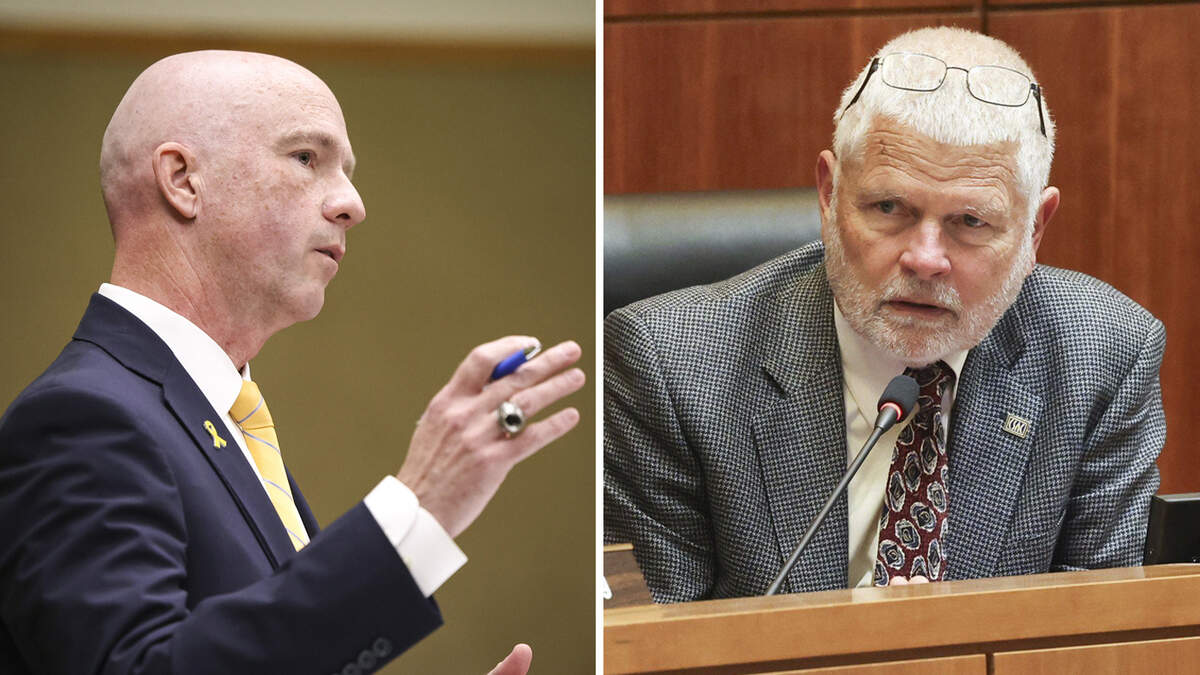
A disagreement between a San Luis Obispo County supervisor and the district attorney continued this week after the Board of Supervisors rejected the lead prosecutor’s nearly $900,000 extra budget request.
The decision came three weeks after District Attorney Dan Dow issued a formal notice to the county that he may take legal action if the 2026-27 fiscal year budget fails to fund more positions for his office.
The District Attorney’s Office initially requested a new paralegal and a new elder abuse vertical prosecutor in February, which the county did not fund in its recommended budget. At the May 19 Board of Supervisors meeting, Dow again requested the two positions, as well as money for three more roles — a victim witness advocate, an administrative assistant and a felony deputy district attorney.
In total, the five positions would have cost $857,839.
The DA’s Office was already set to receive a nearly 5% increase in funding, equaling almost $19.5 million in general fund support and just over $924,000 more than it received during fiscal year 2025-26, according to the $1.2 billion recommended budget.
A day before the board voted against funding the additional positions for the District Attorney’s Office, Supervisor Bruce Gibson wrote about Dow’s “unwarranted” demand and his office’s “ineffectiveness at getting criminal convictions at trial” in his Sunday email newsletter.
“Going to trial consumes a huge quantity of resources,” Gibson told The Tribune. “He’s getting very poor returns on the commitment of those resources, and yet he’s here asking us for more.”
But Dow said the supervisor had it all wrong.
“The most important goal of a prosecutor is to seek the truth — not to secure a conviction,” Dow said in a news release Tuesday.
The Tribune looked into the different data shared by Dow and Gibson as a part of its Reality Check series.
SLO County supervisor said DA has been unsuccessful at trial
Gibson wrote that of the DA’s Office 15 felony and misdemeanor cases that have gone to trial this year, six have ended in convictions, according to data he requested from the court.
That represents a 40% trial “success rate,” as Gibson called it, so far in 2026, compared to a 75-85% statewide average, which he told The Tribune he pulled from a 2015 Public Policy Institute of California fact sheet.
He later used a more recent figure showing an 87% statewide felony trial conviction rate for fiscal year 2024-25 taken from the California Judicial Council 2026 Court Statistics Report Statewide Caseload Trends.
Given that the year is only halfway through, Gibson told The Tribune he supposed Dow’s office “could improve in the second half, but he has a ways to go.”
He added that the “full-year 2025 numbers aren’t great,” which he had also requested from the court. The data reflects that, of the 51 felony and misdemeanor cases that went to trial last year, 37 — or 72.5% — resulted in a plea or conviction.
Dow told The Tribune that pulling data from a partial year was “arithmetic cosplay.”
Notably, Gibson was also comparing the DA’s Office total trial conviction rate — including both felony and misdemeanor cases — to only the felony trial conviction rate from the state.
But Gibson said that didn’t materially change the facts.
“Lumping his combined numbers together, he’s performing very poorly in 2026, and he wasn’t setting the world on fire in 2025,” Gibson said.
DA’s response: 5 years of conviction rates
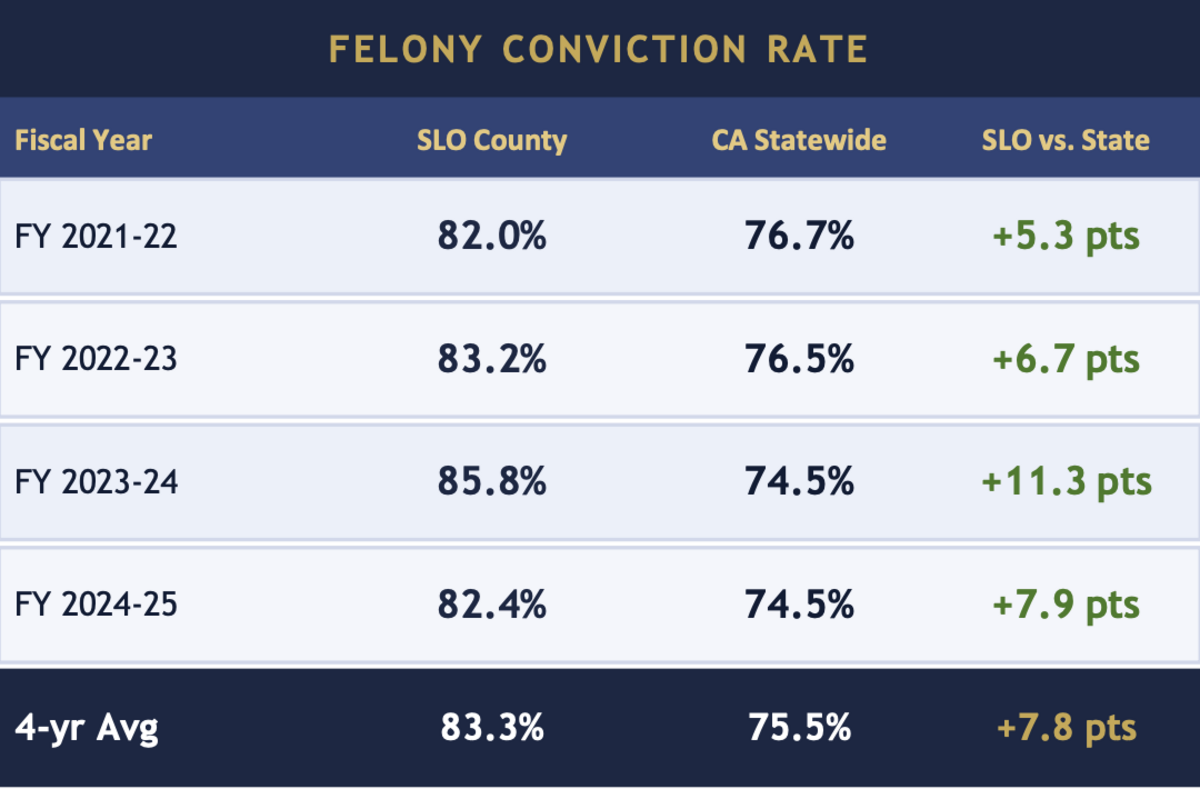
In response to Gibson’s newsletter and Monday’s budget hearing, Dow sent out a news release with five years of SLO County’s felony and traffic misdemeanor conviction rates, drawn from the annual California Judicial Council reports for 2021 through 2025.
The release pointed to the DA’s Office’s “remarkably stable and strong” felony conviction rate over the last five years, ranging from almost 82% in fiscal year 2020-21 to nearly 86% in 2024-25. In that same time, the statewide felony conviction rate averaged 75.5%, the release said.
SLO County’s traffic misdemeanor conviction rates similarly sat on average 8 points above the state average of 69.3% for the same timeframe, the release said. Traffic misdemeanors can include driving under the influence, reckless driving, hit-and-run or driving with a suspended license, though some of these crimes can be charges as felonies.
The release did not mention non-traffic misdemeanors, but an attached PowerPoint presentation shows the conviction rate sits lower — between 28% fiscal year 2020-21 and 42% in fiscal year 2024-25.
That is because they are low-level offenses — like minor drug crimes or petty theft — that are usually diverted by a judge or dismissed in plea deals, Dow said. In fiscal year 2024-25, 58% of non-traffic misdemeanors were diverted or dismissed, according to the Judicial Council of California data.
Infractions — minor violations such as speeding tickets or noise ordinance breaches — were intentionally excluded because they are not criminal offenses, Dow said.
What does the data show?
The DA’s Office’s calculated felony conviction rate includes misdemeanor convictions on so-called trailing charges — felony cases in which the charge was reduced to a misdemeanor and the defendant was still convicted of the lesser offense.
“A felony case that results in a misdemeanor conviction is still a conviction,” Dow told The Tribune when questioned about the methodology. “The defendant was charged with a felony, prosecuted and held accountable.”
Even more notably, the DA’s conviction rate included the result of all felony cases, whether resolved by trial or beforehand, whereas Gibson’s numbers only looked at trial results.
Unlike Gibson, Dow said trial convictions are not, and should not, be the leading metric of success.
“The ethics of prosecution require that the most important goal is truth — not maximizing convictions,” the PowerPoint in the release said. “We genuinely want an innocent person to be acquitted. We want the guilty to be convicted.”
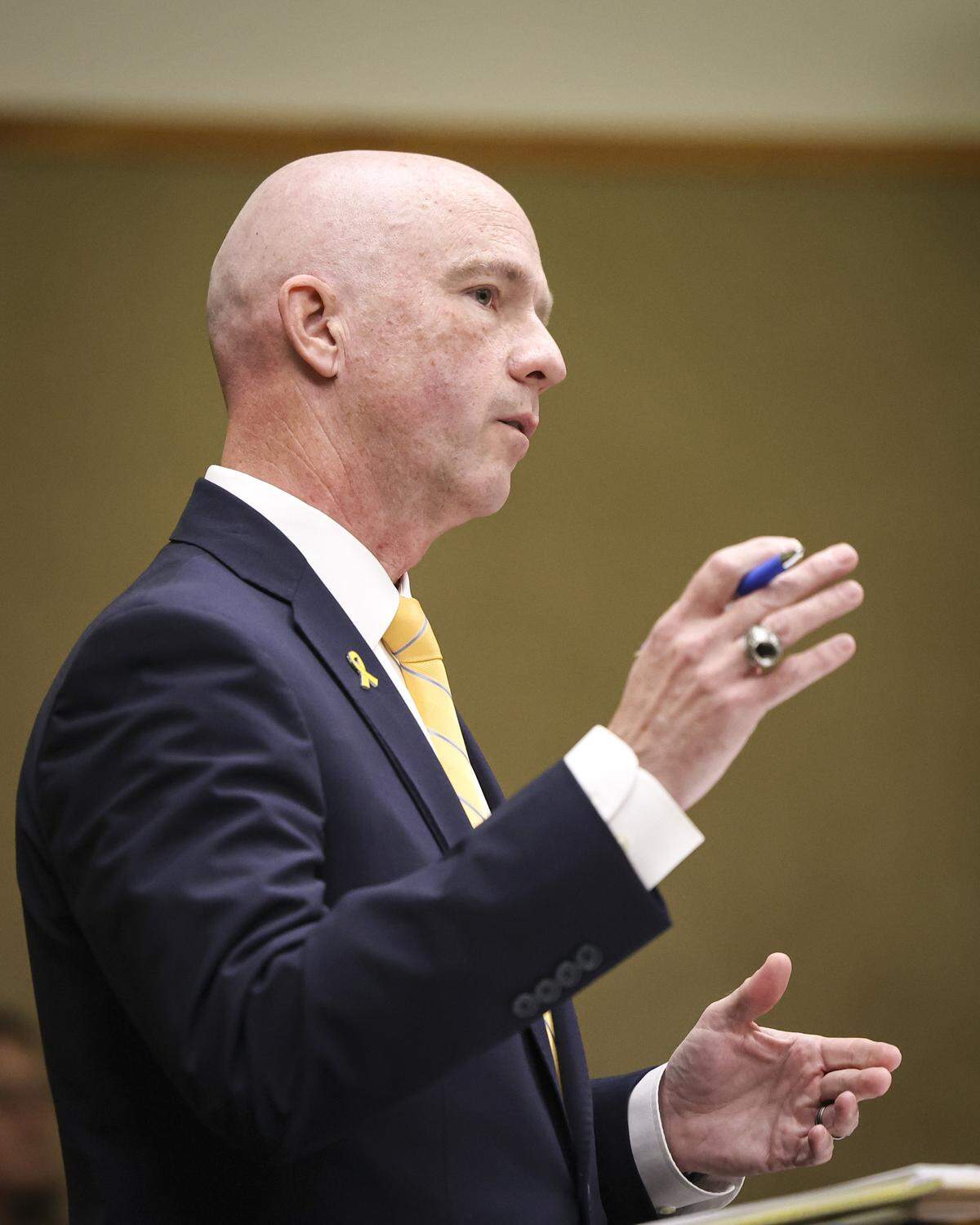
“There is an irony worth noting here: A DA who protects his statistics by declining hard cases looks brilliant on paper,” Dow elaborated in an emailed statement to The Tribune. “My office takes the difficult cases — the ones that go to trial precisely because they are contested — and we do so in service of victims and the criminal and victim justice system, not in service of a supervisor’s opinion.”
It is the DA’s Office policy that deputy district attorneys are never rated on their jury trial conviction rate, the release said.
“We do not incentivize prosecutors to protect a statistic by avoiding the difficult trials that victims and the community deserve to have heard,” the release said.
The DA’s Office success is instead measured by performance metrics that include total number of cases, number of misdemeanor cases diverted and victims contacted within three days — all of which the DA’s Office met this year, according to the recommended budget.
The dispute came after Dow addressed the board on May 19, asking for more funding while raising the potential for legal action if denied, which prompted Gibson to ask if the district attorney was threatening to sue the county if their decision didn’t go his way.
Dow put the county on formal notice, noting that failing to fund more positions for his office “unlawfully impairs the public prosecutor’s constitutionally and statutorily mandated duties.”
While simultaneously criticizing Dow for what Gibson labeled poor trial conviction results and resource management, the supervisor pointed to the DA’s satisfactory performance metrics as evidence that the office was doing just fine with the budget it had.
“Meeting your numbers under strain is called doing your job,” Dow told The Tribune in his statement. “It is not evidence that the strain does not exist.”
In his Sunday newsletter, Gibson also pointed out the DA’s Office still has unfilled positions — even while asking for more. In an effort to fill those jobs, Dow’s office posted a recruitment video in April that “extols the laid-back lifestyle of SLO County, the lower-than-elsewhere caseloads of his staff and the family-friendly vibe of the office,” Gibson wrote.
“All good things, but hardly indicative of an office stressed by workload,” he said.
Dow added that in fiscal year 2024-25, his office handled nearly 1,000 more adult criminal cases than projected, while operating with fewer staff than the year before.
“An office processing above-target caseloads on a reduced roster is not an office with excess capacity,” he said.
Did County CEO agree to fund extra DA’s Office positions?
After Dow made his initial request and formal notice to the board on May 19, he met with SLO County CEO Matt Pontes on May 29 to discuss alternative funding options for three of the five requested positions.
Dow’s budget request and the conversation around funding options took place months after the county finalized its recommended budget in March.
“I am glad we found a path to meet both our current objectives,” Pontes said in a text to Dow after their May 29 meeting. The Tribune obtained text messages related to the meeting through a Public Records Act request.
After the meeting, Dow said in a text to Supervisor Dawn Ortiz-Legg that Pontes “agreed to recommend three of the five positions I asked for.”
Dow told The Tribune that Pontes “expressly” told him and Assistant District Attorney Eric Dobroth at their meeting that he would recommend to the board the positions be approved at the June 8 budget hearing.
Come June 8, however, Dow said that isn’t what Pontes did.
The county did present supervisors with possible funding options for three of the five requested positions, including drawing upon opioid settlement funds and Proposition 172 trust funds instead of the county’s general fund, according to a PowerPoint presentation.
But with the final call up to the supervisors’ vote, Dow said Pontes didn’t go to bat for his office the way he had expected.
“It’s not part of the recommended budget, but it is something that is an option for the board to consider, because we had finished the recommended budget by the time that the district attorney had submitted his additional requests,” Pontes said at the June 8 meeting.
“So you’re not recommending. .... You’re just giving a statement?” Supervisor Heather Moreno asked him.
“I’m giving you the options,” Pontes said.
“He refused to say he recommended it and said merely it was something the board could choose to do,” Dow told The Tribune over text.
Pontes told The Tribune he did “recommended which funding sources could be used for three of the five positions requested ... if the board voted to fund any or all of the positions.”