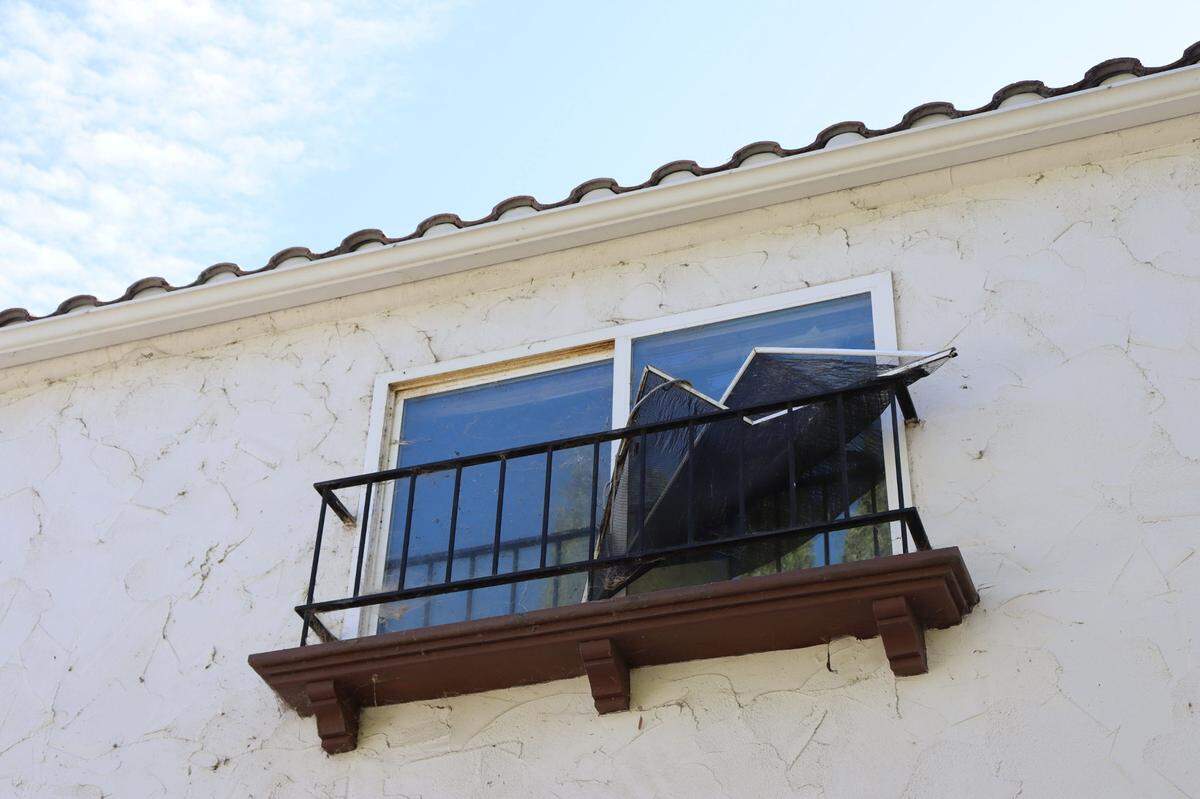
Witness found 40 dead cats and ‘multiple years’ of feces in Paso Robles apartment
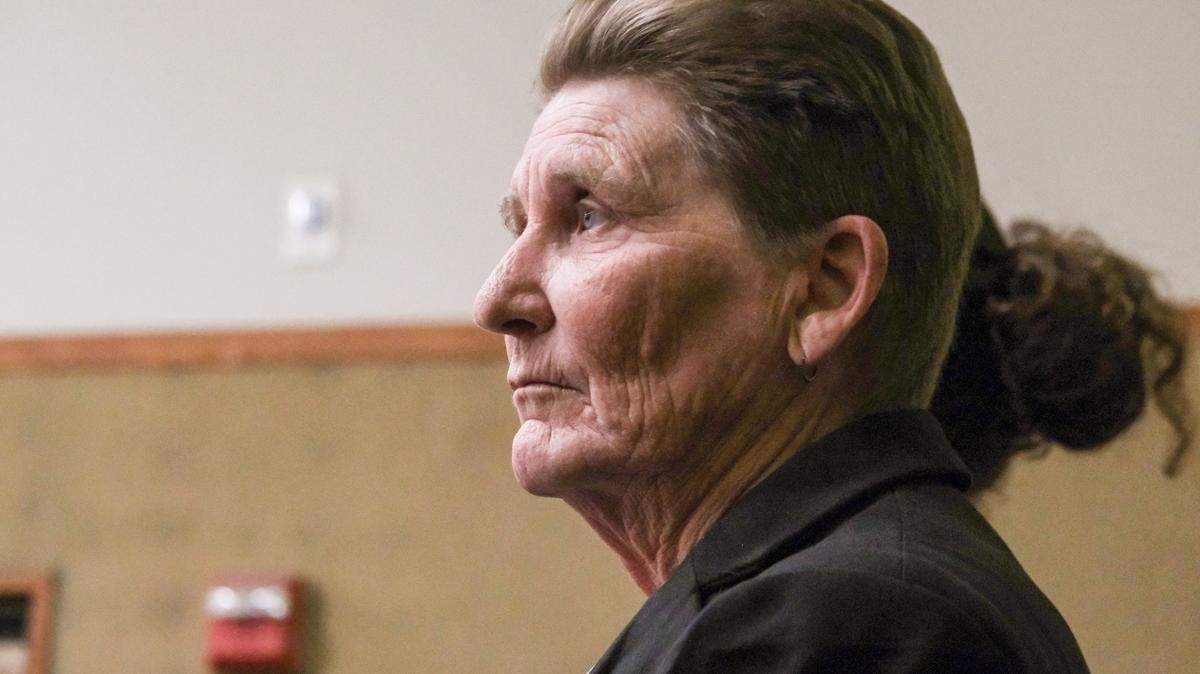
The property manager of a Paso Robles apartment complex where 40 dead cats were found in an abandoned, feces-filled unit will face trial for animal cruelty, a judge ruled Thursday.
Laurie Bryant, 63, was charged with seven counts of animal cruelty by the SLO County District Attorney’s Office on Feb. 10, 2025. Under the penal code, animal cruelty includes intentional abuse, depriving animals of necessary sustenance, drink or shelter, and subjecting animals to needless suffering. She pleaded not guilty in March 2025.
Unit four at the Presidio Apartments, which Bryant managed and previously lived in, was red-tagged — meaning it was deemed unsafe to occupy — in August 2024 after animal control officers forcibly entered the apartment to find it caked in fecal matter, trash and cat carcasses, SLO County Animal Services Lead Officer Marissa Whitaker said on the witness stand in court Thursday.
Bryant had allegedly moved out in October 2023 after living there for 10 years. Neighbors reported seeing her coming and going to feed the cats after she moved out, but they hadn’t seen her since June 2024.
Whitaker said she smelled the apartment before she saw it. There was so much waste covering the floor that it blocked the door from opening. She had to break it down to enter.
What she testified to finding inside was hard to believe.
“These cats were left to die, and not only that, but they continued to multiply,” Deputy DA Kristofer Baughman said in court Thursday, summarizing Whitaker’s testimony. “There were babies in there. There were dead baby cats, kittens. One was inside of a food bag. It was trying to survive. These cats were eating each other. They were in a state of desperation.”
Whitaker also found six live — but starving — cats in the apartment, she said.
Thursday’s preliminary hearing was the first time evidence in the case was presented to the public, or to the court. The purpose of the hearing was for San Luis Obispo County Superior Court Judge Jesse Marino to decide whether the evidence presented probable cause to support the charges and warrant a trial.
Carrie Winters, Bryant’s defense attorney, admitted that it was a “strange” case but said that her client — though she managed and had lived in the property before — was not responsible for the neglect of the unit or the animals inside.
“We have three people who also have keys and control, I’d say, (to) this apartment that are not Ms. Bryant,” Winters said.
Winters also emphasized Bryant’s lack of criminal history.
Ultimately, Marino found “overwhelming” probable cause to continue to trial. Though animal cruelty is a “wobbler” felony charge, meaning it could’ve been reduced to a misdemeanor, Marino decided to keep all seven charges as felonies “based on the sheer scope and scale” of the allegations.
“I don’t know if I’ve ever seen a house in such a state of disrepair,” Marino said. “It’s clear that whatever animals were there in that state were neglected.”
Bryant was released on her own recognizance without paying bail. Her next court appearance is scheduled for May 19.
What did animal control find in the abandoned apartment?
The first time authorities entered the apartment at 1040 Chestnut St. was the morning of Aug. 16, 2024.
However, it was not Whitaker’s first time visiting the apartment complex. Animal Services had received three anonymous calls reporting numerous cats in apartment 4 and a strong odor coming from the unit before ever investigating inside — in April, June and on Aug. 7 of 2024.
All three times, Whitaker called Bryant, who said she had moved out of the apartment in October 2023 and was by then residing in her mother Jacqueline’s old home on San Fernando Drive in Paso Robles. Jacqueline also owned the Presidio Apartments.
During the first call in April, Bryant said she had left eight cats in the apartment and was in the process of moving them to the San Fernando Drive home. In Paso Robles, people are allowed to own a maximum of six cats at a single premise, so Bryant had to secure proper permitting.
By the second call on June 20, however, Bryant said she had moved the cats to the home, which Whitaker visited to confirm. The home was clean with food, water and litter set up, and the cats looked healthy, Whitaker said.
When animal services received a third call on Aug. 7, still reporting a strong smell from the apartment, Whitaker visited to leave a notice on the door, and reported a “foul” odor coming from inside unit 4 when standing outside the door. She called Bryant and left a notice at her San Fernando Drive home as well, but received no response.
A week later, Whitaker finally opened the door to the apartment. It was Laurie’s brother, Steven, who lived in the neighboring apartment and let Whitaker into unit 4 with an extra key he had.
But the door only budged about a foot inward, she said.
“As soon as the door was opened, there was fecal matter coming out from under the door, and there were skeletal remains right in the doorway on the floor,” Whitaker said. “It appeared to be an animal.”
She put on a mask to bear the smell, a “mix of feces and urine,” but couldn’t get in due to “an accumulation of trash and feces behind the door blocking it.”
It took breaking the door off its hinges to even get inside. Upon first look, she found trash and layers of feces everywhere, skeletal remains of dead cats, and one live cat sitting on the couch. Multiple bowls and dishes that could’ve been used for food or water laid out empty, as well as empty cat food bags and containers, she said. Strangely, the electricity was on.
Every room was in disarray, some worse than others.
The bathroom was “by far the most unsanitary room in the apartment,” she said.
“The amount of waste and organic material” — the feces — “was just overwhelming,” Whitaker said. She described the bathtub as “overflowing” with feces and the floor covered with feces so thick that it reached the rim of the tub.
“I’ve never seen a tub fully full of feces,” she said.
Across both bedrooms, the bathroom, a kitchen and main living room, Whitaker found 40 dead cats and six live ones, she said. The six live cats were trapped and seized by animal control.
“There were cats everywhere,” primarily in the master bedroom, she said.
One deceased cat was found in the bathroom, five deceased cats were found in the bedroom, two were found in the hallway, seven were found in the living room, six were found in the kitchen and 15 were found in the master bedroom, she said.
According to the complaint amended in March 2025, two gray domestic short-hair cats, one male and one female, were both victims of animal cruelty.
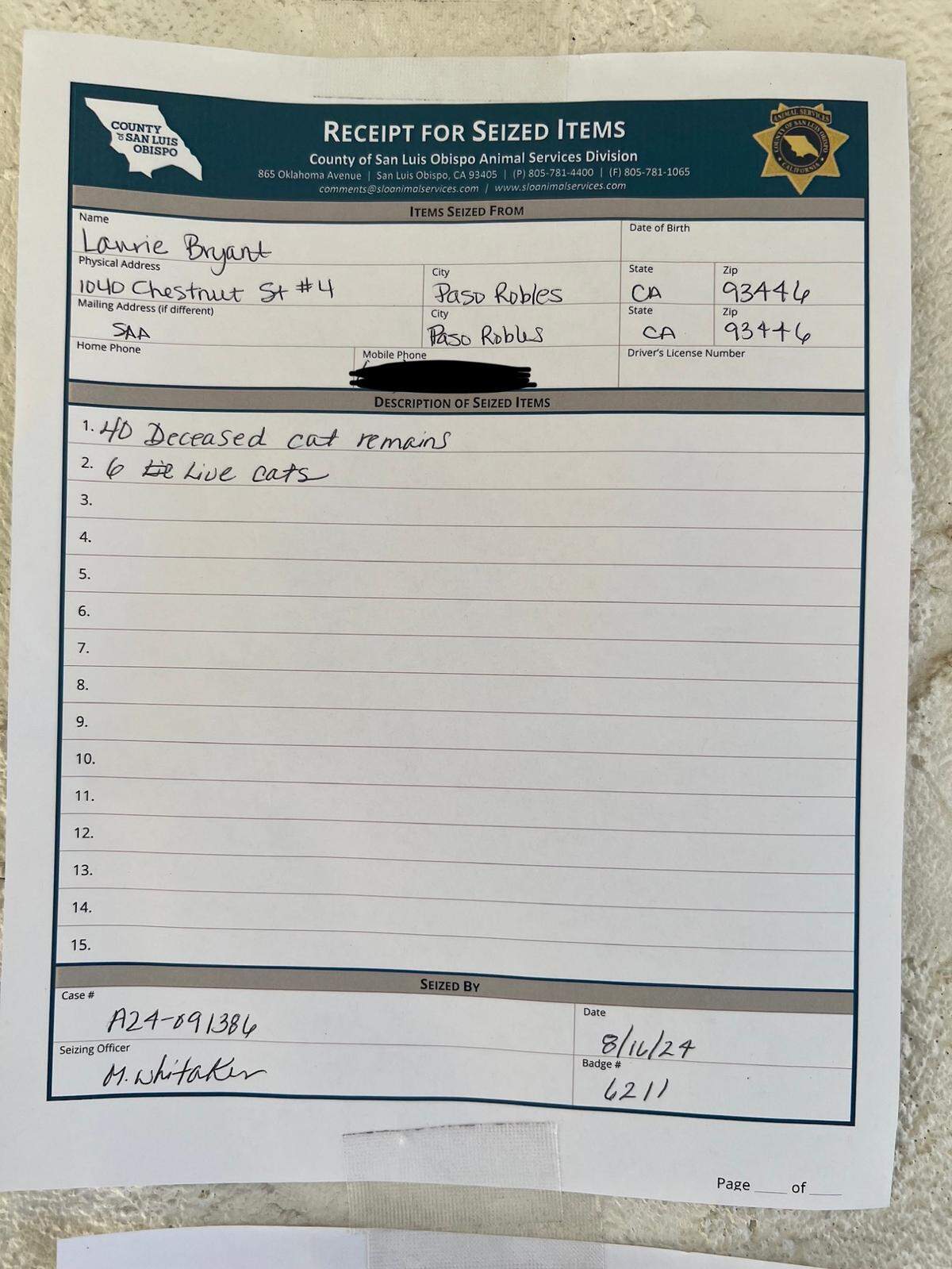
One of the evidence photos Whitaker looked at in court was of a cat skull surrounded by trash and feces in the hallway of the apartment, she said. In another photo, an animal carcass showed both fur and skeleton.
Chief Animal Control Officer Eric Anderson, who is also a veterinarian, later testified that he conducted necropsies on the deceased cats and found they had “died at different periods of time.” Some were further decomposed while other carcasses were more fresh, he said.
Some showed signs of being cannibalized by other cats after death, which he described as uncommon and an indication of the “point of desperation” the animals were at.
“Cats are predators and carnivores,” Anderson said. “They’re not scavengers.”
Whitaker said she later spoke to Nicole Fernandes, who was contracted to clean the apartment on Oct. 9, 2024. Fernandes described finding additional cat remains to the 40 Whitaker identified, including multiple “newborn cat remains,” Whitaker said.
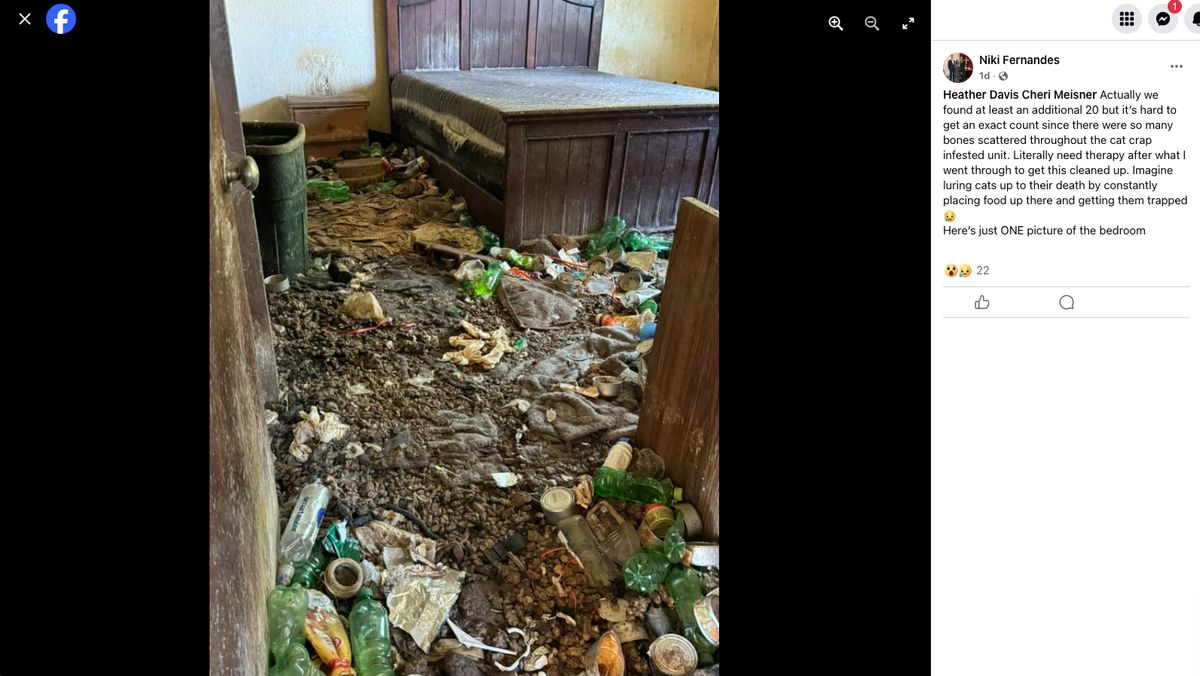
Fernandes posted on Facebook at the time that she found an additional 20 cats but it was “hard to get an exact count since there were so many bones scattered throughout the cat crap infested unit.” Fernandes said it took her two weeks to clean.
Fernandes also reported finding remains in one of the cat food bags, Bryant’s trust paperwork and a passport in a nightstand of the master bedroom and coffee grounds extensively scattered on the ground, which she believed was possibly to mask odor, Whitaker said.
Finally, the cleaner found a fresh sandwich in the refrigerator, Whitaker said.
Who else accessed the apartment?
Whitaker testified that based on the state of the apartment, the accumulation of feces looked to her as if it would’ve taken “multiple years” of neglect to have built up to that degree of uncleanliness.
However, Bryant claimed to have been living in the apartment until October 2023 — less than a year before it was red-tagged — and continued to visit the property for months after she moved out.
Another witness corroborated this story — somewhat.
Duane Zaragoza was a contractor for the Bryant family and often did maintenance work on all the Presidio Apartment units, he testified on Thursday.
He visited the apartment after Laurie Bryant had already moved out to evaluate what work needed to be done to get it market ready again, he said. He did not observe any feces, overwhelming trash, or cat remains.
“If the feces have been accumulating for years, she moved out in October of 2023, Duane Zaragoza comes and sees the apartment, it doesn’t look anything like what it looked like just a few months later — it’s bizarre to say the least,” Bryant’s attorney Winters said.
However, Zaragoza could not recall if his visit was in March of 2023 — over six months before Bryant says she moved out — or 2024 — six months before the apartment was red-tagged.
According to the animal services officers, two other people also had access to the apartment: Laurie’s brother Steven, who had the key to let Whitaker into unit 4, and his roommate, Trevor Campbell.
Campbell had rented a room in unit 3 with Steven Bryant for a couple of months prior to August, Anderson said. On the day Anderson was on the property investigating unit 4 in August 2024, Campbell showed Anderson a video he took of the apartment allegedly in April of that year. In the video, it looked nearly the same as it did when the officers found it and red-tagged it in August.