How to keep SLO County skies dark at night, why it’s important and how we can make it happen
It’s always a pleasant surprise when an event I’m assigned to cover turns out to be more interesting than I expected.
Despite having been taken many times as a child to the American Museum of Natural History’s Hayden Planetarium in New York, I never really took to astronomy and other astral sciences.
Now that I have some vision issues, it’s literally harder to focus on individual beauties in the night sky.
Hence my dim enthusiasm about reporting on Cambria Dark Skies Initiative’s “Future of the Night” event. And son Brian’s level of interest was even lower.
Well, surprise, surprise! We found the event to be remarkably interesting.
For instance, we learned why dark skies are important — turtles, really? — and we were told there are an estimated 130 million pieces of space debris out there that scientists are not tracking, and of the 46,000 objects out there that scientists are following, only 10,500 are active satellites.
That’s a bunch of space junk, folks.
At the forum, a group of noted scientists, astrophotographers and astronomers at the forum explained the dark-sky concept more thoroughly.
Attendees learned about the future of space, the cosmos, the value of darkness and how to help preserve Cambria’s dark skies.
‘Saving the Night: Shedding Light on the Importance of Darkness’ event discussed
Sivani Babu of Santa Barbara, an award-winning photographer, explorer and writer, explained how each of us — and the rest of Earth’s living things — can be impacted by the loss of dark skies at night.
Essential, life-sustaining behaviors of many species are triggered by darkness. For instance, hatchling sea turtles will head the wrong way if external lighting leads them astray.
Hummingbirds, bats and owls, wallabies, monarch butterflies, fish, corals, amphibians and more are among other species that can be harmed by light pollution, according to an IDA flyer and Babu’s recent article in San Diego Magazine.
Babu’s passion for stargazing began as a child with her father, watching the night skies from their driveway in Orcutt, she said. Now, increased lighting has dimmed some of those sights, she said sadly.
“We can’t see the Milky Way from that driveway anymore,” she said.

Impacts of excessive light at night can range from ecological to philosophical, psychological and even immunological, she said.
Yes, over-lit night skies apparently can make you sick, by increasing risks for obesity, sleep disorders, depression, diabetes, breast cancer and more, according to DarkSky International.
National Geographic’s Nov. 1 story says the same things, emphatically.
While light-polluted night skies seem overwhelming and unfixable, small changes made by individuals can go a long way toward reducing the problem, Babu said.
For instance, reducing “wasted light” is a good start.
“Wasted light is lighting that’s on where there’s nobody around to see it,” Babu said.
In his “More Dead than Alive” presentation about satellites and space junk, Steve Williams quantified the astounding, rapidly expanding amount of debris cluttering up what we perceive as the sky.
The orbital analyst, airway-management specialist and mechanical engineer should know, as the director of Cyberspace Operations at Vandenberg.
The eye-popping total current estimate of 130 million untrackable objects, Williams said, is creating a dangerous, outer space traffic jam of debris and other space garbage.
The troubling situation, often termed the Kessler Syndrome, he said, is an increasing hazard to future ventures in space, functioning satellites and fixtures like the International Space Station and Hubble Space Telescope.
Large pieces of space trash could even pose a risk to people on the ground, although the risk of being hit by it is low.
Astro-scientists and space entrepreneurs are struggling with the issue because there don’t appear to be any immediate solutions to the problem, Williams said. There’s no agency, government, country or group that controls the space junk, and no established way yet to retrieve it.
However, the brightest minds are searching for possible future solutions, some of which might have made interesting episodes of “Twilight Zone” or “The Outer Limits.”
Anyone for the outer-space equivalent of a monster trash truck?
NASA scientist from Cambria describes ‘the hunt for exoplanets’
David Breda, a lead engineer from NASAs Jet Propulsion Laboratory and Cambria resident, explained how the upcoming launch of the Nancy Grace Roman Space Telescope, nicknamed the “Roman,” which includes the science’s most advanced coronagraph, will explore exoplanets and dark matter.
It’s an infrared radiation space telescope that eliminates glare from nearby stars to look back in time.
As of Sept. 6, our skies included more than 4,750 confirmed exoplanets, Breda said. An exoplanet is defined as a planet that orbits a star outside the solar system.
%20Nebula.jpg "10-14-24 frank widmann’s Omega (Swan) Nebula.jpg")
“It may uncover the mystery about life beyond our solar system,” he said, “and is there life on other planets.”
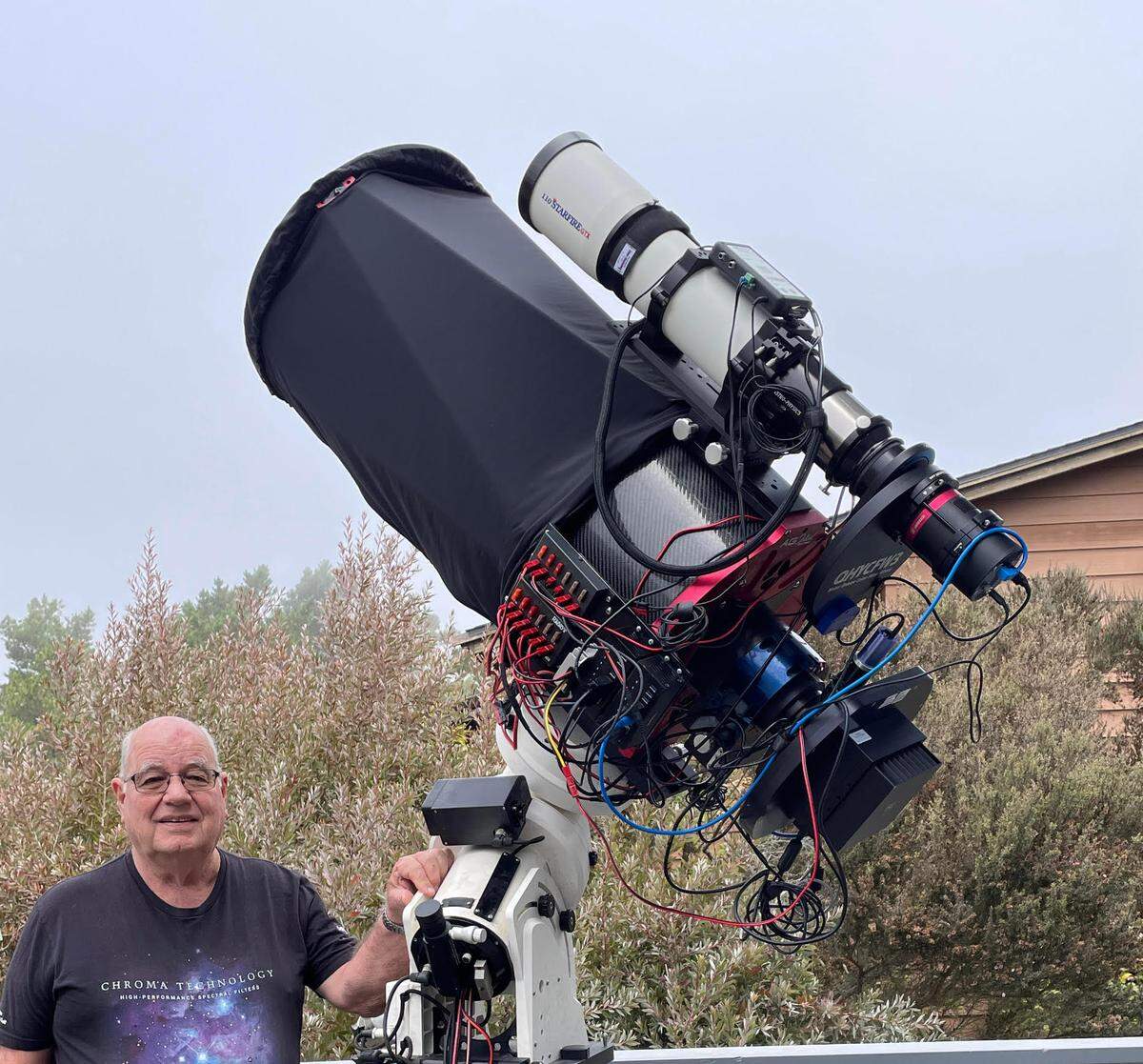
Among others presenting at the forum were Cambria astrophotographer Frank Widmann — his photos are amazing — and Claudia Harmon Worthen, founder of the Dark Skies Initiative in Cambria.
What I see when I look skyward at night may still be a bit blurry, but now I find it more fascinating than ever, and grateful that, when it’s not foggy or cloudy, I can still see the Milky Way here.
For details on how you can help preserve dark skies at night, go to the Cambria Community Services District website, Dark Sky International’s website or Beautify Cambria’s web page on the Dark Skies Initiative.
We’ve been doing some of those dark-skies-protecting things for years and are working to add more protections to our arsenal.