SLO County posters told people how to ‘turn themselves in’ during World War II
I’m always thrilled when readers share their thoughts about one of my writings with me — whether they contact me by email, social media or phone, or engage me in conversation over the artichokes in the grocery store.
I even enjoyed chatting with a lovely lady while I was flat on my back in the hospital, waiting for my angioplasty incision to heal enough so I could sit up again.
I certainly wasn’t feeling top notch, and I’m sure I looked as scruffy as a mud-dunked doodle dog. But hearing that what I’d written had made her laugh, think and remember was the best medicine she could have given me that day.
What’s really fun is when I get a response that launches a flurry of emails and conversations, with a new friendship as the cherry on top.
That was the case on April 21, when my inbox held an email from a member of a longtime Cayucos family.
Dante “Dan” Borradori, who owns the circa-1932 Borradori Garage in Caycucos, was commenting on my column about the Morro Bay Museum of Natural History’s summer-long exhibit showcasing the effect that World War II had on the Central Coast.
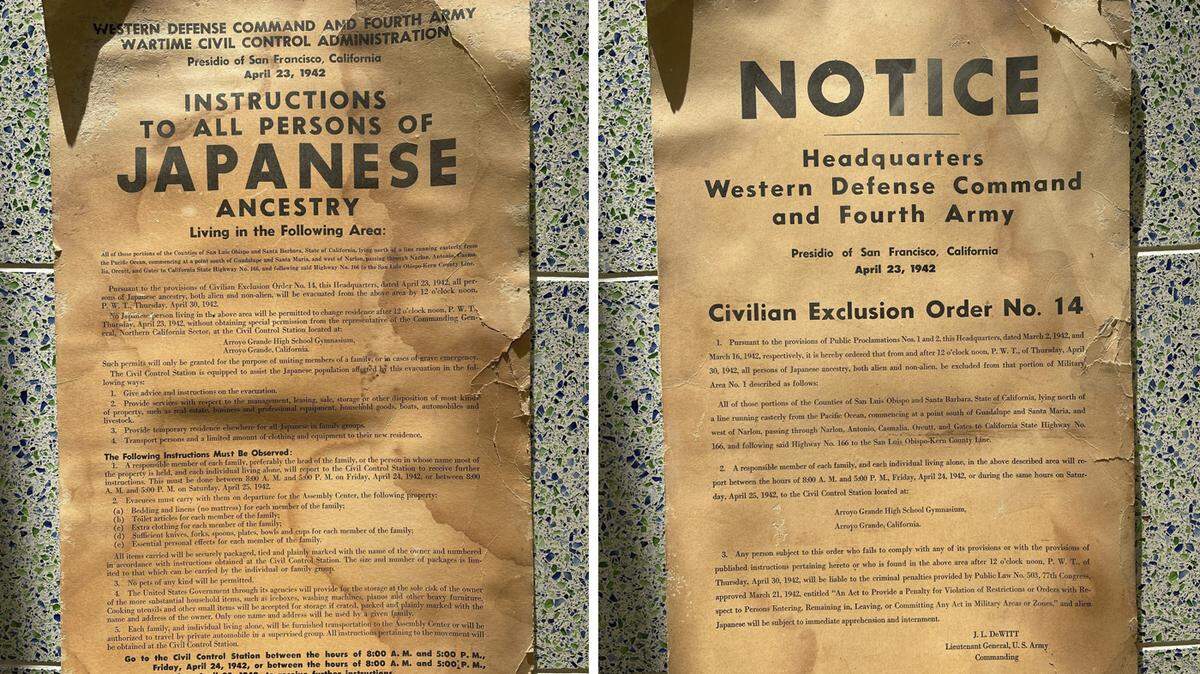
In his email, Dan shared two pictures of posters “telling people of Japanese descent where and when to turn themselves in to the government.”
The haunting posters were dated April 23, 1942, just a couple months after then-President Franklin Roosevelt signed Executive Order 9066 authorizing the forced removal of all persons deemed a threat to national security from the West Coast to so-called “relocation centers” further inland.
“These posters are specific to the Central Coast,” Dan wrote. He offered to share them with the groups preparing the museum’s displays.
The two darkly sepia-toned posters, signed by commanding U.S. Army General J.L. DeWitt, serve as stark reminders of a dark time in our country’s history, when our government responded to the Japanese bombing of Pearl Harbor by turning against an entire group of people just because their ancestors were Japanese.
During those shockingly dark days, about 120,000 people of Japanese heritage were forcibly relocated and incarcerated in concentration camps across the West.
About two-thirds of them were U.S. citizens.
Also detained were about 10,000 people of German and Italian ancestry.
The Civilian Exclusion Order No. 14 notices from the Headquarters Western Defense Command and Fourth Army required that, as of noon on April 30, “all persons of Japanese ancestry, both alien and non-alien” were to be excluded from the prime agricultural area of San Luis Obispo and Santa Barbara counties, from Guadalupe and Santa Maria to Highway 166 to the San Luis Obispo County-Kern County line and the Pacific Ocean.
They were to report between 8 a.m. and 5 p.m. the following Saturday and Sunday to the “Civil Control Station” in the Arroyo Grande High School gym with a “limited amount of clothing and equipment” such as bedding, plates, bowls and toilet articles, the posters say.
From there, the posters said, the internees would be relocated to “temporary residences.”
In reality, they were incarcerated for up to four years, without due process of law, in bleak, remote camps surrounded by barbed wire and armed guards. Families were deprived of of their normal lives, and in many cases, their land and livelihoods.
Decades later, the country and state apologized for their imprisonment.
In 1988, President Ronald Reagan signed the Civil Liberties Act, officially apologizing for the internment on behalf of the U.S. government and authorizing a payment of $20,000 — the equivalent of $48,605 in 2022 — to each former internee who was still alive when the act was passed.
In my opinion, belated apologies and token payments can’t undo decades of pain and lost dignity for so many people who had no responsibility at all for the Pearl Harbor bombing or Japan’s participation in the war, and whose only crime was being of Japanese descent.
Will we ever learn? Vicious, unprovoked anti-Asian attacks and persecution during the COVID-19 pandemic would seem to indicate that some of us never will, and that bigotry can be contagious.
While studying Dan’s photos of the historic posters, it would have been so easy for me to tumble down a depressing emotional rabbit hole.
Reviewing unpleasant history can be a real downer, unless you set your mind to doing whatever you can to make positives out of such horrific negatives. We should read about history, learn from it and vow to never do it again.
Since there’s little I can do now to rectify the wrongs done then, other than rally against bigotry, I was determined instead to look forward and focus on the story behind the posters.
Where did posters come from?
First, I wanted to know how the Borradoris got those now-fragile pieces of paper history.
Dan found the posters among a treasure trove of documents and artifacts from bygone eras collected by his uncle Sam Borradori after Sam died in 1995. Family members were remodeling Sam’s home to get it ready for renters.
But how did Sam get those posters in the first place? He lived in Cayucos and ran the busy garage, while those notices mostly affected people in the southern San Luis Obispo County and northern Santa Barbara County.
Therein lies the mystery.
Dan said his wily uncle never revealed the answer, instead giving his standard reply: “You’ll figure it out someday.”
Other historical treasures found by the Borradoris include 1950s-era photographs, 1960s Telegram-Tribune articles, a ledger book from the Cass warehouse in Cayucos and his great-great grandfather Sam Donati’s original legal books with California statutes from 1850-1875.
Dan took the internment posters home to Bakersfield, and later loaned them to his children to use as centerpieces for their History Day presentations.
Dan’s youngest son, Anthony Borradori, gave a presentation that wound up winning at state level and competed at the national level competition, Dan said proudly.
Now, Dan’s willing to share the posters with all of us, and maybe donate them some day to a fortunate Central Coast museum.
In the meantime, I’ve gained a new friend with whom I can gleefully chat about history, politics, land planning and more.
Have we mutually solved the mystery of the posters and how they came to be in Uncle Sam’s garage? Not yet. But maybe someday. And what fun we’ll have trying.
This story was originally published May 4, 2022 at 5:05 AM.