
A tale of two forests: One a fraction of its former size, the other expanding
“Cambria Pines by the Sea,” “Where Pines Meet the Sea” and “Pines Touch the Sea.” That’s how our community was marketed beginning in the 1920s. Not as the logging, whaling, mining, dairying settlement it had been, but as a collection of vacation homes on tiny lots in an ancient forest by the ocean.
The Cambria Pines Development Company was in charge. Sales agents from San Francisco to Los Angeles to Bakersfield promoted it, as did radio advertisements offering “a little piece of paradise where the pines meet the sea.”
The flaw in the undertaking was that to build homes in the pine forest you have to cut down the treasured trees. A wag suggested it could one day be “Cambria in the Pine.”
Scientists say that Monterey pine forests once existed from north of San Francisco to San Diego and, due to changing climatic conditions, the forests contracted and expanded during tens of thousands of years. But it is within the last two centuries that the biggest changes have taken place.
Generations of native peoples who preceded European settlement tended it almost like an orchard and a garden — harvesting what was ready, pruning for the future, selectively digging and re-planting edible corms and bulbs, using bark, seeds, nuts and berries to provide for their needs. The forest sustained them, and they sustained the forest.
Initially European settlers cut the pines for lumber. “Slab Town” was an early name for this community, where slabs of lumber used in construction sometimes still had bark showing.
After the forest was culled for the tall, straight trees for lumber, clear-cutting the rest provided firewood and open land for dairy cows and beef cattle. Due to human industry and the vagaries of climate, a remnant forest was left.
What we see now must be the forest’s lowest ebb ever. And still there always seem to be future development plans that necessitate further reducing Cambria’s pine forest by the sea.
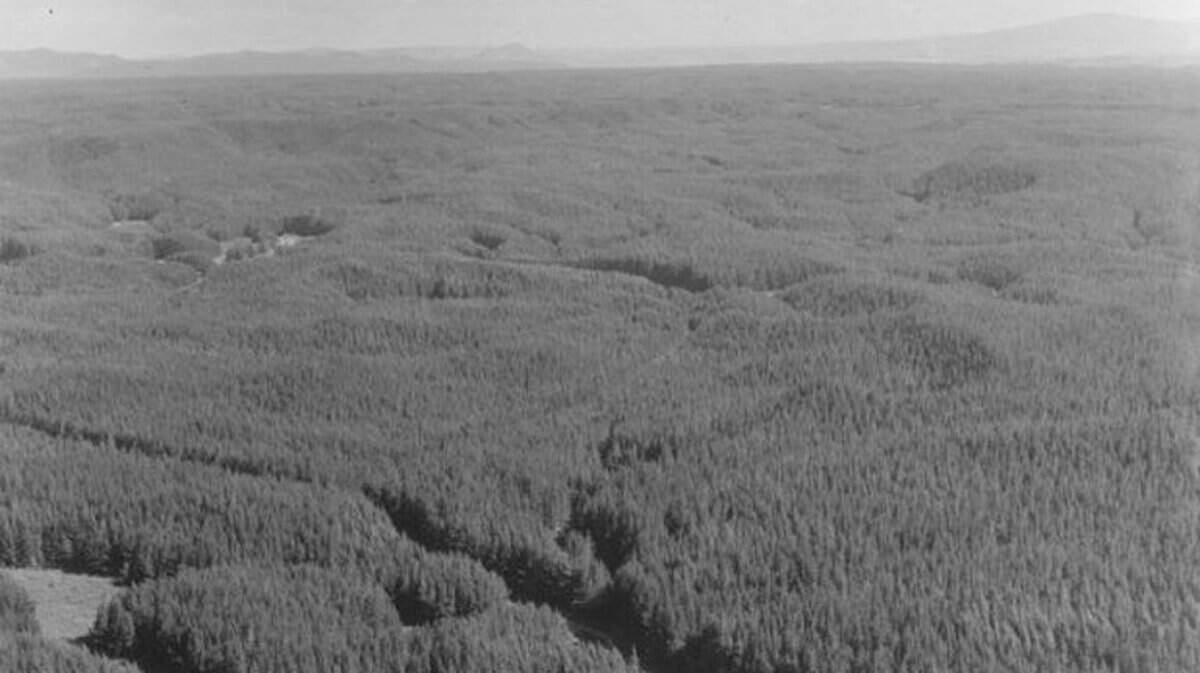
Six thousand miles away, at the other end of the world, people are dealing with our pine trees in a very different way. First, they call them pinus radiata rather than Monterey pine. And their concern is not to settle among the trees, but to treat them as a crop. They plant the trees by the tens of thousands, wait 28 years or so, cut them down for lumber and paper manufacturing and then plant again. Compared to the 2,500 acres of pine forest around Cambria (and 14,500 acres total in the three California stands), New Zealand has 3 million acres, Australia 2 million acres, with more in South America, Africa and Spain. It is the most planted conifer in the world.
It’s heartening to know that the seed stock for those distant plantations came from California beginning in the 1850s. Those “foreign” trees are straighter than ours because they’ve been carefully selected for generations to yield straight, tall, fast growth. What they lack is the genetic diversity of the original native stands in California. Despite pinus radiata being the most-planted conifer in the world, the original Monterey pines here and just north of here are a species in danger, with only their perfected, hybridized progeny to succeed them.
This story was originally published October 28, 2013 at 4:58 PM with the headline "A tale of two forests: One a fraction of its former size, the other expanding."