
Scarecrows 101: Tips from veterans of Cambria's annual festival
Gil Eastman’s very first scarecrow was an ambitious one: In 2009, he, along with his wife, Valerie Eastman, built “Blowin’ in the Wind” — one of Cambria Scarecrow Festival’s most recognizable scarecrows.
The scarecrow, a completely horizontal man hanging midair onto a pole, was a big undertaking for Gil Eastman.
“I probably bit off more than I could chew for the first try,” he said. “That scarecrow was really difficult with the strength; the wrists and body had to be much stronger than I originally thought to stay up.”
In five years however, the scarecrow, which won the Best in Show award in 2010, has had only one minor break and has come to be one of the most popular scarecrows in the entire festival.
The Eastmans have gone on to win several other awards during the festival over the years, including last year’s third place for best animation for their scarecrow, “Maneki Neko (Good Fortune Cat).”
Although the pair has decided against building a new scarecrow this year, Gil Eastman encouraged others to get started on their own.
“My big advice is to just have fun and get your hands dirty,” he said. “Don’t get caught up in what it should look like — it’s a scarecrow!”
But how exactly do you get started? Follow our tips to find out — so that you can try creating your own!
Step 1: The idea is everything
The most important thing is to start with an idea, said Sue Oberholtzer, a volunteer with the Cambria Scarecrow Festival.
If you’re planning to create one for next year, “Come to the festival and see what is missing,” she said. “Whatever is missing, say you will make it next year.”
Each year, festival organizers create a theme for participants to follow. Some recycle scarecrows from previous years and update them to fit the new theme, while others build entirely new scarecrows.
Oberholtzer said she plans to update her scarecrow from last year, a man proposing to a woman, to be holding an empty cup and saying, “Water, water everywhere, and not a drop to drink,” to fit with this year’s water theme.
Step 2: Plan ahead
Building a scarecrow can be time-consuming, depending on the materials you use and your level of expertise.
Michele Sherman, who taught a recent scarecrow-building workshop in Cambria, encourages people to set aside about two months to make their scarecrow, or sign up for the festival’s workshops.
“For a new person, taking one of the classes is the biggest thing, because there are so many tricks you can learn from those of us who have done one or two or three,” said Sherman, who estimates she has built at least 11 scarecrows since she began working with the festival three years ago.
The workshops are typically offered starting early to mid-July to allow for necessary drying time while making papier-mâché pieces for the scarecrows, she said. They continue through August.
Sal and Mary Buongiorno, who attended this year’s workshops to get help making a scarecrow girlfriend for the lawn-bowling scarecrow they built last year, also encourage people to attend the workshops.
“Get started. Come here. They do a really good job helping out,” Sal Buongiorno said. “And get going because there isn’t going to be any room if we keep building like we are.”
Step 3: Start at the top
Once you have your idea, the first item to start working on is the head, Sherman said.
Most participants choose to craft papier-mâché heads, she said, and those can take about four weeks to complete — two weeks for the six layers of newspaper and wallpaper glue that form the base of the head to dry, and two more weeks for the Celluclay (a clay-like paper and glue composite good for sculpting) to dry on top of that.
Once the head is dry, you can paint and decorate it. At this point, Sherman said it’s a matter of creative license how you decorate the face. In the past, she has used everything from clocks for eyes (to go in front of the town’s clock shop) to Tic-Tacs for realistic-looking teeth.
“You can learn as you go along,” she said. “You can look online and read about it all you want, but until you start making one, you don’t realize something doesn’t work; it’s trial and error.”
Step 4: Frame-building
While the head is drying, Sherman advised, build the frame for the scarecrow’s body. The frame can be made out of whatever materials are handy, though most prefer wood or PVC pipe, she said. The scarecrow can be as tall or short as you want, though most tend to be between 5 and 6 feet.
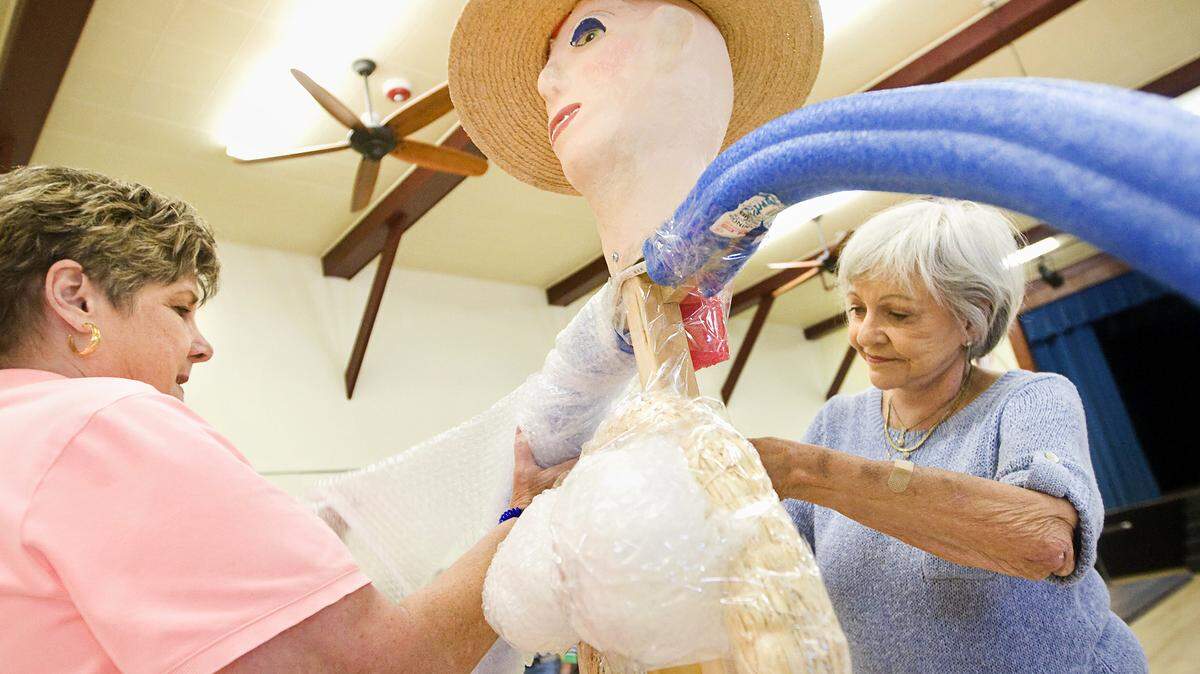
Once the frame is situated in the position you want the scarecrow to be in, it needs to be padded to make the body shape.
Sherman suggested only using plastic padding materials such as bubble wrap, rather than batting or cotton, because the moisture in the air often causes fabric padding to lose its shape.
“My first year, one of my ladies, I made her behind stuffed with batting, and sure enough, after two weeks, her behind was dragging down to the ground,” she said.
Sherman also suggested putting a foam wreath, like one you would use to make a holiday wreath, on the scarecrow’s torso so you can use it to grab and lift the scarecrow.
Step 5: Dressing and weatherproofing
Once the head is dry and painted, and the body padded, the pieces can be put together and the clothing and accessories put on, Sherman said.
Most people choose to dress their scarecrow with thrift store clothing, she said, because pieces often go missing at night.
To combat this, Sherman and Oberholtzer advised securely wiring and attaching all pieces to your scarecrow — Oberholtzer said she used a can of spray insulation to attach her boots permanently to her scarecrow last year and had no problems.
Once the pieces are put together, everything must be weatherproofed. Sherman typically uses a poly-acrylic sealant on the head and hands, and a fabric-protective spray on the clothing, to prevent the scarecrow from getting ruined by rain.
Once weatherproofed, the scarecrow is ready for display.
Pro tip
It can be easy to get wrapped up in making the perfect scarecrow, Sherman said, but in the end, it’s all about having fun.
“It’s a scarecrow! Don’t worry about what it looks like,” she said. “One year, a couple years ago, a lady was going to make a ballerina, I think, and it turned out being a pig. You have to just go with the flow, because there’s no right nor wrong way with art.”
This story was originally published September 10, 2014 at 4:37 PM with the headline "Scarecrows 101: Tips from veterans of Cambria's annual festival."