Coastal Commission approves new SLO County conservation district, forest project
Recent actions by the California Coastal Commission could have long-lasting effects on North Coast forests and nearby communities.
At their Oct. 14 meeting, commissioners certified a new resource conservation district and public works plan that will make it easier to get permits for “vegetation treatment projects to improve forest health, restore ecosystems and increase wildfire resistance” from the Monterey County line south to the northern boundary of Morro Bay, according to a commission staff report.
The Coastal Commission has review authority over any proposed vegetation management projects within the district, with input from all the stakeholders, including San Luis Obispo County and the public.
The new district is the third such public works plan in the state’s coastal zone approved by the commission in the past three months, with the other two being in Santa Cruz and San Mateo counties.
The North Coast district will be in place for 10 years. After that point, results will be reviewed in detail before a decision is made about extending the policy.
Vegetation treatments within the district will depend on available funding.
Covell Ranch project to focus on restoring Monterey pines
After commissioners gave the new district their unanimous blessing, they approved the first pilot project under the new policy. It affects about 665 acres of rare native Monterey pine forest on the Covell Ranch in Cambria — acreage that’s covered by a conservation easement held by nonprofit organization The Nature Conservancy.
According to Coastal Commission staff, the Covell Ranch “project focuses on restoring one of five naturally occurring Monterey pine stands in the world to native ecological conditions for long-term forest health, wildlife abundance, carbon sequestration and resilience of rare botanical alliances.”
The ranch butts up against and surrounds Cambria’s eastern and northeastern boundaries, also known as a wildland-urban interface zone (WUI).
The project’s dual goals, according to Dan Turner, business manager of the San Luis Obispo County Fire Safe Council, are “the ecological restoration of the rare forest and protection of Cambria.”
To accomplish that, no live trees larger than 8 inches at human chest height can be removed unless they are deemed hazardous to nearby homes or other structures. Larger trees can only be targeted for removal if they have died or a forester has confirmed they are dying.
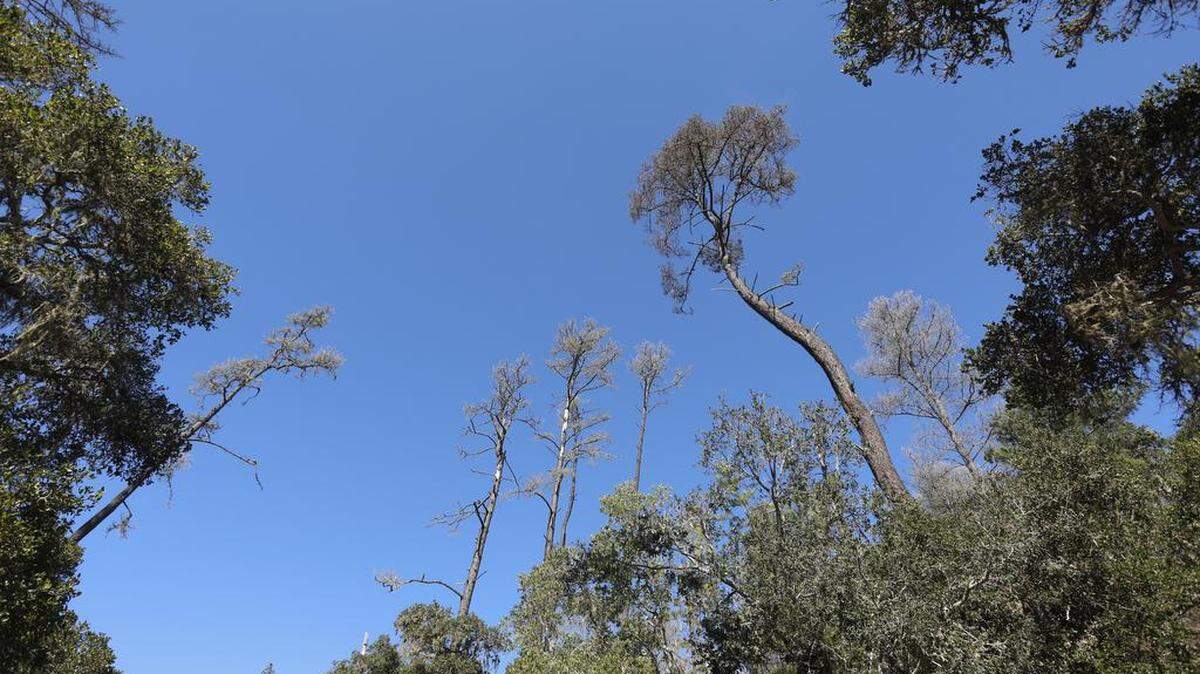
Turner estimated “about 70% of the forest is dead or dying due to drought” and those other factors.
He said it’s “not only a diseased forest, it’s also a fire-dependent forest” that’s adapted to having a fire every 30 to 40 years.
That was before Western development came to the area in the late 1860s. Now, he said, “a probable fire would be a stand replacement fire, catastrophic for the forest and Cambria.”
“As the climate warms, forest health declines and altered fire regimes and increased fuel loads” can lead to more disastrous blazes, according to an exhibit in the staff report.
Factors contributing to the risk, the report said, are “historic fire suppression” practices, “an accumulation of fuel loads, including dead, dying and diseased trees … drought, a warming climate and the spread of invasive species.”
That means “larger and more catastrophic wildfires are threatening the county’s communities and natural resources,” the report said.
When it comes to California’s wildfire crisis, commission staff stated, “the state’s overall strategy relies on an increase in the pace and scale of vegetation treatment in order to help reduce those risks.”
Vegetation management proposals within the district will still get close scrutiny before they’re approved, according to Turner, but the process will be faster and easier.
When Coastal Commission senior ecologist Jonna Engel, commission staff, consultants and others visited the site in October, they found evidence of dwarf mistletoe, western gall and pitch canker and drought and bark beetles, plus a dense understory, she said.
During that Oct. 3 tour, Engel learned that “foresters would incorporate site-specific criteria, tagging trees to remove,” while carefully noting such elements as “slope orientation, steepness, soil, the number of healthy/dead/dying/diseased trees,” she recalled.
“I gained a lot of confidence at that site visit,” Engel said, noting that the Coastal Commission “project is limited in severity and scope.”
Some grant-funded work has already been done on ranch forest areas adjacent to the community, primarily in the form of fuel breaks. Future projects would maintain and expand those, and deal with other areas within the forest.
If the confirmation process goes as planned, and the weather cooperates, work could begin as early as Nov. 1, Turner estimated.
Grant funding has already been secured for the first phase of the Covell Ranch project, but there’s much more to do beyond those initial chores.
Conservation plan was years in planning process
The detailed resource conservation district plan was years in the planning, with research and cooperation between Fire Safe Council, the Upper Salinas-Las Tablas Resource Conservation District, Cal Fire, Cal Poly and other agencies.
The Covell Ranch plan involved input from those plus the property owner and easement holder, registered professional forester Steve Auten of Auten Resource Consulting, Cambria Community Services District and others.
The public had input into both documents and the plans within them.
Experts involved in the planning process for the district and the Covell Ranch project included 12 foresters, five biologists and nine fire-related experts, Turner said. They took part in a total of 65 community meetings.
As Auten told the commission, “it’s not a massive shift we’re going for. This prescription is to nudge the system into a different direction …”
“It’s a balancing act,” he added, one he knows well after 20 years of working in forested areas including the Monterey pine forests in Cambria and Monterey County.
Engel and Auten tried to address concerns expressed during brief public comments by Crosby and Laura Swartz of the Cambria Forest Committee about the decisions commissioners were about to make.
Some of the techniques to be used in the Covell Ranch project worry the Swartzes, they said, especially the use of a mechanical masticator, a tractor-like device that chomps its way through the understory, often to create a work trail for other equipment and crews.
Other approved techniques include manual treatment such as chainsaws as well as herbicide application and “prescribed herbivory,” the use of grazing animals to reduce the fuel load.
“I appreciate the comments Laura and Crosby have made, and not just here,” Auten said, and he asked for their trust that the work would be done sensitively and correctly. “We’re identifying sensitive areas where mechanical mastication is not appropriate.”
Crosby Swartz said he remains “very concerned that a large amount of tree removal will cause longtime damage to forest,” and that “tens of thousands of live trees will be cut down,” increasing exposure to the forest floor, producing hotter, dryer conditions and reducing the wind break effect.
“We all desire fire safety but at what cost to the native habitat?” Laura Swartz asked. “Forests are a system that has adapted over the millennium” and disrupting that “will fail in the long term.”
She asked commissioners to “please limit the scope and severity of this first project to come under your authority” in San Luis Obispo County.
Commissioner Catherine Rice said the proposals and staff report about the new district and the Covell Ranch project provide “a good template” for what commissioners will want to see in future resource conservation district project applications.
“We want to make sure that these projects are really done in the most environmentally sensitive way,” she said, treatments that leave the “forest in a healthier condition that it is today.”
She explained that the streamlined review-and-approval process is needed because “we don’t want to get in the way of communities up and down the coast to deal with fire danger.”
“Fire has not been on the landscape as it should have been,” Rice said, and now the state is dealing with the results of that.
Before approving the new district, commissioners found that the new district is consistent with the county’s Local Coastal Plan.
Jack Ainsworth, the commission’s executive director, explained that the agency is committed to doing what it can to help with the coastal zone’s crucial vegetation management issues, but the agency has received no additional money to pay for the vast amounts of work such reviews require.
“We’re seeking additional funding, but we can’t wait” for it, Ainsworth said. “We’re moving forward.”
For more details on the new district and the Covell Ranch project, go to www.coastal.ca.gov/meetings/agenda/#/2021/10, select the agenda for Friday, Oct. 15, and click on item 21.